


U.S. Department of Labor
2025 Chief FOIA Officer Report
Solicitor of Labor/DOL Chief FOIA Officer
(March 2024 through March 2025)
EXECUTIVE SUMMARY
The Department of Labor (DOL), Office of the Solicitor (SOL), provides Department level guidance and oversight for the Department's FOIA program and supports the statutorily-based responsibilities of the DOL Chief FOIA Officer. The Office of the Solicitor (SOL) serves as the coordinator and legal advisor for FOIA activities within the Department. SOL houses the Department's Chief FOIA Officer and FOIA Public Liaison. In addition, the SOL Management and Administrative Legal Services (MALS) Division houses the Office of Information Services (OIS), Counsel for FOIA Appeals and the Counsel for FOIA and Information Law (which addresses, among others, FACA and Privacy Act matters) These programmatic and counsel areas are responsible for providing department-wide guidance regarding FOIA compliance. SOL also makes administrative appeal determinations, defends FOIA litigation and fulfills FOIA performance measurement duties and reporting requirements, including the statutorily mandated FOIA Annual Report.
Within DOL, day-to-day FOIA operation is decentralized. As a result, each of the 23 agency components has been given flexibility to design a program that meets its needs. Most agencies have delegated their disclosure responsibilities to officials at the Office Director or Division Chief level in Washington, as well as to their regional offices. Others have delegated their field FOIA responsibilities to district or area offices. Conversely, some small agencies handle all of their FOIA requests centrally in Washington, DC. The differences in agency practices are driven partly by the number of requests that agencies receive and partly by the nature of the programs they administer.
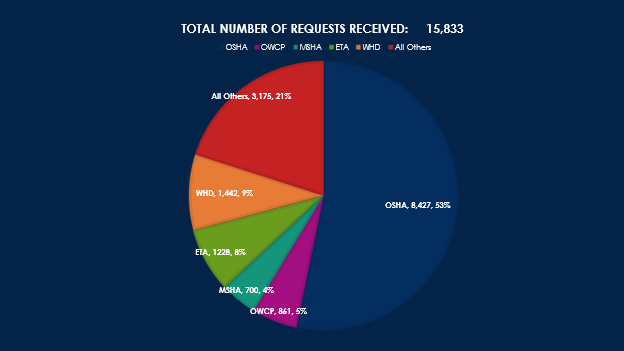
Although FOIA operations are decentralized, the OIS functions as the Department's central FOIA office and has agency-wide responsibility for intake, assignment and advice for the Department’s FOIA program. Its work includes the central receipt and assignment of 98% of all FOIA requests received by the Department via email, the FOIA Portal at FOIA.gov and through the Public Access Link (PAL) associated with enterprise FOIA tracking system, FOIAXpress. During Fiscal Year 2024, DOL received 15,833 FOIA requests and processed 14,856. As demonstrated within the table below, most of the requests received were processed by the Occupational Safety and Health Administration (OSHA – 53%), followed by the Wage and Hour Division (WHD – 9%), Employment Training Administration (ETA – 8%), Mine Safety and Health Administration (MSHA – 4%) and the Office of Workers Compensation Programs (OWCP - 5%). The remaining 21 percent of the Department's requests were processed by the other 18 agency components.
FY 2024 – Total Number of FOIA Initial Requests Received
DOL FOIA Modernization – Ongoing
The Department's Chief FOIA Officer remains committed to the efficient and effective management of the Department's FOIA program. In a keynote address held at the 2024 FOIA Conference, the Chief FOIA Officer placed significant emphasis on the following four areas of focus as the Department moves forward with the next phase of its FOIA modernization efforts:
- Improving alignment between policy documents with our current work processes;
- Increasing attention to reduction of FOIA backlog;
- Closing the Department's ten oldest FOIA initial requests; FOIA appeals and FOIA consultations;
- Providing additional learning opportunities for FOIA professionals;
- Enhancing FOIA customer service; and
- Launching the FOIAXpress Collaboration Portal
Within the Department there is a renewed commitment to training that promotes proficiency among our FOIA professionals across the Department. On May 8 and 9, 2024, the Office of the Solicitor, Office of Information Services hosted its Annual FOIA Training Conference. With a theme of "Navigating the FOIA Landscape", the lecture styled training was presented in-person, as well as via a WEBEX production. The event was attended by over 300 employees from DOL agency components. In addition, the Department provided other learning opportunities during the year that included a two-day course on FOIAXpress that took place in June 2024 that included a session on Electronic Document Review (EDR). DOL FOIA staff also engaged in informal learning sessions such as quarterly meetings, briefings, eLearning and ad hoc trainings to discuss topics such as FOIA best practices, effective customer service, FOIA backlog reduction and FOIAXpress functionality.
Section I: FOIA Leadership and Applying the Presumption of Openness
The guiding principle underlying the Attorney General's 2022 FOIA Guidelines is the presumption of openness. The Guidelines also highlight the importance of agency leadership in ensuring effective FOIA administration. Please answer the following questions about FOIA leadership at your agency and describe the steps your agency has taken to ensure that the presumption of openness is being applied to all decisions involving the FOIA.
A. Leadership Support for FOIA
1. The FOIA requires each agency to designate a Chief FOIA Officer who is a senior official at least at the Assistant Secretary or equivalent level. See 5 U.S.C. § 552(j)(1) (2018). Is your agency's Chief FOIA Officer at or above this level? Yes
2. Please provide the name and title of your agency's Chief FOIA Officer.
The Chief FOIA Officer is Jon Snare, Acting Solicitor of Labor.
3. What steps has your agency taken to incorporate FOIA into its core mission? For example, has your agency incorporated FOIA milestones into its strategic plan?
FOIA strategic milestones regarding timely FOIA processing and backlog reduction are incorporated at the Departmental level and are including in the FY2025 Agency Management Plan of the Office of the Solicitor to promote accountability and awareness for the Chief FOIA Officer. FOIA related milestones and process measures are also tracked in the Department's Financial & Administrative Scorecard to promote visibility as the Secretary's level as well as for leadership within DOL's free standing agency components. The Departmental Strategic milestones are regularly captured, tracked, and reported on a quarterly basis. In addition, the following components have taken the initiative of incorporating FOIA into its core mission:
- OFCCP has included FOIA training within its Agency Management Plan.
- The Office of the Inspector General (OIG) has incorporated FOIA into its core mission by modernizing FOIA technology and streamlining procedures reflected in the Office of Inspector General's FOIA Directive.
- The Office of the Assistant Secretary for Administration and Management (OASAM) has incorporated FOIA into its core mission by realigning the FOIA oversight function into the Office of Strategic Operations which is part of the Immediate Office of the Assistant Secretary for Administration and Management. OASAM provides information on FOIA requests weekly to OASAM leadership through OASAM's internal weekly reporting.
- MSHA adheres to the performance management measures set by the Department of Labor (DOL) and monitors activities based on these metrics. Additionally, MSHA includes the completion or contribution towards fulfilling FOIA requests as part of the performance standards for management and FOIA coordinators. Throughout the performance cycle, MSHA's FOIA coordinators gather FOIA data categorized by each program area and its respective district offices, then share this information with MSHA executives and managers.
B. Presumption of Openness
4. The Attorney General's 2022 FOIA Guidelines provides that "agencies should confirm in response letters to FOIA requesters that they have considered the foreseeable harm standard when reviewing records and applying FOIA exemptions." Does your agency provide such confirmation in its response letters?Yes.
Some examples among DOL's agency components:
- OASAM will be implementing Agency templates which will include this confirmation.
- OSHA's model response letter incorporates language indicating that processors have considered the foreseeable harm standard when reviewing records and applying FOIA exemptions.
- MSHA is in the process of revising its FOIA response template letters to confirm, where applicable, that the component has considered the foreseeable harm standard when reviewing records and applying FOIA exemptions. This change will enhance clarity and ensure compliance with FOIA requirements.
5. In some circumstances, agencies may respond to a requester that it can neither confirm nor deny the existence of requested records if acknowledging the existence of records would harm an interested protected by a FOIA exemption. This is commonly referred to as aGlomarresponse. If your agency tracks Glomar responses, please provide:
- the number of times your agency issued a full or partial Glomar response during Fiscal Year (FY) 2024 (separate full and partial if possible);
- the number of times a Glomar response was issued by exemption during FY 2024 (e.g., Exemption 7(C) – 20 times, Exemption 1 – 5 times).
N/A
6. Optional -- If there are any other initiatives undertaken by your agency to ensure that the presumption of openness is being applied, please describe them here.
Note: Provide a short narrative for how your agency improved its FOIA administration.
The Office of Federal Contract Compliance Programs (OFCCP) communicates with each of its subcomponents to identify what information can be proactively published. In addition, OFCCP has developed basic FOIA training for staff and new hires to ensure they are informed about their FOIA responsibilities.
To share best practices and lessons learned, OASAM has instituted a monthly internal newsletter for OASAM Center coordinators, backups, and additional staff designated to receive communications regarding OASAM FOIA's. OASAM also holds internal FOIA meetings and has developed an internal OASAM FOIA Resource Center. In addition, OASAM maintains an internal FOIA log to monitor for frequently requested items to assess for proactive disclosures.
MSHA promotes a culture of transparency, builds public trust, and aligns its practices with the principles of presumption of openness. Here are some examples of this commitment:
- Ongoing training opportunities were provided for agency staff members involved in handling FOIA requests, highlighting the significance of presumption of openness and offering guidance on its implementation.
- Regular reviews of the agency's practices were conducted to ensure compliance with the presumption of openness and to identify opportunities for improvement.
- Rather than issuing complete denials, the agency considered redacting sensitive information to maximize the amount of information released.
MSHA frequently advises FOIA requesters to check its website for information that is readily accessible online. Additionally, FOIA coordinators engage with subject matter experts, MSHA's FOIA Officer, and the Solicitor's Division to discuss responsive documents and receive guidance, ensuring consistent and regular application of the presumption of openness. If documents are found that originate outside of a specific program area or the agency, they are forwarded to the appropriate office for consultation and assessment regarding what information can be released. Throughout this consultation process, the principle of presumption of openness is emphasized.
Section II: Ensuring Fair and Effective FOIA Administration
The Attorney General's 2022 FOIA Guidelines provide that "[e]nsuring fair and effective FOIA administration requires . . . proper training, and a full understanding of FOIA obligations by the entire agency workforce." The Guidelines reinforce longstanding guidance to "work with FOIA requesters in a spirit of cooperation." The Attorney General also "urge[s] agency Chief FOIA Officers to undertake comprehensive review of all aspects of their agency's FOIA administration" as part of ensuring fair and effective FOIA administration.
A. FOIA Training
1. The FOIA directs agency Chief FOIA Officers to ensure that FOIA training is offered to agency personnel. See 5 U.S.C. § 552(a)(j)(2)(F). Please describe the efforts your agency has undertaken to ensure proper FOIA training is made available and used by agency personnel.
Please refer to the response to question #3.
2. Did your FOIA professionals or the personnel at your agency who have FOIA responsibilities attend substantive FOIA training during the reporting period such as that provided by the Department of Justice? Yes
3. If yes, please provide a brief description of the type of training attended or conducted and the topics covered.
Working with the Chief FOIA Officer, the Office of Information Services and OASAM provided the following trainings to FOIA professionals.
- 2024 Virtual FOIA Training Conference
On May 8 – 9, 2024, the Office of the Solicitor, Office of Information Services hosted the Department's 2024 FOIA Training Conference. The lecture styled training was presented in-person, as well as via a WEBEX production with a theme entitled, "Navigating the FOIA Landscape." There were over 300 employees with representation from each DOL agency component. The two-day event took place from 12:45pm (EST) to 5:00pm (EST) each day.
The training was designed is to train Department of Labor FOIA professionals on a variety of topics that included sessions that included a FOIA Administrative Processing Overview; FOIA Exemptions Overview; Privacy Act and SORNS; FOIA Exemption 5; FOIA and Records Management Interface; Administrative Appeals and Litigation Considerations; Fees and Fee Waivers; FOIA Exemption 4; Overview of the FOIAXpress Case Management System; Exemption 7(D) and Investigative Files; FOIA Best Practices and Process Management; Third Party Subpoenas; and an Open Forum Question and Answer Session - 2024 FOIAXpress Training
In June 2024, the Department procured OPEXUS to conduct FOIAXpress New User Training that covered the entire lifecycle of a request from inception to resolution. The training was designed to benefit both new users and intermediate users alike and was delivered in a presentation-style WEBEX format. - DOL LearningLink Courses.
The Department also provides FOIA training for managers and FOIA Service Center staff via its LearningLink on-line training library. LearningLink is DOL's e-Training solution which provides employees access to a one-stop portal of training programs and services. The Department requires that all new and current employees with FOIA responsibilities utilize the Learning Link On-line Module for FOIA training. FOIA professionals may choose one or two FOIA e-learning training courses that include courses entitled, "FOIA e-Learning Professionals Training" and "FOIA e-Learning Employees Training." The first module is an in-depth course specifically designed for FOIA professionals, addressing all of the major procedural and substantive requirements of FOIA. The second course is a brief module designed for all employees that provide limited FOIA support and highlights ways in which employees can assist their agencies in the administration of the FOIA statute. - Training Videos on the DOL FOIA LaborNet Page
The Office of Information Services (OIS) has made available to DOL employees via its internal LaborNet page, a series of videos that contain segments of sessions that were pre-recorded from prior DOL FOIA training conferences. In 2023, a recording of the entire Virtual FOIA Training Conference was added for viewing. The Office of Information Services added a video library that contained FOIAXpress training modules. The FOIAXpress segments continue to service as an excellent reference source for both new FOIA staff and other professionals who require a refresher regarding the Department's FOIA case management system.
In November 2024, the posted segments from the FOIAXpress refresher trainings that were conducted the prior month. It has also made a concerted effort to encourage FOIA staff to take part in other training opportunities such as those that are provided by the U.S. Department of Justice, as well as other organizations that offer comprehensive FOIA instruction. - Quarterly FOIA Briefings
DOL through the Office of Information Services, holds quarterly FOIA Coordinator briefings in which all FOIA contacts Department-wide are encouraged to attend. The primary purpose of the sessions is to share best practices and offer administrative and procedural guidance to staff. During FY 2024, FOIA Coordinators were also briefed on FOIAXpress functionality through scheduled demonstrations and questions and answer sessions. Other topics of interest included FOIA reporting, backlog reduction plans and FOIA administrative process guidance.
In addition, DOL agency components provided specific FOIA training on issues relevant to their particular areas and/or to individuals within these agency components who may be involved in FOIA responses, even if not a FOIA professional.
- Within the Office of the Administrative Law Judges (OALJ), FOIA training schedules for Department of Justice OIP FOIA training sessions are circulated to agency personnel when available. The annual OIS FOIA conference information is circulated to agency personnel when provided. Information about Learning Link training courses is provided to agency personnel. One on one virtual training sessions have been provided by the FOIA Coordinator and/or FOIA Supervisor to agency personnel when requested. Agency Personnel provide confirmation of annual FOIA training taken to the FOIA Supervisor and/or the FOIA Coordinator.
- OSHA held multiple series of FOIA training including a virtual three (3) day FOIA training. OSHA also has Q&A calls with its FOIA team where various FOIA issues are discussed. OOC receives multiple calls and emails from OSHA's processing offices with FOIA questions and uses the opportunity to provide training to the FOIA staff. OSHA's FOIA training is open to all OSHA personnel. Further, OSHA alerts and encourages participation by its FOIA personnel in Department of Justice and Department of Labor provided training opportunities.
- MSHA's FOIA Officer regularly updates MSHA management and all FOIA coordinators about the DOL and DOJ FOIA training sessions offered throughout the year. These training opportunities include both virtual live sessions and pre-recorded sessions that can be accessed at any time. New FOIA coordinators must complete two e-learning training sessions before they are permitted to start processing FOIA requests. They are also provided with a link to the DOL FOIA page which contains additional FOIA resources. MSHA's headquarters program areas collaborate closely with their district FOIA coordinators, including one-on-one training and support, to ensure they receive proper training and are well-informed about FOIA requirements and procedures.
4. Please provide an estimate of the percentage of your FOIA professionals and staff with FOIA responsibilities who attended substantive FOIA training during this reporting period. 100%
5. OIP has directed agencies to "take steps to ensure that all of their FOIA professionals attend substantive FOIA training at least once throughout the year." If your response to the previous question is that less than 80% of your FOIA professionals attended training, please explain your agency's plan to ensure that all FOIA professionals receive or attend substantive FOIA training during the next reporting year. N/A
6. Describe any efforts your agency has undertaken to inform non-FOIA professionals of their obligations under the FOIA. In particular, please describe how often and in what formats your agency provides FOIA training or briefings to non-FOIA staff; and if senior leaders at your agency received a briefing on your agency's FOIA resources, obligations and expectations during the FOIA process?
OASAM is creating resources to inform non-FOIA professionals of their obligations under the FOIA. When Centers receive a FOIA request, OASAM conducts FOIA Review Conversations where, as needed, OASAM's FOIA professionals provide on the spot training to non-FOIA professionals with an obligation associated with the request received. OASAM senior leaders receive OASAM's internal monthly newsletter, weekly updates on FOIAs, and monthly program briefings.
OSHA's leadership is briefed weekly on the OSHA FOIA program. OSHA's FOIA training is offered remotely to all OSHA personnel and is attended by OSHA managers. This year OSHA's Deputy Assistant Secretary attended one of the OSHA FOIA training sessions.
The EBSA National Office staff coordinates and tracks the FOIA obligations of the National and regional offices. These coordination efforts also include informing non-FOIA professionals of their FOIA obligations, including letting them know of the LearningLink training available for non-FOIA professionals. EBSA personnel, including contractors, must complete the annual training on "Information Systems Security and Privacy Awareness," and "Records Management for Everyone." In addition, EBSA FOIA Procedures SOP is geared toward all employees to guide staff in implementing EBSA's policies, processes, and standards.
Agency Component | "FOIA Training" | Percentage Trained |
| Adj Bds | DOL's Office of Information Services provided FOIA training May 8-9, 2024, which was attended by the Board's FOIA Coordinator. The training covered administrative processing, exemptions, appeals and litigation considerations, best practices, and fees. | 100% |
| BLS | BLS FOIA staff attended Department of Justice - OIP trainings; the 2024 DOL annual FOIA conference; LearningLink trainings; and the American Society of Access Professionals FOIA training conference. | 100% |
| EBSA | The EBSA National Office has presented and participated in different types of FOIA training. The EBSA Lead FOIA Coordinator and the Enforcement Office's FOIA Coordinator provided detailed training sessions to FOIA personnel on FOIA Workshop for EBSA - FOIA Exemption 4 and FOIA and Privacy Act Training for Agency Benefits Advisors that focused on the FOIA Basics. These trainings emphasized on recognizing records, information requests, the difference between FOIA and Privacy Act requests, System of Records Notices, and what protections they provide. EBSA staff nationwide attended the "2024 DOL FOIA Training Conference" presented by the DOL/SOL, which focused on "Effectively Implementing the FOIA Through Openness, Transparency." Numerous EBSA coordinators were unable to participate in the live session and, therefore, turned to watching the recording. EBSA FOIA Coordinators also participated in the Department of Justice training on various topics, including an overview of the FOIA's procedural requirements, an overview of FOIA exemptions, basic principles for processing FOIA requests from start to finish, communicating with requesters, searching for and reviewing documents, and preparing final determinations and responses. In addition, the EBSA Lead FOIA Coordinator has been producing and releasing fliers entitled, "EBSA FOIA Hint – Did You Know" that covers areas of Multitrack Processing, Perfected Request, Exemption 4, E.O 12,600, and Public Interest, Time limits, Letters and language needed (OGIS, EBSA POC, SOL LIAISION, APPEALS), Legal Determinations, Reverse FOIA, Exemption 5 and proactive disclosures, and Quarterly score cards. | 100% |
| ETA | ETA personnel attended the following FOIA trainings during the reporting period:
| 100% |
| ILAB | ILAB FOIA staff attended a variety of trainings provided by DOJ, Management Concepts and other commercial vendors, and attended the Department's Annual FOIA Conference that took place in May 2024. | 100% |
| MSHA | MSHA's FOIA coordinators took part in DOL's quarterly virtual meetings for FOIA coordinators and attended the 2024 FOIA conference, which covered a wide range of FOIA topics such as receiving and acknowledging requests, managing sensitive information, and delivering excellent customer service. MSHA's FOIA coordinators also participated in various DOJ trainings. Topics covered during this reporting period included:
| 100% |
| OALJ | Office of the Administrative Law Judges (OALJ) FOIA professionals attended the 2024 Departmental FOIA Conference which covered FOIA Administrative Processes, FOIA in the Digital Age, FOIA Exemptions, Administrative Appeals and Litigation Considerations, Fees and Fee Waivers, FOIA Best Practices and Process Management, and using FOIAXpress to process FOIA requests. | 100% |
| OASAM | The Office of the Assistant Secretary for Administration and Management (OASAM) promotes and attends both internal training provided by the Department of Labor's Solicitor of Labor as well as the Department of Justice's Office of Information Policy. Training opportunities are highlighted in OASAM's monthly internal newsletters and on OASAM FOIA Resource Center. DOJ Training for FOIA Professionals is available to all DOL employees through the Department's internal learning platform LearningLink and training videos for use of the Department's FOIA system FOIAXpress are available on SharePoint and the Department's internal website.
| 100% |
| OASP | The OASP FOIA Coordinator attends FOIA training provided through the Department's SOL, the Department's LearningLink website, and Virtual FOIA training provided by DOJ. DOL's FOIA Courses include the following every Fiscal Year:
DOJ Virtual Courses (Refresher) include the following:
| 100% |
| OCFO | OCFO FOIA staff attended all required DOL FOIA briefings and other trainings, conferences, meetings and activities in relation to FOIA. | 100% |
| OCIA | Office of Congressional and Intergovernmental Affairs FOIA personnel participated in the 2024 FOIA Training Conference organized by the Department. The conference included sessions on FOIA exemptions with a focus on exemption 4, 7D, and 5. It also covered administrative appeals, fee waivers, and best practices. | 100% |
| ODEP | The Office of Disability Employment Programs FOIA Coordinator participated in the department's FOIA training conference, which was conducted over 2 days in May (5/8 and 5/9). The training included the following:
| 100% |
| OFCCP | The Office of Federal Contract Compliance Programs (OFCCP), has incorporated FOIA training in the agency's AMP and has developed basic FOIA training for all staff that can be accessed on the agency's "Learning Portal." Agency staff attended both the DOL 2024 FOIA training conference in May 2024, as well as the FOIAXpress training that was provided by OPEXUS in June 2024. | 100% |
| OIG | Office of the Inspector General (OIG), Office of Information Disclosure staff have taken FOIA training throughout the year and provided FOIA briefings internally. OIG FOIA staff engaged in training through DOJ's Office of Information Policy's Advanced FOIA Training, DOJ Privacy Considerations Training, DOJ Procedural Requirements Training, DOJ FOIA Exemptions 5 and 7, and DOJ FOIA Exemption 6 and 7 training. | 100% |
| OLMS | Office of Labor-Management Standards FOIA staff attended the 2024 DOL FOIA Training Conference and took part in the FOIA eLearning courses on Learning Link. OLMS also provides webinar PowerPoint presentations to all field offices which include an overview of FOIA by the FOIA Coordinator. The next training will be in January/February 2025. | 100% |
| OPA | Office of Public Affairs FOIA staff has attended the 2024 DOL FOIA Training Conference that took place in May 2024. | 100% |
| OSEC | Office of the Secretary FOIA staff participated in the 2024 FOIA Training Conference that took place on May 8 and 9, 2024. | 100% |
| OSHA | OSHA provided training on the FOIA exemptions, fees and fee waivers, administrative tracking of FOIA requests, proper FOIA determination letters, and FOIA record retention schedules. OSHA staff also attended the Department's 2024 FOIA Training Conference that took place on May 8 and 9, 2024. OSHA has over 200 employees who work on FOIA at least one hour per week. Most had FOIA training through OSHA, DOL and/or the DOJ FOIA training. | 100% |
| OWCP | OWCP staff participated in the following training:
| 100% |
| SOL | The Office of the Solicitor – Management and Administrative Legal Services Division - Office of Information Services (OIS) hosted the 2024 DOL Virtual FOIA Training Conference in that took place on May 8 and 9, 2024. SOL FOIA contacts and DOL FOIA Coordinators were in attendance. SOL is the agency that houses the Office of Information Services that is responsible for managing and maintaining the FOIA Intranet website that provides various helpful FOIA resources for DOL agency components. The website contains several guidance documents pertaining to FOIA best practices, an updated DOL National FOIA directory, FOIA training conference video segments, as well as prerecorded video tutorials that serve as guides for FOIAXpress functionality and refresher training. All DOL employees can access the FOIA page to view the online training modules and best practices documents; review FOIA implementing regulations and annual reports. They can also experience online tutorials and review examples of FOIA response letters. Office of the Solicitor FOIA professionals also attended trainings at the American Society of Access Professionals and attended DOL Quarterly FOIA meetings that were held by the SOL - Office of Information Services. The Office of the Solicitor – Office of Information Services also hosted a two-day FOIAXpress training that was conducted by OPEXUS in June 2024. | 100% |
| VETS | DOL Training 2024 Virtual and In-person FOIA Annual Training Conference conducted on May8 and 9, 2024. FOIAXpress User Training OPEXUS FOIAXpress Fundamentals FOIA Learning Link Courses FOIA Training for Professionals SOL/OIS FOIA Quarterly Coordinator Meetings 1st Quarter Coordinator's Meeting 2nd Quarter Coordinator's Meeting 3rd Quarter Coordinator's Meeting 4th Quarter Coordinator's Meeting VETS TRAINING VETS' All Hands FOIA Briefing Presentation | 100% |
| WB | The Women's Bureau FOIA coordinator attended the 2024 Departmental FOIA Training two-day Conference hosted by SOL from May 8 - 9, 2024. Topics covered:
| 100% |
| WHD | The Department held a 2023 Virtual FOIA Training Conference between June 6-7, 2023. WHD FOIA personnel attended that training. The training was also available on LaborNet for those who could not attend in person. Additionally, LaborNet also has many resources, training guides, presentations, and reports. WHD's FOIA Office conducted hands-on training for its FOIA personnel that focused on managing case files in FOIA Express. Included in the training were practical examples of how to upload and review documents, make redactions, and process records in FOIAXpress utilizing its automated tools and features. The training also featured specifics on managing case files and ensuring the administrative record contained necessary information to facilitate possible appeal and litigation responses to FOIA requesters. WHD FOIA professionals receive training in conjunction with the branch's weekly staff meetings. These training sessions cover various aspects of FOIA processing relevant to the current workload and case files moving through the office at the time. They are topical and cover a wide range of FOIA concepts and issues in an open dialog format. Open discussion and participation by all the FOIA professionals are encouraged at these meetings. Further, the meetings provide virtual hands-on training on various software issues and workarounds for FOIA Express, Adobe Professional, Microsoft Excel and Microsoft Word when processing FOIA requests. These trainings follow a scheduled training plan and cover topics relevant to the office's needs. The training goals for the office are to produce FOIA professionals with in-depth of knowledge of how and why to apply redactions when processing a request and the ability to negotiate effectively with a requester on various aspects of a FOIA request. WHD FOIA staff provided hands-on training on August 10, 2023, to all of its FOIA professionals. This training focused on managing case files in FOIAXpress. In-house training provided during this reporting period included the following: Standardization and Standard Operating Procedures (SOP) for the office; FOIA exemption (b)(4) and (b)(5) training; Administrative closure requirements; and FOIA fee requirements
PII & other personal information
| 100% |
B. Outreach
7. As part of the standard request process, do your FOIA professionals proactively contact requesters concerning complex or voluminous requests in an effort to clarify or narrow the scope of the request so requesters can receive responses more quickly? Please describe any such outreach or dialogue and, if applicable, any specific examples.
Yes. For example, MSHA coordinators often reach out to requesters to inform them of any issues that may affect the timeliness of their responses. Outreach efforts made by phone are followed up with emails that summarize the conversation and clarify expectations. A recent example involved an Enforcement HQ FOIA coordinator who contacted a requester seeking complex information that was accessible in the Agency's publicly available database. The coordinator guided the requester through the database, demonstrating how to search, run data queries, and download the information. The requester appreciated the assistance and subsequently withdrew the FOIA request, as the public database provided all the necessary information.
8. Outside of the standard request process or routine FOIA Liaison or FOIA Requester Service Center interactions, did your FOIA professionals engage in any outreach or dialogue, with the requester community or open government groups regarding your administration of the FOIA? For example, did you proactively contact frequent requesters, host FOIA-related conference calls with open government groups, or provide FOIA training to members of the public? Please describe any such outreach or dialogue and, if applicable, any specific examples of how this dialogue has led to improvements in your agency's FOIA administration. (Please see chart below.)
Agency Component | Outreach and Other Initiatives |
| Adj Bds | The ECAB FOIA coordinator conducts outreach to requesters to clarify questions about requests or to provide timeline expectations about voluminous requests. |
| BLS | Following the August 21 release of the Current Employment Situation Preliminary Benchmark Revision, the agency received several FOIA requests for the same if not similar records. To satisfy these requests and process them in a timely manner, we contacted each requestor to offer them the same records as the first request we received. While we have employed this strategy previously, this instance allowed us to close five requests with one set of records. This strategy was also employed regarding an uptick in requests around the BLS CPI release in May 2024. These requests produced hundreds of records that our small FOIA team needed to process. In an effort to provide the requestors with the information they wanted, we worked with them to provide records on a rolling basis. BLS has found that this strategy is extremely beneficial to both parties and demonstrates to the requestor we are actively processing their requests. For narrowing the scope specifically, we reached out to a requestor who desired extremely detailed BLS server logs for users. After conferring with the subject matter experts at BLS, it was determined that it would take years to complete the request as written. We also coordinated to have a subject matter expert present when we spoke to the requestor. This enabled the requester to ask highly technical questions, receive answers on-the-spot, and better understand what BLS would be able to provide in a reasonable timeframe. We were able to find an alternative data set that was already cleaned for public release and would satisfy the requester. |
| EBSA | EBSA FOIA professionals engage regularly with the requester community through phone calls, emails, and other correspondence to clarify questions, negotiate the scope of requests, and address fee-related inquiries. They maintain open communication with most frequent requesters. Additionally, EBSA FOIA professionals collaborate with the requester community via the FOIA status inbox and the DOL FOIA Public Liaison to address and resolve any concerns raised by FOIA requesters. |
| ETA | FOIA coordinators are required to notify requesters via email or phone as soon as they identify a possibility to narrow the scope of a voluminous or complex request. For clarification done via phone, a follow up email confirming the details of the conversation must be sent to the requester with two business days. ETA staff also have templates available to ensure the response is consistent and aligned with Department regulations. |
| ILAB | ILAB has contacted multiple requesters seeking to narrow the scope or otherwise expedite the production of documents. |
| MSHA | MSHA's FOIA coordinators regularly provide requesters with pertinent information to assist them through the FOIA process. They are informed about the estimated time required to fulfill their requests and are offered opportunities to modify them as needed. Requesters receive consistent status updates regarding their requests, such as when they have been referred to another agency, redirected to a different office, or if there are delays. Additionally, MSHA's FOIA coordinators guide requesters to data that is publicly available on MSHA's website when it can adequately address their requests. These interactions contribute to ensuring that FOIA requests are handled efficiently and in a timely manner. |
| OALJ | OALJ's FOIA Coordinator and Processors contact requesters through FOIAXpress correspondence and phone calls to determine if there is a way to narrow the scope of the request due to the volume of records being requested. OALJ's intranet contains information accessible to all OALJ staff regarding FOIA responsibilities and procedures, DOL FOIA Guidance and resources, FOIA Memoranda and Manuals, DOJ FOIA Guides and DOL FOIA Training conference materials in addition to links to other FOIA resources. |
| OASAM | OASAM works with requestors and provides additional information regarding how our search tool operates and effective ways to modify requests. Upon occasion we have asked our IT staff to run a modified search and been able to provide cost estimates to allow the requestor better information about the impact of different requested searches. We have had requestors then limit the search time, reduce search terms, or specify who they would like communications from. |
| OASP | It is standard for OASP to send requesters an acknowledgement receipt that may include a request to clarify or narrow the scope of the request. However, OASP normally conducts formal outreach through SOL/OIS when there are complex or voluminous requests, in an effort to clarify or narrow the scope of the request. |
| OCFO | OCFO FOIA personnel contacted Requestors where the Request was too vague or broad to be answered responsively – clarification was sought. |
| OCIA | OCIA FOIA staff have reached out to requesters to clarify the scope of requests and, in cases where OCIA does not possess the requested documents, provide additional information about who may possess the requested documents. |
| ODEP | ODEP has no actions to report. |
| OFCCP | OFCCP FOIA staff reach out to requesters via email and phone to clarify the scope of requests and/or negotiate timeframes for production of voluminous cases. The most recent case is a request for 2021 EEO-1 data of fourteen thousand contractors. The agency exchanged emails with the requester and engaged in Teams meetings with the requester to explain the submitter notice process and timeframe for receiving responsive documents. |
| OIG | The FOIA Office routinely conducts individual routine outreach and dialogue via email, mail, and phone with the requester community in order to manage the FOIA workload, which includes unusual and complex cases. The Department of Labor (DOL) OIG FOIA office conducts outreach where the request is complex, and the response will be overdue because of the complexity and/or volume of material awaiting review. OIG has provided details about how information is maintained to help the requesters reframe the request so that a thorough search can be made for the responsive material. For example, requesters commonly seek the complete investigative file, which may involve a large volume of material. This office reaches out to requesters to consider narrowing the scope of the request to the investigative closing report, which might provide them with the most amount of condensed information that they are seeking. Similarly, when reviewing the results of searches for email communications, this office will communicate with the requester to discuss search results and determine what records are responsive. This dialogue has led to requesters' better understanding of the volume and complexity of FOIA requests received by the OIG. |
| OLMS | OLMS's extent of outreach and/or dialogue with the requester community or open government groups is comprised of access to extensive public information regarding our administration of the FOIA. We believe that our maintenance of this website contributes to the general public's submission of proper and clear written FOIA requests that are made by the correct means. OLMS continually updates its Online Public Disclosure room with new records. |
| OPA | OPA did not engage in any significant FOIA outreach or other initiatives. |
| OSEC | OSEC issues notices to requesters to clarify requests, narrow the scope of requests and make still interested inquiries regarding older requests. |
| OSHA | OSHA's requester community is highly diversified between media, individual requesters, unions, and employers. Many individual requesters are seeking more information about workplace accident inspections. For example, on July 8, 2024, OSHA held a "FOIA Process" session with families of deceased workers. The meeting covered how to file FOIA requests and what OSHA documents were public and allowed the families provide feedback about OSHA's FOIA program. OSHA also does substantial outreach with individual or "Other" requesters. Frequent requesters often call OSHA prior to filing their FOIA requests and OSHA works with them to structure the requests to keep fees, if any, low, and keep the processing time as short as possible. |
| OWCP | OWCP FOIA staff, contacts FOIA requesters, when needed, first by telephone and follow-up by issuing either a letter and/or a follow-up email documenting what was discussed and agreed upon during the call regarding the data categories or the PII-redacted data fields that we could potentially provide to assist requesters in clarifying and narrowing the scope of their EEOICPA data requests. |
| SOL | The Office of the Solicitor is committed to FOIA outreach and continues to engage with external stakeholders. The agency has conducted listening sessions with both Management and Plaintiff Bars. SOL has created an amicus referral mailbox for the public to reach out at: Amicusreferrals@dol.gov The Department's FOIA Public Liaison (who is housed within the Office of the Solicitor) has reached out to several requesters on behalf of the Department and various agency components to discuss the scope of FOIA requests that required either consolidated or coordinated treatment due to either the volume or complexity of the requests. The FOIA Public Liaison also functions as a mediator for the public with respect to inquiries they make regarding the status of their FOIA requests. |
| VETS | VETS conducts outreach to FOIA requesters to: (1) offer the opportunity to narrow the scope of their request, (2) seek clarification, (3) inform requesters of any circumstances that may delay timely processing, such as the complexity or volume of the request, (4) advise on how fees could be reduced by modifying the request, (5) address the need to obtain records from NARA, (6) discuss the need for consultation, and (7) propose, recommend, or negotiate an alternate timeframe for processing the request or suggest modifications to ensure a quicker response. |
| WB | WB FOIA professionals routinely communicate with individual FOIA requestors to clarify and/or discuss the scope of requests, narrow the scope of overly broad requests, and provide status updates and other information to ensure the highest levels of customer service. |
| WHD | in January 2023, WHD's FOIA office formed a dedicated intake team. This team reviews all in-coming requests for specificity and clarity when they are received. Requests who have submitted requests which are complex, voluminous, or vague are contacted by the intake team for additional information to clarify their requests. Because of the nature of our records and the assurance of confidentiality provided to individuals who may have cooperated with our investigations, our office requires proof of identity before discussing any specific issues about an investigation case file. However, our office does reach out to requesters to assist in reformulating requests and manage expectations on what documents they can reasonably expect to obtain from our agency. The agency also offers services for mediation and offer links to procedural requirements for FOIA and Privacy Act requests. This proactive outreach takes several forms. Primarily WHD's template acknowledgement letter and other template letters sent by the intake team are designed to inform requesters of the most common records available through WHD and explain what those documents are to assist requesters in making informed decisions when requesting records. The office regularly asks requesters to narrow the scope of their requests. The agency's acknowledgement letter template includes language describing artifacts in our investigative case files known as the Compliance Action Report (CAR) and case narrative and asks requesters to consider narrowing the request to those documents to fast-track responses to their FOIA requests. Some requesters are receptive to narrowing their requests and the success rate is fairly high in those cases. In other cases, requesters will not narrow the scope of their requests, and we move those requests to the complex track for action as they meet the criteria outlined for unusual circumstances. In these other cases where requests are more complex, staff engages with requesters to determine if there are specific items which will satisfy their information needs but reduce the overall complexity of their request. WHD uses targeted letters to requesters so they can understand the specific issue that makes their request vague or complex. These letters ask requesters to either reformulate their requests or contact the agency's intake team for assistance in reformulating their request. WHD also provides links to various self-help webpages maintained by WHD, particularly the Worker's Owed Wages website and the Enforcement Database can be very useful. Each site hosts all publicly available information for requesters to determine if records are available and, in some cases, provide responses to a request without moving through the FOIA process. The agency's intake team does reach out by phone to numerous requesters when requests are vague, and requesters may need assistance with issues. In some cases, the requester is not submitting a FOIA request, but instead asking for assistance with some issue the Department could assist with (filing a complaint, asking for assistance with compliance, or determining if they are owed back wages). In those cases, WHD contacts requesters to better assist them by routing their concern to the appropriate office for action or providing them with links to publicly available websites where the requesters can obtain that information. The agency also assists requesters with reformulation of their requests where necessary, especially when the requester is not familiar with the FOIA process or is unclear about the status of their WHD investigation. Further, we have numerous frequent requesters, and we proactively have reached out to those requesters to explain our processes and guide them to being able to submit more manageable requests so that their requests are processed in a more timely and efficient manner. Our office has also proactively reached out to media requesters to assist them in requests to obtain information in a timely and efficient manner. For example, WHD recently conducted negotiations with a major media organization who submitted 16 similar requests regarding child labor. The agency was able to negotiate with them on providing a subset of documents which would provide them with the information and material they were interested in more quickly than processing potentially 1,000s of pages in those 16 investigation case files. This successful negotiation allowed WHD to quickly process and close 16 requests. These combined practices have allowed the agency to process requests in a timely manner and free up resources to process other requests and serve more customers in the end. |
9. The FOIA Improvement Act of 2016 requires additional notification to requesters about the services provided by the agency's FOIA Public Liaison. Please provide an estimate of the number of times requesters sought assistance from your agency's FOIA Public Liaison during Fiscal Year 2024 (please provide a total number or an estimate of the number for the agency overall).
2024 FOIA Liaison Inquiries | |
Number of inquiries (status/customer service/other) | 476 |
C. Other Initiatives
10. Has your agency evaluated the allocation of agency personnel resources needed to respond to current and anticipated FOIA demands? If so, please describe what changes your agency has or will implement.
The U.S. Department of Labor operates within a decentralized FOIA program. Although the administrative management of the program is within the Office of the Solicitor, each of its 23 agency components is responsible for determining and allocating agency personnel resources that are necessary to respond to their FOIA demands.
However, the Department currently has a "ROAD" detail program where employees have an opportunity to cross over from their respective agencies and for a specified amount of time, they can work within other DOL agency components to gain the experience, knowledge and training necessary to enhance their career paths. This program has been utilized by several components in an effort to gain additional FTE resources that would not otherwise be available to meet their FOIA demands.
OASAM continually assesses and evaluates the allocation of agency personnel resources to respond to FOIA demands. To reduce burden on OASAM components, OASAM has been consolidating the role of Agency Disclosure Officers. OASAM intends to hire a government information specialist to respond to and manage FOIA requests, provide training and resources, and support Center personnel as needed.
MSHA has evaluated the allocation of agency personnel resources needed to respond to current and anticipated FOIA demands. MSHA management has allocated resources to support FOIA efforts. During FY 2024, individuals trained in FOIA procedures were designated to prioritize the closure of critical overdue requests. Furthermore, an additional FOIA professional was assigned to an MSHA FOIA program area to process the current workload and improve the overall effectiveness of the FOIA program.
11. How does your agency use data or processing metrics to ensure efficient management of your FOIA workload? For example, case management reports, staff processing statistics, etc. In addition, please specifically highlight any data analysis methods or technologies used.
DOL agency components rely on the FOIAXpress tracking system's reporting tools to measure processing days, overdue requests, number of pages processed and other reporting data in which to manage their workloads.
OSHA has a decentralized FOIA program with national, regional, and area offices. OSHA requires all national and regional offices to review their backlogs every two weeks and report that backlog to the National Office FOIA coordinator in The Office of Communications (OOC). OOC routinely runs fee, and backlog reports and discusses any issues of concern with the appropriate action office. Data on the age of OSHA requests is provided to OSHA processing units to allow emphasis on the oldest requests.
MSHA leverages the data from FOIAXpress to effectively manage its FOIA workload. Active and closed requests are monitored daily. In addition to daily reviews of the system data, MSHA generates weekly reports detailing the number of requests received and processed both for the week and for the year. MSHA also tracks the percentage of FOIA requests completed within 20 working days, as well as the number of overdue requests. Individual program areas use Microsoft Excel to monitor their incoming and outgoing FOIA requests. All metrics are communicated to MSHA management.
EBSA uses FOIAXpress to monitor active requests and generate statistical reports on backlog and overdue cases. Regional Offices provide biweekly updates to the National Office Lead FOIA Coordinator on sensitive, overdue, and on-hold requests. This information is compiled into a Biweekly Report overseen by the National Office FOIA Disclosure Officer, who keeps the EBSA Deputy Assistant Secretary for Policy updated on the status of these requests.
12. The federal FOIA Advisory Committee, comprised of agency representatives and members of the public, was created to foster dialogue between agencies and the requester community, solicit public comments, and develop recommendations for improving FOIA administration. Since 2020, the FOIA Advisory Committee has issued a number of recommendations. Please answer the below questions:
- Is your agency familiar with the FOIA Advisory Committee and its recommendations? Yes
- Has your agency implemented any of its recommendations or found them to be helpful? If so, which ones?
BLS has found recommendation 2022-10 to be helpful. The recommendation states: "Agencies should endeavor to provide regular and proactive online publication of searchable FOIA logs containing certain information in Excel/CSV (comma-separated values) format." We previously received frequent requests for FOIA logs. Since proactively disclosing our FOIA logs on a quarterly basis, BLS has received fewer of these requests. Now when we receive a request for FOIA logs, we can point the requestor directly to the website in most cases.
OSHA: Recommendation 2020-22, research into the use of artificial intelligence (AI) and machine learning to improve FOIA searches and efficiently process FOIA requests. OSHA has begun discussions with a provider about how the use of AI could be beneficially used in OSHA's FOIA program
OSHA: Recommendation 2024-09, Federal agencies should expand public engagement activities focused on improving all aspects of their FOIA process. As noted in Question 8, OSHA held its first-ever FOIA session with families impacted by workplace accidents. As noted in Question 20, OSHA modified its webpage to give the public a suggested list of OSHA documents that are found in an inspection file. By listing such inspection records, requesters can narrow the scope of their request or save time by using the same terminology as OSHA.
OASAM finds clarifying the relationship between Agency Records Schedules and Agency Records would be helpful both for FOIA processing and FOIA requestors and is looking forward to government-wide solutions to help Departments and Agencies leverage technology for greater efficiency.
13. Optional -- If there are any other initiatives undertaken by your agency to ensure fair and effective FOIA administration, please describe them here.
Section III: Proactive Disclosures
The Attorney General's 2022 FOIA Guidelines emphasize that "proactive disclosure of information is . . . fundamental to the faithful application of the FOIA." The Guidelines direct agencies to post "records online quickly and systematically in advance of any public request" and reiterate that agencies should post records "in the most useful, searchable, and open formats possible."
1. Please describe what steps your agency takes to identify, track, and post (a)(2) proactive disclosures.
Each DOL agency component is responsible for identifying, tracking and posting proactive disclosures. The timeline for posting varies for each component.
For example, OASAM maintains internal FOIA logs to easily monitor for repeated requests and works with our Center FOIA coordinators to identify other items that are frequently requested or likely to be frequently requested.
OSHA has an extremely robust website with over 80,000 pages of information. OSHA data, guidance, news and other information is readily available on the site. OSHA explored posting multiple requested records in compliance with Section 508 of the Rehabilitation Act of 1973.
MSHA's FOIA coordinators will notify MSHA's FOIA Officer of requests for records that have been requested three or more times.
EBSA adheres to the DOJ regulation, which requires that records requested three or more times be posted on the agency's public website. Additionally, the agency regularly posts updates to the frequently requested Form 5500 Annual Report data and related materials to help plan participants and businesses meet their regulatory requirements.
2. Does your agency post logs of its FOIA requests? Yes
- If so, what information is contained in the logs?
- Are they posted in CSV format? If not, what format are they posted in?
Yes. However, some logs are posted in pdf format.
- Please provide a link to the page where any FOIA logs are posted. If applicable, please provide component links.
Due to the decentralized structure of the Department's FOIA programs, there are some agencies that post FOIA logs and some that do not because there are no requests for logs. FOIAXpress is the Department's FOIA case management system. Its functionality allows the creation of logs that contain a multitude of fields. Typically, a responsive log will contain at a minimum, the requester name; record number; date of receipt; description; agency assigned; and disposition of the request.
- OCFO has been publishing and regularly updating its FOIA Logs on DOL.gov since 2020. It includes Requestor name, request, date, & status. OCFO logs can be found at: https://www.dol.gov/agencies/ocfo/foia
- OSHA's FOIA logs can be found at: https://www.osha.gov/foia
- BLS proactively discloses FOIA logs quarterly on the BLS public FOIA website.
3. Provide examples of any material (with links) that your agency has proactively disclosed during the past reporting year, including records that have been requested and released three or more times in accordance with 5 U.S.C. § 552(a)(2)(D).
Agency Component | Proactive Disclosures | Links to Proactive Disclosures |
| Adj Bds | The three Boards – the Administrative Review Board, the Benefits Review Board, and the Employees' Compensation Review Board, all post their decisions, in chronological order, on the Department's public website. | https://www.dol.gov/agencies/ecab/decisions |
| BLS | The agency posts FOIA logs on the BLS public website. This is updated every quarter. The BLS provides economic releases and high-level data related to these topics on the public-facing website. The agency is committed to providing a high level of customer service. BLS staff of experts quickly and efficiently answer questions from the public. At the top of every webpage, you'll find a link to the contact us page. The "contact us" page includes phone numbers, email, and physical addresses for national and regional statistical and information staffs. As a Federal statistical agency, BLS conducts work in an open environment. The BLS Data Tools main page can be found here: https://www.bls.gov/data/tools.htm | https://www.bls.gov/bls/blsfoia.htm. https://www.bls.gov/data/tools.htm
|
| EBSA | EBSA's dynamic website is regularly updated with new and revised materials.
| https://www.dol.gov/agencies/ebsa https://www.dol.gov/agencies/ebsa/about-ebsa/our-activities/public-disclosure/foia https://www.dol.gov/agencies/ebsa/laws-and-regulations/rules-and-regulations/public-comments. https://www.dol.gov/agencies/ebsa/about-ebsa/our-activities/public-disclosure/foia/electronic |
| ETA |
| https://www.jobcorps.gov/reports https://oui.doleta.gov/unemploy/index.asp https://www.dol.gov/agencies/eta/foreign-labor/performance https://www.dol.gov/agencies/eta/tradeact/reports/research https://oui.doleta.gov/unemploy/performance.asp https://www.dol.gov/agencies/eta/wotc/performance https://wdr.doleta.gov/research/search.cfm?CFID=44789344&CFTOKEN=79473204 |
| ILAB | ILAB has an informal process for identifying, tracking, and posting proactive disclosures. There are several documents that are posted on a regular basis as a matter of practice. As a small agency, ILAB staff work together closely, and the receipt of multiple FOIA requests for the same materials would trigger an internal conversation about proactive disclosure. The following ILAB websites regularly disclose record material. This is as non-exhaustive list. Reports and Publications: https://www.dol.gov/agencies/ilab/research-impact-evaluation International Child Labor & Forced Labor Reports: https://www.dol.gov/agencies/ilab/resources/reports/child-labor Resources (provides a list to several reports and other publications): https://www.dol.gov/agencies/ilab/resources | Reports and Publications: https://www.dol.gov/agencies/ilab/research-impact-evaluation International Child Labor & Forced Labor Reports: https://www.dol.gov/agencies/ilab/resources/reports/child-labor Resources (provides a list to several reports and other publications): https://www.dol.gov/agencies/ilab/resources |
| MSHA | MSHA has received multiple data requests and regularly updates its data in our Mine Data Retrieval System which is available at: https://www.msha.gov/data-and-reports/mine-data-retrieval-system. Additionally, MSHA investigates each mining fatality and prepares the following documents to alert the mining community and prevent similar occurrences.
This information is also located on the MSHA public website at the following link: https://www.msha.gov/data-and-reports/fatality-reports/search?page=1. | https://www.msha.gov/msha-foia-information https://arlweb.msha.gov/READROOM/HANDBOOK/HANDBOOK.HTM https://arlweb.msha.gov/REGS/COMPLIAN/PIB/PIB.HTM https://arlweb.msha.gov/REGS/COMPLIAN/PILS/PIL.HTM https://www.msha.gov/regulations/rulemaking/petitions-modification https://arlweb.msha.gov/REGS/COMPLIAN/PPM/PMMAINTC.HTM https://arlweb.msha.gov/REGS/COMPLIAN/PPLMEN.HTM https://arlweb.msha.gov/readroom/FOIA/AccountabilityAudits/AccountabilityAudits.asp |
| OALJ | OALJ posts all orders issued by its administrative law judges to its website. These documents are easily accessed via the website's Case Status Lookup, available at Office of Administrative Law Judges - U.S. Department of Labor - Case Status Lookup (dol.gov), as well as in OALJ's other search options. See Search Tools | U.S. Department of Labor (dol.gov). OALJ also posts a quarterly case inventory report detailing information on total pending cases, disposed cases, and median processing time for each disposition at www.dol.gov/agencies/oalj/about/FOIA_Frequently_Requested_Records. The PDF for the fourth quarter of fiscal year 2024 is available at: | https://www.oalj.dol.gov/Proactive_disclosures_ALJ_appointments.html |
| OASAM | Information OASAM has proactively disclosed can be found here: | https://www.dol.gov/agencies/oasam/hrc/foia |
| OASP | OASP did not proactively disclose any material during FY 2024. | |
| OCFO | DOL-OCFO financial, audit, performance, strategic, and performance reporting: https://www.dol.gov/general/aboutdol#budget OCFO FOIA LOG: https://www.dol.gov/agencies/ocfo/foia | |
| OCIA | OCIA does not have any (a)(2) disclosures during FY 2024. OCIA's small size makes hosting regular calls or events infeasible, but we did recently add a FOIA section to our public website, available here: | https://www.dol.gov/agencies/ocia/foia. |
| ODEP | ODEP, has not posted any FOIA information during FY 2024. However, through its Division of Policy Communication and Outreach, the agency regularly updates its website to provide the most relevant and current information to stakeholders. For example, ODEP currently features a dedicated landing page with materials regarding National Disability Employment Awareness Month (NDEAM). | https://www.dol.gov/agencies/odep/research-evaluation/statistics |
| OIG | The OIG has published more information on its website such as updated FOIA request procedures including how to submit requests using OIG's new and active Public Access Link (PAL). The link to this information is available on the OIG FOIA website. The FOIA office has also encouraged OIG staff, when possible, to write sensitive audit reports in such a way that they do not include FOIA sensitive information and can be published on the OIG website without disturbing the integrity of the audit report. Each of the OIG component areas routinely identify emerging issues such as notable investigations, audits, alerts and upcoming audit projects and they are posted to the OIG website. The website information is routinely maintained and updated by the OIG staff. | |
| OLMS | OLMS continually provides proactive disclosures and updates the site to add new releases. These records are related to OLMS's administration and enforcement of the Labor-Management Reporting and Disclosure Act of 1959 (LMRDA). The records include Trusteeship Case Decisions; Transit Employee Protection Decisions; OLMS Director and Assistant Secretary Decisions and Orders; Form LM-2 Hardship Determinations; and Frequently Requested Reports (CAP Closing Letters, I-CAP Closing Letters, OLMS Historical Enforcement Data, OLMS Annual Reports), and Statutory Program's Certification Determinations and Claims Decisions made pursuant to 49 U.S.C § 5333(b). | |
| OPA | OPA has not proactively posted any FOIA materials during the reporting year. | |
| OSEC | OSEC posts calendar and travel itinerary requests for the Acting Secretary because they are frequently requested. The public can access the information because it is routinely posted on a monthly basis in the FOIA reading room on DOL.GOV. Acting Secretary's Monthly Calendar and the Acting Secretary's Travel Vouchers | https://www.dol.gov/general/foia/readroom |
| OSHA | OSHA has an extremely robust website with over 80,000 pages of information. OSHA data, guidance, news and other information is readily available on the site. OSHA continues to post cumulative data about the number of incoming safety and health and whistleblower complaints on a monthly basis. Data & Statistics | Occupational Safety and Health Administration (osha.gov) OSHA's frequently requested records can be found here: https://www.osha.gov/foia | https://www.osha.gov/FOIA |
| OWCP | Within OWCP, based on receiving a number of FOIA requests over the past decade for specific types of DEEOIC EEOICPA records, DEEOIC proactively discloses and posts the following DEEOIC records on the DEEOIC Public Reading-room webpage:
The web-link for the DEEOIC FOIA Public Reading-room, containing the above-mentioned types of DEEOIC previously requested records, is: https://www.dol.gov/agencies/owcp/energy/regs/compliance/efoia. | https://www.dol.gov/agencies/owcp/energy/regs/compliance/efoia https://www.dol.gov/agencies/owcp/dlhwc/IndustryDBAPerformanceResults. https://www.dol.gov/agencies/owcp/dlhwc/lsdbareports payee_provider_impairment_ratings_report07052024.xlsx (live.com) eligible_employee_claimants_accepted_medical_conditions_summary06282024.xlsx (live.com) |
| SOL | The Office of the Solicitor has an on-line "Brief Bank" in which several legal briefs and opinions were posted during FY 2024. DOL Departmental FOIA Library (Reading Room) | |
| VETS | VETS uses its main public website to proactively post and disclose its accessible information, materials and data proactively disclosed during this reporting period. The link is at: www.dol.gov/agencies/vets
| National Veterans' Training Institute National Veterans' Technical Assistance Center HIRE Vets Medallion Program (HVMP) Homeless Veterans' Reintegration Program (HVRP) Jobs for Veterans State Grants (JVSG) National Veterans' Training Institute (NVTI) Transition Assistance Program (TAP) Uniformed Services Employment and Reemployment Rights Act (USERRA) |
| WB | The Women's Bureau made no proactive disclosures during the timeframe of this report. | |
| WHD | WHD has posted numerous documents online during the reporting period. The workers owed wages site has all workers who may be owed back wages available publicly. https://www.dol.gov/agencies/whd/wow The agency provides publicly available information on investigations undertaken at the enforcement database website: https://enforcedata.dol.gov/homePage.php?_ga=2.30679999.1601618366.1700178615-1131356246.1663951739 The agency provides employers with numerous resources related to compliance and guidance. https://www.dol.gov/agencies/whd/employers#reglibrary The following documents from previous years are still available online:
| https://www.dol.gov/agencies/whd/field-operations-handbook https://www.dol.gov/agencies/whd/field-assistance-bulletins https://www.dol.gov/agencies/oasam/grants/credit-card-officials |
4. Please provide a link (or component links, if applicable) where your agency routinely posts its frequently requested records.
(Please see chart above located under bullet number three.)
5. Beyond posting new material, is your agency taking steps to make the posted information more useful to the public, especially to the community of individuals who regularly access your agency's website? If yes, please provide examples of such improvements, such as steps taken to post information in open and machine readable formats. If not taking steps to make posted information more useful, please explain why.
The Department posts its annual reports in open, machine-readable formats.
OSHA posted over 3178 webpages of new or revised content in FY 24. One area where OSHA has made great strides is the posting of the Injury and Illness Reports. Injury and Illness dated from the OSHA Form 300A: Summary of Work-related Injuries and Illness can be found here: Establishment Specific Injury and Illness Data (Injury Tracking Application) | OSHA.gov | Occupational Safety and Health Administration. Beginning in FY2025, OSHA anticipates releasing OSHA Form 300 data, which could only be found in OSHA inspections files, on this or a similar website.
The main users of the BLS website are primarily interested in economic data. The BLS measures labor market activity, working conditions, price changes, and productivity in the U.S. economy to support public and private decision making. BLS experts quickly and efficiently answer questions from the public. At the top of every program webpage, you'll find a link to a "contact us" page. The "contact us" page includes phone numbers, email, and physical addresses for national and regional statistical and information staff. Each BLS program maintains a Frequently Requested Materials (FAQ) page and a Handbook of Methods (HoM), which provides detailed methodology on specific BLS data products.
BLS FOIA staff have provided clear instructions on the BLS FOIA public website to differentiate between data requests and FOIA requests to better serve the public. If requesters follow the data request process instead of the FOIA request process, they will often receive a faster response and will be put in contact with the subject matter experts.
6. Does your proactive disclosure process or system involve any collaboration with agency staff outside the FOIA office, such as IT or data personnel? If so, describe this interaction.
Yes. The U.S. Department of Labor website is managed by the Office of the Assistant Secretary for Administration and Management – Office of the Chief Information Officer (OASAM-OCIO). All modifications to internal and public facing pages must be approved and implemented by that office. This means that FOIA Service Center staff must collaborate with that office, in order to post proactive disclosures and make changes to their FOIA pages.
The Office of the Inspector General's FOIA office has collaborated with the Office of Audit to review audit reports for pre-publication release. The purpose is to identify any portions of the report that might be FOIA exempt. The OIG FOIA office has also collaborated, upon request, with the OIG's Office of Congressional and Public Relations in their efforts to share legally releasable information in cooperation with Congress.
OSHA FOIA staff collaborates with OSHA's enforcement, recordkeeping (OSHA has certain recordkeeping and reporting rules for injuries and illnesses) and administrative directorates to continually update its FOIA website.
VETS' work in collaboration with the OASAM/OCIO team, the OPA Office, VETS web support contractors, as well as VETS leadership and program offices to ensure that the agency's proposed web content and platforms remain in compliance. This collaborative process is essential for the Departmental clearance, approval, and postings of agency websites and updates.
7. Optional -- Please describe the best practices used to improve proactive disclosures and any challenges your agency faces in this area.
Section IV: Steps Take to Greater Utilize Technology
A key component of FOIA administration is using technology to make information available to the public and to gain efficiency in FOIA processing. The Attorney General's 2022 FOIA Guidelines emphasize the importance of making FOIA websites easily navigable and complying with the FOIA.gov interoperability requirements. Please answer the following questions to describe how your agency is using technology to improve its FOIA administration and the public's access to information.
1. Has your agency reviewed its FOIA-related technological capabilities to identify resources needed to respond to current and anticipated FOIA demands? Yes
2. Please briefly describe any new types of technology your agency uses to support your FOIA program.
Agency Component | Steps Taken to Greater Utilize Technology |
| Adj Bds | The Adjudicatory Boards utilize the Department's public website and FOIAXpress to manage its current FOIA program. |
| BLS | Due to security concerns, BLS staff are unable to send emails with large attachments. This proved to be an issue when we needed to provide responses with large numbers of records. During FY24, we used Kiteworks to send these large responses. Kiteworks is a FedRAMP authorized, secure file sharing platform. When we send an email to a requester through Kiteworks, they receive a link to a site to securely download all of their responsive records. Before Kiteworks, we would send the responsive records to the requester through a series of multiple emails. Kiteworks has simplified and organized our process for delivering documents to the requester. BLS has fully transitioned to using FOIAXpress to process requests. The agency also uses FOIAXpress for redactions instead of Adobe Acrobat. |
| EBSA | EBSA uses FOIAXpress for processing FOIA requests. The National and Regional FOIA staff continue to use a common drive to share FOIA records between EBSA offices for redaction purposes. |
| ETA | The Employment and Training Administration FOIA staff is utilizing FOIAXpress for request processing and is exploring new redaction features such as find and redact and electronic document review. |
| ILAB | ILAB utilizes the FOIAXpress case management system for processing FOIA requests received by the agency. |
| MSHA | MSHA utilizes the DOL FOIA request management software, FOIAXpress, to continuously support its FOIA program. This software is regularly updated to improve user experience and address the evolving needs of the FOIA program in response to updated guidance and changes in processes. The reporting feature in FOIAXpress is often leveraged in innovative ways to maximize its contribution to the FOIA program, generating data-driven results. |
| OALJ | OALJ mainly utilizes Adobe and FOIAXpress in its FOIA processing. |
| OASAM | OASAM uses the eDiscovery tool in the Microsoft Compliance portal for searches of electronically stored information. The results file it generates allows us to verify the search accurately seeks responsive records and allows for some manual analysis to allow FOIA professionals to assist requestors in rescoping a request as needed. The agency also utilizes all current electronic search methods, (i.e., FOIAXpress, emails, data storage systems, and contract writing systems). OASAM's Office of the Chief Information Officer (OCIO) has developed the ESI program to efficiently search for and deliver data as requested by requestors. |
| OASP | OASP continues to utilize the following: Electronic Search (E-Search) functions and capabilities within our information technology department to conduct a search for records (when needed); use of Adobe for redactions, technology assisted review; and FOIAXpress. |
| OCFO | The Office of the Chief Financial Officer utilizes the FOIAXpress case management system for processing FOIA requests. |
| OCIA | OCIA is now using the Department's FOIAXpress system for FOIA case management. Adobe Acrobat is also used by the agency. |
| ODEP | ODEP uses FOIAXpress for its FOIA case management needs. |
| OFCCP | OFCCP uses FOIAXpress, SharePoint and Adobe Acrobat to facilitate the processing of its requests. |
| OIG | The OIG is able to monitor the case volume, statuses, backlog reduction progress, and case completion progress through the use of FOIAXpress. The OIG now uses Microsoft Purview to conduct all searches for email communications. |
| OLMS | OLMS FOIA personnel continue to use FOIAXpress as its FOIA case management system. Our agency continues to use OASAM - OCIO to conduct our complex searches of staff email accounts and documents in response to FOIA requests. |
| OPA | The Office of Public Affairs utilizes email, E-Discovery, OCIO ESI Online Search and FOIAXpress. |
| OSEC | OSEC is utilizing the Department's FOIAXpress case management system. The agency also utilizes an online electronic search request system to assist in conducting searches and Adobe Acrobat is used to make the redaction process more efficient. |
| OSHA | OSHA continues to use Adobe Acrobat combined with the Autoportfolio plugin to process most FOIA records. |
| OWCP | Currently, beyond utilizing the DOL FOIA-Xpress FOIA request database, the OWCP - DEEOIC National Office uses SharePoint for all our DEEOIC FOIA request processing. DEEOIC utilizes a SharePoint share-drive for the gathering of responsive records and the review of un‑redacted and redacted responsive records for the FOIA requests. This allows DEEOIC officials and staff members to upload responsive emails and other records to an electronic FOIA request record central location. The DEEOIC National Office utilizes Adobe Acrobat software for electronic redactions of protected sensitive information, exempt under the FOIA statutory exemptions, and DEEOIC also uses Adobe Acrobat software for digital signatures, which is especially significant during extended periods of pandemic teleworking. In addition, DEEOIC FOIA personnel communicate with FOIA requesters, via email, using the DOL Outlook Email System, and by telephone, utilizing the Interaction Desktop telephone Soft‑Phone (SIP) software (Voice Over Internet Protocol or VOIP). |
| SOL | The Office of the Solicitor utilizes various technologies to perform FOIA related duties within the agency. It uses SharePoint and has begun to create a centralized repository of SOL related documents. Additionally, the agency, via contracted services, has utilized "Relativity" as a means in which to electronically search for documents. The Office of the Solicitor serves as the Business Manager for FOIAXpress, which is the Department's sole FOIA case management system. In addition, the agency facilitates the use of Kiteworks for the transmission of large case files and electronic documents. Adobe Acrobat is uniformly used for document sanitation and redaction methodology. WEBEX, Microsoft TEAMS and Cisco Jabber are the primary choices for the facilitation of meetings and training sessions. In some instances, with the assistance of OASAM-OCIO, SOL uses the ESI E-Discovery tool to search for documents located on the DOL network. |
| VETS | VETS is currently using the following IT platforms:
VCMS c/o VETS USERRA and VP Case Files record and data searches |
| WB | The WB has reviewed its technological capabilities and is currently using Adobe and FOIAXpress for FOIA processing. In some instances, with the assistance of OASAM-OCIO, WB uses the ESI E-Discovery tool to search for documents located on the DOL network. |
| WHD | WHD staff utilizes the following electronic mechanisms for FOIA processing:
|
3. Does your agency currently use any technology to automate record processing? For example, does your agency use machine learning, predictive coding, technology assisted review or similar tools to conduct searches or make redactions? If so, please describe and, if possible, estimate how much time and financial resources are saved since implementing the technology. Yes
DOL uses the eDiscovery tool in the Microsoft Compliance portal for searches of electronically stored information. The results file it generates allows us to verify the search accurately seeks responsive records and allows for some manual analysis to allow FOIA professionals to assist requestors in rescoping a request as needed.
The agency also utilizes the FOIAXpress case management system as its sole source for data and processing FOIA requests. The system contains the functionality that allows for technology assisted review of documents and has the capability to conduct searches, de-dupe, as well as make redactions and store responsive documents.
As part of the IT Modernization Project, the OASAM - Office of the Chief Information Officer (OCIO) developed the Electronically Stored Information (ESI) E-Discovery request system to search more efficiently for agency records.
MSHA employs Adobe Auto Portfolio for email deduplication, Adobe Creative Cloud Premiere for redacting photos and videos, including audio tracks, and Kiteworks for the secure distribution of large volumes of documents to FOIA requesters. MSHA's FOIA coordinators also routinely requests email searches from the Office of the Chief Information Officer (OCIO). Staff members from OCIO conducts the email search based on specific keywords and other parameters provided by MSHA's FOIA coordinators. This process is efficient, saves processing time and it helps to promote confidence that the agency conducted a thorough search of requested electronic records. Additionally, MSHA utilizes the MCAS and MSIS databases to search for responsive records related to data.
4. OIP issued guidance in 2017 encouraging agencies to regularly review their FOIA websites to ensure that they contain essential resources and are informative and user-friendly. Has your agency reviewed its FOIA website(s) during the reporting period to ensure it addresses the elements noted in the guidance?
Yes
5. Did all four of your agency's quarterly reports for Fiscal Year 2024 appear on FOIA.gov?
Yes
6. If your agency did not successfully post all quarterly reports on FOIA.gov, please explain why and provide your agency's plan for ensuring that such reporting is successful in Fiscal Year 2025. (N/A)
7. The FOIA Improvement Act of 2016 requires all agencies to post the raw statistical data used to compile their Annual FOIA Reports. Please provide the link to this posting for your agency's Fiscal Year 2023 Annual FOIA Report and, if available, for your agency's Fiscal Year 2024 Annual FOIA Report.
https://www.dol.gov/general/foia/reports/annual
8. In February 2019, DOJ and OMB issued joint Guidance establishing interoperability standards to receive requests from the National FOIA Portal on FOIA.gov. Are all components of your agency in compliance with the guidance?
Yes
9. Optional -- Please describe the best practices used in greater utilizing technology and any challenges your agency faces in this area.
Section V: Steps Taken to Remove Barriers to Access, Improve Timeliness in Responding to Requests, and Reduce Backlogs
The Attorney General's 2022 FOIA Guidelines instruct agencies "to remove barriers to requesting and accessing government records and to reduce FOIA processing backlogs." Please answer the following questions to describe how your agency is removing barriers to access, improving timeliness in responding to requests, and reducing FOIA backlogs.
A. Remove Barriers to Access
1. Has your agency established alternative means of access to first-party requested records, outside of the typical FOIA or Privacy Act process?
There is no Department-wide uniform policy with respect to how individual agency components provide access to first party requested records outside of the FOIA process. However, some agencies, like the OIG provide access to first party requested records outside of the FOIA process by Human Resources staff when those records are fully releasable and only about the first party.
2. If yes, please provide examples. If no, please indicate why not. Please also indicate if you do not know.
OASAM systems which contain first-party information have not been modernized to allow direct first party review of requests and access is limited to personnel within DOL's network infrastructure.
Most OSHA FOIA requests are for enforcement files. OSHA releases inspection safety and health citations without requiring a FOIA request; now with citation data directly posted OSHA's public website. The OSHA whistleblower program does, as authority allows, have exchanging of information during the investigation between parties.
3. Please describe any other steps your agency has taken to remove barriers to accessing government information.
In an effort to remove barriers to accessing government information, the U.S. Department of Labor procured the FOIAXpress case management system. The system has functionality that includes the Public Access Link, which enables the citizenry to submit FOIA requests directly to the agency by creating accounts within the system. The public is also able to communicate directly with DOL staff who are processing requests via the FOIAXpress built in messaging system. Requesters are also able to obtain processing status updates, as well as receive responsive documents directly from the system.
The Mine Safety and Health Administration's website offers a wealth of information for public access. Users can explore a wide range of mine safety and health data, including details on mine inspections, accidents, injuries, illnesses, violations, employment figures, production totals, air sampling, and more. The compliance calculator tools allow individuals to review a mine's history of key health and safety violations. Applications for approval information, compliance information guides, approved products lists, and standard test procedures are commonly requested items that can be found on our website. Additionally, the website hosts various data sets as part of the Open Government Initiative, providing text-delimited data that encompasses topics such as accident and injury statistics, air sampling information, employment data, and much more. Making these datasets available to the public often helps fulfill information requests from FOIA requesters. To access the MSHA website, visit: https://www.msha.gov/data-and-reports/data-sources-and-calculators.
In addition to directing FOIA requesters to MSHA's website for requested information, requesters are also directed to specific offices that can provide them with the information they are seeking without needing to file a FOIA request. For example, our Approval and Certification Center (A&CC) approves and certifies certain mining products for use in underground coal and gassy underground metal and nonmetal mines. They have an Information Processing Services Office (IPSO) that maintains all the MSHA approval records for these products. There are times that an approval holder will submit a FOIA request for certain records that they can receive from the IPSO office. Once a request is received, the requester is informed to withdraw their FOIA request and contact the IPSO directly.
B. Timeliness
4. For Fiscal Year 2024, what was the average number of days your agency reported for adjudicating requests for expedited processing? Please see Section VIII.A. of your agency's Fiscal Year 2024 Annual FOIA Report.
FY 2024 - Requests for Expedited Processing
| Average Number of Days to Adjudicate | |
| DOL TOTAL | 33.55 (2024) |
5. If your agency's average number of days to adjudicate requests for expedited processing was above ten calendar days, according to Section VIII.A. of your agency's Fiscal Year 2024 Annual FOIA Report, please describe the steps your agency will take to ensure that requests for expedited processing are adjudicated within ten calendar days or less.
The agency has taken the opportunity to highlight the importance of adjudicating timely requests for expediting processing by conducting a FOIA Overview training session at the DOL Virtual FOIA Training Conference that was held in May 2024. Also, during Quarterly FOIA Coordinators meetings conducted by the Office of Information Services, agency FOIA staff have been briefed on various Departmental internal FOIA processing measures and metrics that include timeliness with respect to expedited processing.
6. Does your agency utilize a separate track for simple requests? Yes
7. If your agency uses a separate track for simple requests, according to Annual FOIA Report section VII.A, was the agency overall average number of days to process simple requests twenty working days or fewer in Fiscal Year 2024? Yes
Simple Requests – FY 2024
| Number of Simple Requests Processed | Average Number of Days | Total Number of Requests Processed | Percentage of Total Requests |
| DOL OVERALL | 8,785 | 18.14 | 14,856 | .591 (59%) |
8. If not, did the simple track average processing time decrease compared to the previous Fiscal Year? Yes
9. Please provide the percentage of requests processed by your agency in Fiscal Year 2024 that were placed in your simple track. Please use the following calculation based on the data from your Annual FOIA Report: (processed simple requests from Section VII.C.1) divided by (requests processed from Section V.A.) x 100.
59.1% - Please see chart above.
10. If your agency does not track simple requests separately, was the average number of days to process all non-expedited requests twenty working days or fewer? (N/A)
C. Backlogs
Backlogged Requests
11. If your agency had a backlog of requests at the close of Fiscal Year 2024, according to Annual FOIA Report Section XII.D.2, did that backlog decrease as compared with the backlog reported at the end of Fiscal Year 2023? No
Fiscal Year | Number of Backlogged FOIA Requests |
2023 | 1,489 |
2024 | 2,094 |
12. If not, according to Annual FOIA Report Section XII.D.1, did your agency process more requests during Fiscal Year 2024 than it did during Fiscal Year 2023? Yes
13. If your agency's request backlog increased during Fiscal Year 2024, please explain why and describe the causes that contributed to your agency not being able to reduce its backlog. When doing so, please also indicate if any of the following were contributing factors:
- An increase in the number of incoming requests
- A loss of staff
- An increase in the complexity of the requests received (if possible, please provide examples or briefly describe the types of complex requests contributing to your backlog increase)
- Litigation
- Any other reasons – please briefly describe or provide examples when possible
The Department received an unprecedented influx of FOIA requests in 2024. Due to the sheer volume of the incoming requests, most of which were complex, agency components have experienced some difficulties with respect to reducing backlog while intaking and processing the additional caseload.
During FY 2024, MSHA and other DOL agency components continued to experience numerous staffing changes, with experienced FOIA coordinators leaving the agency or their roles, leading to the appointment of new coordinators or necessitating the redirection of resources to meet the replacement needs for these positions. In addition, FOIA coordinators were required to take on extra responsibilities outside of FOIA due to staffing shortages in other areas, which diverted essential focus on completing FOIA tasks. Furthermore, numerous FOIA requests required extensive searches, redactions, or consultations with multiple internal and external offices, which delayed fulfillment and contributed to the backlog.
14. If you had a request backlog, please report the percentage of requests that make up the backlog out of the total number of requests received by your agency in Fiscal Year 2024. Please use the following calculation based on data from your Annual FOIA Report: (backlogged requests from Section XII.A) divided by (requests received from Section V.A) x 100. This number can be greater than 100%. If your agency has no request backlog, please answer with "N/A."
2024 Backlog Percentage Chart – Initial Requests
| Total Number of Requests Received | Total Number of Backlog at End of FY 2024 | Percentage of Total Requests |
| DOL OVERALL (2024) | 15,833 | 2,094 | .132 (13.2%) |
| DOL OVERALL (2023) | 14,282 | 1489 | .104 (10.4%) |
Backlogged Appeals
15. If your agency had a backlog of appeals at the close of Fiscal Year 2024, according to Section XII.E.2 of the Annual FOIA Report, did that backlog decrease as compared with the backlog reported at the end of Fiscal Year 2023? DOL's backlog of FOIA appeals has remained consistent.
16. If not, according to section XII.E.1 of the Annual FOIA Report, did your agency process more appeals during Fiscal Year 2024 than it did during Fiscal Year 2023?No.
17. If your agency's appeal backlog increased during Fiscal Year 2024, please explain why and describe the causes that contributed to your agency not being able to reduce its backlog. When doing so, please also indicate if any of the following were contributing factors:
- An increase in the number of incoming appeals
- A loss of staff
- An increase in the complexity of the requests received (if possible, please provide examples or briefly describe the types of complex requests contributing to your backlog increase)
- Litigation
- Any other reasons – please briefly describe or provide examples when possible
In FY2024, DOL processed 179 administrative appeals, however the backlog remained at 286 appeals, the same as in FY 2023. The attorney staff in the FOIA Appeals Counsel area worked to diligently to reduce the number of backlogged appeals but were impacted by the complexity of appeals requiring electronic searches and the review and redaction of potentially responsive records. Further, the Counsel area was assigned a substantially larger number of non-FOIA administrative law assignments than they typically are assigned, largely due to new work in the Paperwork Reduction Act and Federal Records Act areas.
18. If you had an appeal backlog please report the percentage of appeals that make up the backlog out of the total number of appeals received by your agency in Fiscal Year 2024. Please use the following calculation based on data from your Annual FOIA Report: (backlogged appeals from Section XII.A) divided by (appeals received from Section VI.A) x 100. This number can be greater than 100%. If your agency did not receive any appeals in Fiscal Year 2024 and/or has no appeal backlog, please answer with "N/A."
2024 Backlog Percentage Chart – FOIA Appeals
Fiscal Year | Total Number of Appeals Received | Total Number of Backlog at End of FY | Percentage of Total Requests |
|---|---|---|---|
| DOL OVERALL (2024) | 177 | 286 | 1.61 (161%) |
| DOL OVERALL (2023) | 199 | 286 | 1.43 (143%) |
D. Backlog Reduction Plans
19. In the 2024 guidelines for Chief FOIA Officer Reports, any agency with a backlog of over 1000 requests in Fiscal Year 2023 was asked to provide a plan for achieving backlog reduction in the year ahead. Did your agency implement a backlog reduction plan last year? If so, describe your agency's efforts in implementing this plan and note if your agency was able to achieve backlog reduction in Fiscal Year 2024? Yes
20. If your agency had a backlog of more than 1,000 requests in Fiscal Year 2024, please explain your agency's plan to reduce this backlog during Fiscal Year 2025.
DOL's Target Backlog Reduction Goals
- TARGET 1: Eliminate all backlogged FOIA requests received by the Department during calendar years 2018 – 2019 by 100% by December 31, 2025.
- TARGET 2: Take proactive steps to encourage the reduction of the number of backlogged FOIA requests by the Department during calendar years 2021 and 2022 by 100% by September 30, 2025.
- TARGET 3: Consistent with the Department's standing FOIA Modernization Initiatives, take proactive steps to encourage the reduction by September 30, 2026 of the number of remaining backlogged FOIA requests received by the Department during calendar year 2022 by 50% and by 25% for FOIA requests received during calendar year 2023.
- TARGET 4: Take proactive steps to encourage the reduction of the overall backlog of FOIA requests by 20% on or before September 30, 2025, in compliance with the Department's backlog reduction goal established in the DOL Financial and Administrative Management Scorecard.
E. Reducing the Age of Requests, Appeals, and Consultations
Ten Oldest Requests
21. In Fiscal Year 2024, did your agency close the ten oldest pending perfected requests that were reported in Section VII.E. of your Fiscal Year 2023 Annual FOIA Report? No
22. If no, please provide the number of these requests your agency was able to close by the end of the fiscal year, as listed in Section VII.E of your Fiscal Year 2023 Annual FOIA Report. If you had less than ten total oldest requests to close, please indicate that.
| FY 2023 Ten Oldest FOIA Requests | FY 2024 Ten Oldest FOIA Requests | ||
|---|---|---|---|
10th Oldest | 11-20-2018 | 10th Oldest | 7/31/2019 |
| 9th Oldest | 06-14-2018 | 9th Oldest | 6/19/2019 |
| 8th Oldest | 05-10-2018 | 8th Oldest | 5/1/2019 |
| 7th Oldest | 05-08-2018 | 7th Oldest | 3/15/2019 |
| 6th Oldest | 03-01-2018 | 6th Oldest | 3/8/2019 |
| 5th Oldest | 02-28-2018 | 5th Oldest | 12/21/2018 |
| 4th Oldest | 10-13-2017 | 4th Oldest | 5/10/2018 |
| 3rd Oldest | 10-06-2017 | 3rd Oldest | 10/13/2017 |
| 2nd Oldest | 05-10-2017 | 2nd Oldest | 10/6/2017 |
| Oldest Request | 03-20-2017 | Oldest Request | 03/20/2017 |
Note: As demonstrated in yellow shading within the above table, the Department closed six of its ten oldest FOIA initial requests that were reported within the FY 2023 FOIA Annual Report.
23. Beyond work on the ten oldest requests, please describe any steps your agency took to reduce the overall age of your pending requests.
During FY 2024, the Office of Information Services conducted agency FOIA reviews of all 23 agency components within the Department of Labor. The Department through OIS, also conducted quarterly briefings and a comprehensive FOIA conference where FOIA best practices were emphasized and substantive FOIA training was provided.
The OIG FOIA Officer also identified requests that had responsive records returned that could be processed relatively quickly and closed out. OIG and other DOL agency components worked with requesters to determine if they were still interested in receiving the records requested in older requests. This allowed some agencies to administratively close multiple requests.
Ten Oldest Appeals
24. In Fiscal Year 2024, did your agency close the ten oldest appeals that were reported pending in Section VI.C.5 of your Fiscal Year 2023 Annual FOIA Report?
No, however, the agency did close nine of the Department's ten oldest FOIA appeals.
(Please see the shaded chart below.)
25. If no, please provide the number of these appeals your agency was able to close by the end of the fiscal year, as listed in Section VII.C.(5) of your Fiscal Year 2023 Annual FOIA Report. If you had less than ten total oldest appeals to close, please indicate that.
| FY 2023 Ten Oldest FOIA Requests | FY 2024 Ten Oldest FOIA Requests | ||
|---|---|---|---|
| 9th Oldest | 04-30-2018 | 9th Oldest | 8/302018 |
| 8th Oldest | 04-30-2018 | 8th Oldest | 8/22/2018 |
| 7th Oldest | 04-30-2018 | 7th Oldest | 8/3/2018 |
| 6th Oldest | 04-30-2018 | 6th Oldest | 6/27/2018 |
| 5th Oldest | 04-30-2018 | 5th Oldest | 6/26/2018 |
| 4th Oldest | 04-10-2018 | 4th Oldest | 6/26/2018 |
| 3rd Oldest | 03-16-2018 | 3rd Oldest | 6/25/2018 |
| 2nd Oldest | 12-22-2017 | 2nd Oldest | 6/25/2018 |
| Oldest Request | 12-13-2017 | Oldest Request | 6/1/2018 |
26. Beyond work on the ten oldest appeals, please describe any steps your agency took to reduce the overall age of your pending appeals.
The FOIA Appeals Unit in the Office of the Solicitor prioritizes closing the Top Ten oldest appeals every year. A list of the Top Ten oldest appeals is created at the beginning of the fiscal year; all ten cases are assigned at that time and their progress is monitored by the Counsel for FOIA Appeals throughout the fiscal year. Additionally, the FOIA Appeals Unit is in regular contact with requesters who have older pending appeals to determine their continued interest. The FOIA Appeals counsel regularly invites detailees into the FOIA Appeals Unit when available to handle simple track cases so the experienced permanent attorney staff can turn their attention to the oldest most complex appeals.
Ten Oldest Consultations
27. In Fiscal Year 2024, did your agency close the ten oldest consultations that were reported pending in Section XII.C. of your Fiscal Year 2023 Annual FOIA Report?
| FY 2023 Ten Oldest FOIA Requests | FY 2024 Ten Oldest FOIA Requests | ||
|---|---|---|---|
10th Old | - | 10th Oldest | 9-23-2024 |
| 9th Oldest | - | 9th Oldest | 9-16-2024 |
| 8th Oldest | - | 8th Oldest | 9-13-2024 |
| 7th Oldest | 09-22-2023 | 7th Oldest | 9-4-2024 |
| 6th Oldest | 09-18-2023 | 6th Oldest | 9-3-3024 |
| 5th Oldest | 07-10-2023 | 5th Oldest | 9-3-2024 |
| 4th Oldest | 01-20-2023 | 4th Oldest | 7-25-2024 |
| 3rd Oldest | 01-25-2022 | 3rd Oldest | 11-1-2023 |
| 2nd Oldest | 07-18-2019 | 2nd Oldest | 7-10-2023 |
| Oldest Request | 04-25-2019 | Oldest Request | 7-18-2019 |
Note: As demonstrated in yellow shading within the above table, the Department closed five of the seven FOIA Consultations that were reported within the FY 2023 FOIA Annual Report.
28. If no, please provide the number of these consultations your agency was able to close by the end of the fiscal year, as listed in Section XII.C. of your Fiscal Year 2023 Annual FOIA Report. If you had less than ten total oldest consultations to close, please indicate that.
The Department had less than ten oldest consultations to close at the end of FY 2023.
(Please see chart above.)
Additional Information Regarding Ten Oldest
29. If your agency did not close its ten oldest pending requests, appeals, or consultations, please explain why and provide a plan describing how your agency intends to close those "ten oldest" requests, appeals, and consultations during Fiscal Year 2025.
Six of the ten oldest pending FOIA initial requests were closed during FY 2024. The 100 percent completion rate of this backlog reduction goal has been identified as a priority for FY 2025. Therefore, the Department's Office of Information Services has planned on following up on FOIA agency reviews that were conducted during FY 2024. This endeavor will enable the Department to identify administrative deficiencies, as well as to discuss best practices and next steps with FOIA Service Center staff regarding the achievement of DOL backlog reduction goals and FOIA efficiency throughout the agency.
F. Additional Information about FOIA Processing
30. Were any requests at your agency the subject of FOIA litigation during the reporting period? If so, please describe the impact on your agency's overall FOIA request processing and backlog. If possible, please indicate:
- The number and nature of requests subject to litigation
At the beginning of FY24 DOL had 15 open FOIA cases. During FY24 an additional 9 FOIA cases were filed and 5 cases closed.
- Common causes leading to litigation
Most of the cases were brought based upon issues surrounding timeliness with respect to FOIA initial request or FOIA appeals processing.
- Any other information to illustrate the impact of litigation on your overall FOIA administration
When an agency must comply with a litigation production deadline, it may cause delays in normal processing resulting in increased backlogs. For instance, FOIA litigation in MSHA has required the reallocation of resources, as staff members needed to devote significant time to litigation-related tasks. This diverted resources away from processing other pending FOIA requests, contributing to delays in addressing non-litigated requests. The demands of litigation added to the overall workload of FOIA coordinators, limiting their ability to focus on backlog reduction efforts.