WHD News Release: More than 1,100 New Jersey gas station attendants receive $5.5 million in back wages and damages in US Labor Department enforcement initiative [03/26/2015]

News Release

More than 1,100 New Jersey gas station attendants receive $5.5 million in
back wages and damages in US Labor Department enforcement initiative

Wage and Hour violations found at Shell, Exxon, BP and other national brand gas stations

MOUNTAINSIDE, N.J. — In the past five years, more than 1,100 attendants at Shell, Exxon, BP and other leading brand gas stations in New Jersey have been denied the minimum wage and, in some cases, overtime pay. These workers have received $5.5 million in back wages and damages recovered thanks to a multiyear enforcement initiative conducted by the U.S. Department of Labor's Wage and Hour Division.

"The wages recovered for these low-wage workers will help them pay rent and put food on the table for their families. These wages will also fuel the local economy," said Secretary of Labor Thomas E. Perez. "The U.S. Labor Department is determined to ensure that employers follow the law and to create a level playing field for those competitors who pay their workers all of the wages they have rightfully earned."

"Our investigations of the New Jersey gas station industry found widespread violations of the federal Fair Labor Standards Act's minimum wage, overtime and record-keeping provisions," said Mark Watson, regional administrator of the Wage and Hour Division in the Northeast. "To combat these violations, we are engaged in strategic enforcement and outreach efforts with employer organizations and employee advocacy groups to educate all parties on their rights and responsibilities. Our efforts are having an impact on the industry."

In fiscal year 2014, the division recovered nearly $300,000 in back wages and damages for nearly 100 employees, about $3,000 per worker. While that amount is significant, it has dropped to its lowest point since the initiative began in 2010. In addition, ample evidence shows the division's enforcement efforts have impacted the industry. The division's investigators report that some gas stations hired more employees to avoid overtime violations; purchased time clocks to track hours worked; and contacted the Wage and Hour Division for help in providing intensive training for managers on overtime and minimum wage laws. The division will continue to monitor this industry for continued compliance in fiscal year 2015.

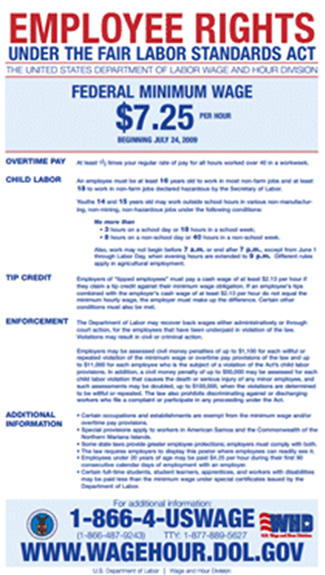
The FLSA requires that covered employees be paid at least the federal minimum wage of $7.25 per hour. Nonagricultural and other nonexempt employees are entitled to time and one-half their regular rates for every hour they work beyond 40 per week. The law also requires employers to maintain accurate records of employees' wages, hours and other conditions of employment, and prohibits employers from retaliating against employees who exercise their rights under the law. The FLSA provides that employers who violate the law are, as a general rule, liable to employees for back wages and an equal amount in liquidated damages.

When employees are denied their hard-earned income, the Wage and Hour Division is committed to ensuring that workers receive wages earned and needed for basic expenses such as rent, transportation and food. Since 2009, the division's investigations have resulted in the recovery of more than $1.3 billion dollars in back wages for more than 1.5 million workers.

For more information about federal wage laws, or to file a complaint, call the Wage and Hour Division's toll-free helpline at 866-4US-WAGE (487-9243), or the division's Northern New Jersey District Office, which is leading the enforcement initiative, at 908-317-8611. Information also is available at http://www.dol.gov/whd/.

Agency
Wage and Hour Division
Date
March 26, 2015
Release Number
15-0336-NEW
Media Contact: Joanna Hawkins
Media Contact: Leni Fortson

WHD News Release: Federal job-protected family and medical leave rights extended to eligible workers in same-sex marriages [02/23/2015]

News Release

Federal job-protected family and medical leave rights
extended to eligible workers in same-sex marriages

US Labor Dept. updates Family and Medical Leave Act's definition of spouse

WASHINGTON — Workers in legal, same-sex marriages, regardless of where they live, will now have the same rights as those in opposite-sex marriages to federal job-protected leave under the Family and Medical Leave Act to care for a spouse with a serious health condition. The U.S. Labor Department announced a rule change to the FMLA today in keeping with the U.S. Supreme Court ruling in United States v. Windsor. That ruling struck down the federal Defense of Marriage Act provision that interpreted "marriage" and "spouse" to be limited to opposite-sex marriage for the purposes of federal law.

"The basic promise of the FMLA is that no one should have to choose between the job and income they need, and caring for a loved one," said U.S. Secretary of Labor Thomas E. Perez in announcing the rule change. "With our action today, we extend that promise so that no matter who you love, you will receive the same rights and protections as everyone else. All eligible employees in legal same-sex marriages, regardless of where they live, can now deal with a serious medical and family situation like all families — without the threat of job loss."

Enacted in 1993, the FMLA entitles eligible employees of covered employers to take unpaid, job-protected leave for specified family and medical reasons. Employees are, for example, entitled to take FMLA leave to care for a spouse who has a serious health condition. Millions of workers and their families have benefited since the FMLA's provisions became effective and even more American families will benefit as a result of the rule.

Today's rule change updates the FMLA regulatory definition of "spouse" so that an eligible employee in a legal same-sex marriage will be able to take FMLA leave for his or her spouse regardless of the state in which the employee resides. Previously, the regulatory definition of "spouse" did not include same-sex spouses if an employee resided in a state that did not recognize the employee's same-sex marriage. Under the new rule, eligibility for federal FMLA protections is based on the law of the place where the marriage was entered into. This "place of celebration" provision allows all legally married couples, whether opposite-sex or same-sex, to have consistent federal family leave rights regardless of whether the state in which they currently reside recognizes such marriages.

For additional information on the FMLA, including information and fact sheets on the revisions, visit http://www.dol.gov/whd/fmla/spouse/index.htm.

Agency
Wage and Hour Division
Date
February 23, 2015
Release Number
15-0285-NAT
Media Contact: Jason Surbey
Phone Number

WHD News Brief: US Labor Department and Wisconsin Department of Workforce Development sign agreement to reduce misclassification of employees [01/20/2015]

News Brief

US Labor Department and Wisconsin Department of Workforce Development sign agreement to reduce misclassification of employees

Participants: Wage and Hour Division, Wisconsin Department of Workforce Development

Description: Officials from the U.S. Department of Labor and the Wisconsin Department of Workforce Development signed a memorandum of understanding with the goal of protecting the rights of employees by preventing their misclassification as independent contractors or other nonemployee statuses. Under the agreement both agencies will share information and coordinate law enforcement.

Background: The memorandum of understanding represents a new effort on the part of the agencies to work together to protect the rights of employees and level the playing field for responsible employers by reducing the practice of misclassification. The Wisconsin Department of Workforce Development is the latest state agency to partner with the Labor Department. Alabama, California, Colorado, Connecticut, Florida, Hawaii, Illinois, Iowa, Louisiana, Maryland, Massachusetts, Minnesota, Missouri, Montana, New Hampshire, New York, Utah and Washington state agencies have signed similar agreements. More information is available on the Department of Labor's misclassification website at http://www.dol.gov/misclassification/.

Duration: 3 years

Quotes: "Misclassification deprives workers of rightfully-earned wages and undercuts law-abiding businesses. This memorandum of understanding sends a clear message that we are standing together with the state of Wisconsin to protect workers and responsible employers and ensure everyone has the opportunity to succeed."

— Dr. David Weil, Administrator, Wage and Hour Division.

"Working with the states is an important tool in ending misclassification. These collaborations allow us to better coordinate compliance with both federal and state laws alike."

— Karen Chaikin, Regional Administrator for the Midwest, Wage and Hour Division


Agency
Wage and Hour Division
Date
January 20, 2015
Release Number
15-0062-NAT
Media Contact: Scott Allen
Phone Number

WHD News Release: US Labor Department signs agreement with Florida Department of Revenue to reduce misclassification of employees [01/13/2015]

News Release

US Labor Department signs agreement with Florida Department of Revenue to reduce misclassification of employees

WASHINGTON — Officials from the U.S. Department of Labor and the Florida Department of Revenue today signed a memorandum of understanding with the goal of protecting the rights of employees by preventing their misclassification as independent contractors or other nonemployee statuses. Under the agreement, both agencies will share information and coordinate law enforcement. The MOU represents a new effort on the part of the agencies to work together to protect the rights of employees and level the playing field for responsible employers by reducing the practice of misclassification. The Florida Department of Revenue is the latest state agency to partner with the Labor Department.

In Fiscal Year 2013, WHD investigations resulted in more than $83,051,159 in back wages for more than 108,050 workers in industries, such as janitorial, food, construction, day care, hospitality and garment. WHD regularly finds large concentrations of misclassified workers in low-wage industries.

"Misclassification deprives workers of rightfully-earned wages and undercuts law-abiding businesses," said Dr. David Weil, administrator of the Wage and Hour Division. "This memorandum of understanding sends a clear message that we are standing together with the state of Florida to protect workers and responsible employers and ensure everyone has the opportunity to succeed."

"Working with the states is an important tool in ending misclassification," said Wayne Kotowski, the Wage and Hour Division's regional administrator for the southeast. "These collaborations allow us to better coordinate compliance with both federal and state laws alike."

"By partnering with the U.S. Department of Labor we are actively working to level the playing field for Florida's businesses to stop the misclassification of workers. Businesses that misreport workers obtain an unfair advantage over other law-abiding businesses," said Florida Department of Revenue Executive Director, Marshall Stranburg.

Business models that attempt to change or obscure the employment relationship through the use of independent contractors are not inherently illegal, but they may not be used to evade compliance with federal labor law. Although legitimate independent contractors are an important part of our economy, the misclassification of employees presents a serious problem. Independent contractors are often denied access to critical benefits and protections, such as family and medical leave, overtime compensation, minimum wage pay and unemployment insurance, to which they are entitled. In addition, misclassification can create economic pressure for law-abiding business owners, who often find it difficult to compete with those who are skirting the law.

Memoranda of understanding with state government agencies arose as part of the department's Misclassification Initiative, with the goal of preventing, detecting and remedying employee misclassification. Alabama, California, Colorado, Connecticut, Hawaii, Illinois, Iowa, Louisiana, Maryland, Massachusetts, Minnesota, Missouri, Montana, New York, Utah and Washington state agencies have signed similar agreements. More information is available on the Department of Labor's misclassification website at http://www.dol.gov/misclassification/.

The mission of the department is to foster, promote and develop the welfare of the wage earners, job seekers and retirees of the United States; improve working conditions; advance opportunities for profitable employment; and ensure work-related benefits and rights. To learn more about the FLSA's requirements, call the Wage and Hour Division's toll-free hotline at 866-4US-WAGE (487-9243) or visit its website at http://www.dol.gov/whd/.

Agency
Wage and Hour Division
Date
January 13, 2015
Release Number
15-0034-NAT
Media Contact: Jose Carnevali

WHD News Release: US Labor Department signs agreement with Alabama Labor Department to reduce misclassification of employees [10/02/2014]

News Release

US Labor Department signs agreement with Alabama Labor Department
to reduce misclassification of employees

WASHINGTON — Officials of the U.S. Department of Labor's Wage and Hour Division and the Alabama Department of Labor today signed a memorandum of understanding to protect the rights of employees by preventing their misclassification as something other than employees, such as independent contractors. The memorandum of understanding represents a new effort on the part of the agencies to work together to protect the rights of employees and level the playing field for responsible employers by reducing the practice of misclassification. The Alabama Department of Labor is the latest state agency to partner with the U.S. Labor Department.

In Fiscal Year 2013, WHD investigations resulted in more than $83,051,159 in back wages for more than 108,050 workers in industries, such as janitorial, food, construction, day care, hospitality and garment. WHD regularly finds large concentrations of misclassified workers in low-wage industries.

"Misclassification deprives workers of rightfully-earned wages and undercuts law-abiding businesses," said Dr. David Weil, administrator of the Wage and Hour Division. "This memorandum of understanding sends a clear message that we are standing together with the state of Alabama to protect workers and responsible employers and ensure everyone has the opportunity to succeed."

"Working with the states is an important tool in ending misclassification," said Wayne Kotowski, the Wage and Hour Division's regional administrator for the southeast. "These collaborations allow us to better coordinate compliance with both federal and state laws alike."

"We are pleased to be able to partner with the U.S. Department of Labor in order to better serve all employers and employees in Alabama," said Alabama Department of Labor Commissioner Fitzgerald Washington. "This sharing of information between agencies can lead to better benefits for and a better understanding of the law by employees, as well as serving to level the playing field for employers who are legitimately reporting their employees' classifications."

Business models that attempt to change or obscure the employment relationship through the use of independent contractors are not inherently illegal, but they may not be used to evade compliance with federal labor law. Although legitimate independent contractors are an important part of our economy, the misclassification of employees presents a serious problem. Independent contractors are often denied access to critical benefits and protections, such as family and medical leave, overtime compensation, minimum wage pay and unemployment insurance, to which they are entitled. In addition, misclassification can create economic pressure for law-abiding business owners, who often find it difficult to compete with those who are skirting the law.

Memoranda of understanding with state government agencies arose as part of the department's Misclassification Initiative, with the goal of preventing, detecting and remedying employee misclassification. California, Colorado, Connecticut, Hawaii, Illinois, Iowa, Louisiana, Maryland, Massachusetts, Minnesota, Missouri, Montana, New York, Utah and Washington state agencies have signed similar agreements. More information is available on the Department of Labor's misclassification website at http://www.dol.gov/misclassification/.

The mission of the department is to foster, promote and develop the welfare of the wage earners, job seekers and retirees of the United States; improve working conditions; advance opportunities for profitable employment; and ensure work-related benefits and rights. To learn more about the FLSA's requirements, call the Wage and Hour Division's toll-free hotline at 866-4US-WAGE (487-9243) or visit its website at http://www.dol.gov/whd/.

Agency
Wage and Hour Division
Date
October 2, 2014
Release Number
14-1889-NAT
Media Contact: Lindsay Williams
Phone Number

WHD News Release: US Labor Secretary Thomas E. Perez announces final rule raising the minimum wage for federal contract workers [10/01/2014]

News Release

US Labor Secretary Thomas E. Perez announces final rule
raising the minimum wage for federal contract workers

Rule raises the minimum wage to $10.10 per hour for covered workers

WASHINGTON — Upholding President Obama's promise to make 2014 a year of action to expand opportunity, reward work and grow the middle class, U.S. Secretary of Labor Thomas E. Perez today announced a final rule that raises the minimum wage for workers on federal service and construction contracts to $10.10 per hour. The final rule implements Executive Order 13658, which was announced by the president on Feb. 12, and it will benefit nearly 200,000 American workers.

"No one who works full time in America should have to raise their family in poverty, and if you serve meals to our troops for a living, then you shouldn't have to go on food stamps in order to serve a meal to your family at home," said Secretary Perez. "By raising the minimum wage for workers on federal contracts, we're rewarding a hard day's work with fair pay. This action will also benefit taxpayers. Boosting wages lowers turnover and increases morale, and will lead to higher productivity."

The final rule provides guidance and sets standards for employers concerning what contracts are covered and which of their workers are covered. The rule also establishes obligations that contractors must fulfill to comply with the minimum wage provisions of the executive order, including record-keeping requirements. It provides guidance about where to find the required rate of pay for all workers, including tipped employees and workers with disabilities. Additionally, the rule establishes an enforcement process that should be familiar to most government contractors and will protect the right of workers to receive the new $10.10 minimum wage.

Executive Order 13658 applies to new contracts and replacements for expiring contracts with the federal government that result from solicitations issued on or after Jan. 1, 2015, and to contracts that are awarded outside the solicitation process on or after Jan. 1, 2015. The minimum wage applicable under this final rule will be indexed to inflation in future years. The final rule makes clear that the executive order minimum wage requirement applies to all contracts for construction covered by the Davis-Bacon Act; contracts for services covered by the Service Contract Act; concessions contracts, such as contracts to furnish food, lodging, automobile fuel, souvenirs, newspaper stands and recreational equipment; and contracts to provide services, such as child care or dry cleaning, on federal property for federal employees or the general public. The final rule came after consideration of extensive comments from the federal contracting community, workers and other interested parties.

For more information about the final rule, including fact sheets and answers to frequently asked questions, please visit http://www.dol.gov/whd/flsa/eo13658/. The rule will be published on the Federal Register Oct. 7, and it is available at https://federalregister.gov/a/2014-23533.

Agency
Wage and Hour Division
Date
October 1, 2014
Release Number
14-1888-NAT
Media Contact: Jason Surbey
Phone Number

WHD News Release: Shell Oil and Motiva Enterprises to pay nearly $4.5M in overtime back wages to employees after US Labor Department investigation [09/16/2014]

News Release

Shell Oil and Motiva Enterprises to pay nearly $4.5M
in overtime back wages to employees after US Labor Department investigation

HOUSTON — Shell Oil Co. and Motiva Enterprises LLC, which markets Shell gasoline and other products, have agreed to pay $4,470,764 in overtime back wages to 2,677 current and former chemical and refinery employees as a result of investigations by the U.S. Department of Labor that found violations of the Fair Labor Standards Act.

The department's Wage and Hour Division conducted investigations at eight Shell and Motiva facilities in Alabama, California, Louisiana, Texas and Washington, which found that the companies violated FLSA overtime provisions by not paying workers for the time spent at mandatory pre-shift meetings and failing to record the time spent at these meetings.

"Employers are legally required to pay workers for all hours worked," said U.S. Secretary of Labor Thomas E. Perez. "Whether in the international oil industry, as in this case, or a local family-run restaurant, the Labor Department is working to ensure that responsible employers do not experience a competitive disadvantage because they play by the rules."

The Wage and Hour Division's Houston District Office coordinated investigations with the Gulf Coast, New Orleans, San Francisco and Seattle District Offices to ensure nationwide compliance by Shell and Motiva. The findings revealed that those eight Shell Oil and Motiva refineries failed to pay workers for time spent attending mandatory pre-shift meetings. The companies required the workers to come to the meetings before the start of their 12-hour shift. Because the companies failed to consider time spent at mandatory pre-shift meetings as compensable, employees were not paid for all hours worked and did not receive all of the overtime pay of time and one-half their regular rate of pay for hours worked over 40 in a workweek. Additionally, the refineries did not keep accurate time records.

Shell, with U.S. headquarters in Houston, is an oil and natural gas producer involved in processing crude oil to manufacture energy products, including gasoline, diesel fuel, jet fuel and petroleum coke. Motiva, which is partially owned by Shell, is a leading refiner, distributor and marketer of fuels in the Eastern and Gulf Coast regions of the United States. It markets petroleum products under the Shell brand.

Shell and Motiva have signed settlement agreements that call for training of managers, payroll personnel and human resources personnel on the FLSA's requirements. The training will stress the importance of requiring accurate recording and pay for all hours worked with emphasis on pre-and post-shift activities.

The FLSA requires that covered employees be paid at least the federal minimum wage of $7.25 per hour. Workers who are not employed in agriculture and not otherwise exempt from overtime compensation are entitled to time and one-half their regular rates of pay for every hour they work beyond 40 per week. The law also requires employers to maintain accurate records of employees' wages, hours and other conditions of employment, and it prohibits employers from retaliating against employees who exercise their rights under the law.

For more information about federal wage laws, call the Wage and Hour Division's toll-free helpline at 866-4US-WAGE (487-9243) or its Houston District Office at713-339-5500. Information also is available at http://www.dol.gov/whd/.

Agency
Wage and Hour Division
Date
September 16, 2014
Release Number
14-1645-DAL
Media Contact: Juan Rodriguez

WHD News Release: US Labor Department secures nearly $2M in back wages, benefits for nearly 150 workers at federally-funded solar energy project in Nevada [10/23/2014]

News Release

US Labor Department secures nearly $2M in back wages, benefits
for nearly 150 workers at federally-funded solar energy project in Nevada

LAS VEGAS — The U.S. Department of Labor has recovered $1,914,681.50 in back wages and fringe benefits for 147 workers at Proimtu Mmi-Nv LLC, a Henderson-based subcontractor providing construction services at the federally funded Crescent Dunes Solar Energy Project in Tonopah. This project, which received a $737 million loan guarantee from the U.S. Department of Energy, is a 110 MW solar energy power plant that will power up to 75,000 homes during peak electricity periods.

"The money we've recovered for these workers is not a windfall — it is their hard-earned pay that their employer was legally obligated to pay them but did not," said Dr. David Weil, administrator of the department's Wage and Hour Division. "Companies that benefit from federal funding must see to it that the money is used properly, and that their workers are compensated according to the law."

An investigation found that Proimtu Mmi-Nv violated the prevailing wage and fringe benefits requirements of the Davis-Bacon and Related Acts for the majority of their employees working at the Tonopah desert solar energy project. The Crescent Dunes Solar Energy Project is subject to specific requirements under the DBRA since its funding includes hundreds of millions of dollars in federal loan guarantees from the U.S. Department of Energy under the American Recovery and Reinvestment Act of 2009.

Investigators established that from June 2013 through April 2014, Proimtu Mmi-Nv failed to pay workers the correct prevailing wage rates and fringe benefits for their particular job duties. The contractor paid "general laborers" rates to workers that routinely performed duties in skilled trades, such as ironworking, electrical work, painting or bridge crane operation, that should have commanded fringe benefits and prevailing wages of up to two times more than they were paid.

In addition to paying back wages and fringe benefits, Proimtu Mmi-Nv now properly classifies its workers by paying them the correct prevailing wages and fringe benefits for all hours worked, including overtime, as required. In addition, the subcontractor has also agreed to raise awareness with other employers working at Crescent Dunes about prevailing wage requirements.

For information on federal wage requirements and laws, contact the Wage and Hour Division's Las Vegas District Office at 702-928-1240 or the Wage and Hour Division's toll-free helpline at 866-4US-WAGE (487-9243). Information is also available at http://www.dol.gov/whd/.

  • Read this news release in Spanish.

Agency
Wage and Hour Division
Date
October 23, 2014
Release Number
14-1361-SAN
Media Contact: Leo Kay
Phone Number
Media Contact: Jose Carnevali

WHD News Release: Proposed rule to extend Family Medical Leave Act protections to all eligible employees in same-sex marriages announced by US Labor Secretary [06/20/2014]

News Release

Proposed rule to extend Family Medical Leave Act protections to all eligible employees in same-sex marriages announced by US Labor Secretary

WASHINGTON — U.S. Secretary of Labor Thomas E. Perez announced today a proposed rule extending the protections of the Family and Medical Leave Act to all eligible employees in legal same-sex marriages regardless of where they live. The proposal would help ensure that all families will have the flexibility to deal with serious medical and family situations without fearing the threat of job loss. Secretary Perez is proposing this rule in light of the Supreme Court's decision in United States v. Windsor, in which the court struck down the Defense of Marriage Act provision that interpreted "marriage" and "spouse" to be limited to opposite-sex marriage for the purposes of federal law.

The FMLA, enacted in 1993, entitles eligible employees of covered employers to take unpaid, job-protected leave for specified family and medical reasons. Employees are, for example, entitled to take FMLA leave to care for a spouse who has a serious health condition. Millions of workers and their families have benefited since the FMLA's provisions became effective and even more American families would be made secure as a result of the proposed rule.

"The basic promise of the FMLA is that no one should have to choose between succeeding at work and being a loving family caregiver," said Secretary Perez. "Under the proposed revisions, the FMLA will be applied to all families equally, enabling individuals in same-sex marriages to fully exercise their rights and fulfill their responsibilities to their families."

The proposed rule would change the FMLA regulatory definition of "spouse" so that an eligible employee in a legal same-sex marriage will be able to take FMLA leave for his or her spouse or family member regardless of the state in which the employee resides. Currently, the regulatory definition of "spouse" only applies to same-sex spouses who reside in a state that recognizes same-sex marriage. Under the proposed rule, eligibility for FMLA protections would be based on the law of the place where the marriage was entered into, allowing all legally married couples, whether opposite-sex or same-sex, to have consistent federal family leave rights regardless whether the state in which they currently reside recognizes such marriages.

Following the Windsor decision, noting that it was "a victory... for families that, at long last, will get the respect and protection they deserve," President Obama directed the Attorney General to work with the Cabinet to review federal statutes to ensure the decision, including its implications for federal benefits and obligations, is implemented.

For additional information on the FMLA, including information and fact sheets on the proposed revisions, visit http://www.dol.gov/whd/fmla/nprm-spouse. The department encourages all interested parties to view the proposed rule and submit comments at http://www.regulations.gov. The regulation identification number is 1235-AA09. Comments must be received within 45 days following publication in the Federal Register.

Agency
Wage and Hour Division
Date
June 20, 2014
Release Number
14-1208-NAT
Media Contact: Jason Surbey
Phone Number

WHD News Release: US Labor Secretary Thomas E. Perez announces proposed rule to raise the minimum wage for federal contract workers [06/12/2014]

News Release

US Labor Secretary Thomas E. Perez announces proposed rule to raise the minimum wage for federal contract workers

Proposed rule would raise the minimum wage to $10.10 per hour for covered workers

WASHINGTON — Fulfilling President Obama's commitment to make 2014 a year of action to strengthen the economy and grow the middle class, U.S. Secretary of Labor Thomas E. Perez today announced a proposed rule raising the minimum wage for workers on federal service and construction contracts to $10.10 per hour. The proposed rule implements Executive Order 13658, which was announced by the president on Feb. 12.

"A core American value is that hard work should be rewarded with fair pay. And as the president said in his State of the Union address, if you cook our troops' meals or wash their dishes, you shouldn't have to live in poverty," said Secretary Perez. "Raising the minimum wage for workers on federal contracts will provide a much needed boost to many who are working hard, but still struggle to get by, and it will also benefit taxpayers with improved employee retention and productivity. Today the department took an important step toward making the promise of the executive order a reality for thousands of workers."

"In America, nobody who works full time should have to raise their family in poverty," said White House Domestic Policy Director Cecilia Muñoz. "President Obama is leading by example, raising the minimum wage for federal contract workers, and governors, mayors and businesses around the country are answering the call to join him. Now it's time for Congress to finish the job and raise the wage for everyone."

The proposed rule provides guidance and sets standards for employers concerning coverage, including coverage of tipped employees and workers with disabilities. It also establishes an enforcement process familiar to most government contractors that will protect the right of workers to receive the new minimum wage. The proposed rule includes an economic analysis showing that nearly 200,000 workers will benefit from the increase.

Executive Order 13658 applies to new contracts and replacements for expiring contracts with the federal government that result from solicitations issued on or after Jan. 1, 2015, and to contracts that are awarded outside the solicitation process on or after Jan. 1, 2015. The order applies to four major categories of contractual agreements: contracts for construction; service contracts under the Service Contract Act; concessions contracts; and contracts entered into by the federal government in connection with federal property or lands and related to offering services for federal employees, their dependents or the general public. The department's proposed rule came after extensive outreach to the federal contracting community, workers, and procurement and contracting officials throughout the executive branch.

In addition to the proposed rule the department issued for public comment, today the Office of Management and Budget and the department jointly provided initial guidance to agencies on steps they should take to begin implementing the increased minimum wage in advance of the rule being finalized. By issuing this guidance, OMB and the department are asking agencies to take reasonable and legally permissible steps immediately to begin implementing the order, so that workers on federal contracts can benefit from wage increases as soon as possible after Jan. 1.

The department encourages all interested parties to view the proposed rule and submit comments at http://www.regulations.gov. The regulation identification number is 1235-AA10. Comments must be received within 30 days following publication in the Federal Register. The department will review comments received and issue a final rule by Oct. 1. More information about the proposed rule and the joint guidance to federal agencies is available at http://www.dol.gov/whd/flsa/nprm-eo13658/.

Agency
Wage and Hour Division
Date
June 12, 2014
Release Number
14-1131-NAT
Media Contact: Jason Surbey
Phone Number
Subscribe to Wages