


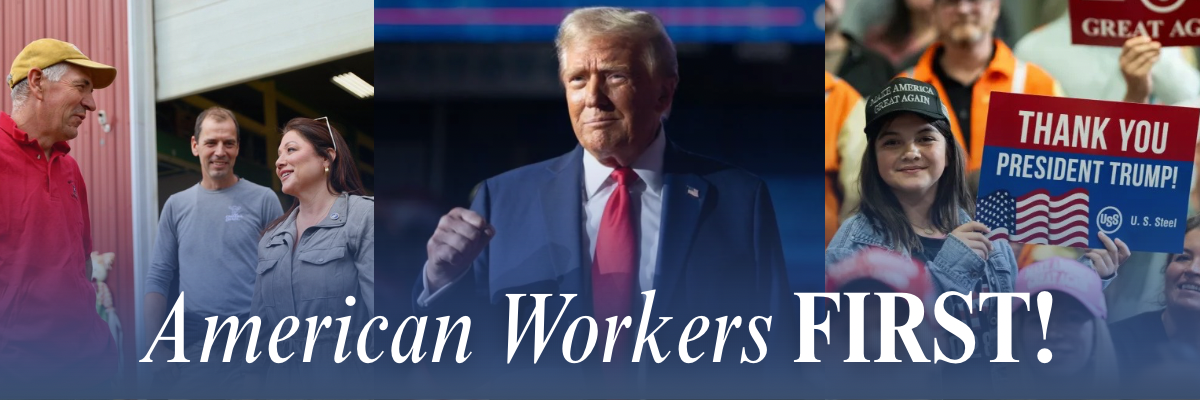
Under President Trump’s leadership, the U.S. Department of Labor moved quickly to put the American Worker First in 2025. Secretary Chavez-DeRemer has led the Department in efforts to expand career pathways, prepare people for new jobs, protect retirement and health benefits, and ensure a level playing field for U.S. workers and employers. Here are some of the highlights:
 Making America Skilled Again
We registered over 2,300 new apprenticeship programs nationally and added nearly 300,000 new apprentices.
Apprenticeships give young people and career changers an alternative to a four‑year degree by training them for mortgage‑paying jobs while they earn a wage. Expanding apprenticeships helps address a shortage of skilled workers in areas like construction, health care, and technology.

Preparing for the Jobs of the Future
$86 million in new skills training investments will support AI infrastructure careers — for example, electricians and technicians who build and maintain the systems that power modern workplaces.
The Department is investing in AI literacy and AI‑related apprenticeships so American workers can succeed as new technology creates new jobs. As part of the Trump Administration’s AI Action Plan, the department is also developing an “AI Workforce Hub” to study how AI is affecting jobs and to help guide training and workforce policy.

Integrating Education and Workforce Development
Our new agreement with the Department of Education aims to target grant dollars more effectively so that students have clearer pathways from school to careers.
Nearly 70% of 4th and 8th graders are not proficient in reading, a challenge that affects long‑term opportunity and the supply of skilled workers. That's why we’re working with the Secretary of Education to return more responsibility to states and better align education with local workforce needs. The Departments of Labor and Education are co‑administering 81 programs to improve coordination between education and workforce development.

Lowering Health Care Costs
We're moving forward with rulemaking to expand health care price transparency and make care more affordable for workers and families.
In coordination with the Departments of Health and Human Services and the Treasury, we’re taking steps to make health care prices clearer by asking the public for input on drug price data and updating rules so health plans share simpler, more useful price information.

Promoting Retirement Security
We rescinded prior guidance restricting the use of cryptocurrency in retirement investments and removed a supplemental statement that discouraged fiduciaries from considering alternative assets in 401(k) plans.
These actions are intended to give retirement plan fiduciaries greater clarity and flexibility in evaluating investments on behalf of plan participants, ultimately helping Americans grow and protect their hard-earned retirement savings.

Enforcing Fair Labor Practices to Protect American Workers
We launched nearly 200 investigations into companies suspected of abusing the H‑1B visa program as part of Project Firewall, an effort to ensure that employers do not displace U.S. workers with cheaper foreign labor.
Project Firewall is helping restore our Nation’s economic dominance by making sure employers hire qualified American workers for high‑skill jobs. Strong investigations and penalties, plus teamwork with other agencies, will protect wages, recover back pay, and keep employers following the law.

Supporting U.S. Agriculture and Protecting Food Security
We have taken steps to cut red tape and have established an “Office of Immigration Policy” to support America’s agricultural employers.
The department is taking action to cut red tape for our farmers and ranchers, including by suspending enforcement of the previous administration’s rule that added several unnecessary, burdensome, and costly requirements on ag employers. We also established the Office of Immigration Policy to help America’s ag employers secure the legal workforce they need to succeed.

Providing Compliance Assistance for Employers
We have rolled out opinion letter and self-audit programs to help employers succeed.
Our opinion letter program expands the department’s longstanding commitment to providing meaningful compliance assistance that helps workers, employers, and other stakeholders understand how federal labor laws apply in specific workplace situations. In addition, our self-audit programs help employers, unions, and pension plans voluntarily assess and improve their compliance with federal labor laws.

Reducing Regulatory Burdens on Businesses
We have rescinded discriminatory diversity, equity, and inclusion (DEI) requirements.
The Trump Administration is committed to easing the regulatory burden on employers while protecting worker rights. Our action will reduce costly paperwork — lowering compliance costs for businesses by at least $1 billion a year — and help workers and employers by focusing on skills, fairness, and lowering legal risks. We also announced 63 deregulatory actions in an aggressive effort to spur job creation and fuel economic opportunity.

It was a busy year, but we’re just getting started! Stay tuned in 2026 by following us
on social media and bookmarking our newsroom page for official announcements.