Agency Acronym
WB
DOL Search Collections ID
9032

READOUT: US Department of Labor report finds stark gender, age-based pay inequities for older women, whose share of the labor force has increased

News Release

READOUT: US Department of Labor report finds stark gender, age-based pay inequities for older women, whose share of the labor force has increased

WASHINGTON – As the nation marks Older Americans Month, the U.S. Department of Labor welcomed U.S. Representatives Debbie Dingell, Lois Frankel, Gwen Moore and Jan Schakowsky for a roundtable discussion on older women in today’s workforce and the findings of two reports by the department’s Women’s Bureau on the unique challenges they face.

Moderated by the bureau’s Director Wendy Chun-Hoon, the panel shared findings in the reports, “The Rise of Older Women Workers” and “Living on Less: Persistent Gender Disparities in Income Levels, Sources for Older Adults.”

The bureau’s Acting Deputy Director Tiffany Boiman; Justice in Aging’s Directing Attorney for Economic Security Tracey Gronniger; Christina Bradshaw-Smith, a member of the American Federation of Teachers; and Antonia Surco, a member of the National Domestic Workers Alliance also participated in the roundtable.

The “Rise of Older Women Workers” reports that while women aged 55 and older make up 10.8 percent of the U.S. labor force – nearly double their 5.8 percent share of the workforce in 1980 – their incomes continue to be lower and they are more likely to live in poverty than men of the same age.

The inequalities that women experience throughout their working lives – things like unequal pay, the lack of affordable childcare, or gender and racial discrimination and harassment – accumulate and grow over time,” explained Women’s Bureau Director Wendy Chun-Hoon. “While some workers may choose to keep working, too many older women simply cannot afford to retire due to a lifetime of low wages, family caregiving responsibilities and systemic inequalities.”

The reports show that, on average, older women’s personal incomes are only 63 percent of men’s, for those aged 65 and older. Long-term solutions require addressing a lifetime of gender-based inequities: eliminating pay disparities, increasing access to worker protections, creating pathways to better paying careers and improving job quality where women are the most likely to work today.

“Older women workers are an important and growing part of our workforce, yet they consistently earn less due to an intersection of multiple factors, including ageism and sexism. The Democratic Women’s Caucus looks forward to working with the Biden administration and other partners to address the disparities and challenges older women face so they can age independently and with financial stability,” said Rep. Lois Frankel.

“These reports make it plainly clear that we must do more to support older women in the workforce and make equity-centered policy interventions to tackle gender disparities. I am so pleased to convene at this roundtable to highlight important insights from these reports,” said Rep. Gwen Moore.

“Older women are an important and growing segment of the U.S. labor force, but they have lower incomes and are more likely to live in poverty than older men. All seniors deserve to age and live independently and with dignity. As a co-chair of the Task Force on Aging and Families, and someone who spends a lot of time working on how we improve quality of life and resources for aging Americans, this issue hits home for me. We must continue to work to understand and address the discrepancies and challenges faced by older women in the workforce,” said Rep. Jan Schakowsky.

Bradshaw-Smith, a high school physical education teacher with more than 30 years in the classroom, shared her experiences, as did Surco, an older domestic worker. Throughout the discussion, participants emphasized the need for stronger worker protections and policies to support working women today to avoid hardship for women as they age in the workforce and into retirement.

Review “The Rise of Older Women Workers” report.

Learn more about the “Living on Less” report.

Agency
Women's Bureau
Date
May 24, 2023
Release Number
23-1114-NAT
Media Contact: Monica Vereen
Share This

READOUT: US Department of Labor report finds impact of caregiving on mother’s wages reduces lifetime earnings by 15 percent

News Release

READOUT: US Department of Labor report finds impact of caregiving on mother’s wages reduces lifetime earnings by 15 percent

WASHINGTON – U.S. Department of Labor and elected federal officials held a media briefing today to discuss the release of a report by the department’s Women’s Bureau on how caring for family has long-term impacts on a mother’s lifetime earnings.

Women’s Bureau Director Wendy Chun-Hoon and U.S. Representatives Gwen Moore, Susan Wild and Shontel Brown shared findings from the “Lifetime Employment-Related Costs to Women of Providing Family Care” report. Women’s Bureau Senior Advisor Sarah Jane Glynn also took part in the briefing.

The report finds the amount of time women spend providing essential care to children and adults has a substantial personal economic cost that continues long after the caregiving ends. The estimated employment-related costs for mothers providing unpaid care averages $295,000 over a lifetime, based on the 2021 U.S. dollar value, adjusted for inflation. Unpaid family caregiving reduces a mother’s lifetime earnings by 15 percent, which also creates a reduction in retirement income.

“Families often think first of immediate demands out of necessity. Children, aging loved ones and people with disabilities need care right now, and when that care is needed during working hours – or is too expensive or inaccessible — it is the mothers who usually scale back on paid work to provide care,” explained Women’s Bureau Director Wendy Chun-Hoon. “This report shows that lacking the necessary care infrastructure and safety net affects more than those immediate moments. They continue throughout a woman’s life.”

“Unpaid caregiving is work and should be recognized as such. This report is another reminder of the long-term cost women incur by providing unpaid care, and it cannot go ignored,” said Congresswoman Gwen Moore. “I am working to ensure our federal policies support those providing unpaid care to loved ones, uplifting women and their families, so we can build an equitable, modern economy.”

“Women spend invaluable time providing compassionate, dedicated care for their children and family members – and their reduced lifetime earnings because of it illustrate just how important solving the childcare crisis is,” said Congresswoman Susan Wild. “Lack of accessible, affordable childcare in Pennsylvania impacts our economy to the tune of more than $6 billion per year, harming working moms’ and working families’ ability to earn more and get ahead. I’m proud to be leading the ‘Child Care for Working Families Act’ to expand care options for all moms and families and unlock our full economic potential.” 

“This report is a call to action. All families should have access to affordable childcare if we want to have an inclusive economy,” said Congresswoman Shontel Brown. “Families across the nation and from all demographics are struggling with high childcare costs. This financial burden is especially high in historically marginalized communities, including Black mothers, as they are the least likely to scale back employment after having children due to challenging economic conditions. A lack of affordable care puts so much pressure on families, Black women deserve the ability to build wealth and build a family. Our children, mothers and families in Northeast Ohio deserve better.”

Although its findings relies on sophisticated modeling to focus on the costs associated with caregiving activities for mothers, the report – prepared for the Women’s Bureau by the Urban Institute – acknowledges that the costs are likely conservative estimates that do not include the total economic costs borne by all caregivers.

Review the “Lifetime Employment-Related Costs to Women of Providing Family Care.”

Agency
Women's Bureau
Date
May 11, 2023
Release Number
23-1008-NAT
Media Contact: Monica Vereen
Share This

US Department of Labor announces availability of $1M in grants to prevent, respond to workplace gender-based violence, harassment

News Release

US Department of Labor announces availability of $1M in grants to prevent, respond to workplace gender-based violence, harassment

Funding aims to assist underserved, marginalized women workers, survivors

WASHINGTON The U.S. Department of Labor today announced the availability of $1 million in funding for up to four grants to prevent and respond to gender-based violence and harassment against underserved and marginalized women workers.

The Fostering Access, Rights and Equity grants will help survivors and women at high risk for violence and harassment in the workplace.

Administered by the department’s Women’s Bureau and the Employment and Training Administration, the FARE grant program will support non-profit organizations’ efforts to address gender-based violence and harassment. Workplace violence and harassment disproportionately harms women from underserved and historically marginalized communities, including women of color, individuals who identify as LGBTQI+, women with disabilities, and women affected by persistent poverty and inequality.

The grants seek to improve job quality by supporting projects that address harmful workplace norms and helping employ strategies to prevent and reduce gender-based violence and harassment. Successful applicants will include strategies to accomplish the following:

  • Develop and distribute worker and survivor-centered materials to raise awareness.
  • Reduce workplace risks and prevent workplace gender-based violence and harassment.
  • Connect working women to services, benefits and legal assistance.
  • Encourage working women and survivors to become focal points in their communities and provide ways to expand their effectiveness through train-the-trainer programs, guided conversations, leadership circles or other activities.

Read about the 2022 FARE Grant recipients and review Frequently Asked Questions.

Learn about the FARE grant funding opportunity and apply.


Agency
Women's Bureau
Date
April 21, 2023
Release Number
23-737-NAT
Media Contact: Monica Vereen
Share This

US Department of Labor announces $5M funding opportunity to attract, retain women in Registered Apprenticeships, nontraditional occupations

News Release

US Department of Labor announces $5M funding opportunity to attract, retain women in Registered Apprenticeships, nontraditional occupations

Grants address underrepresentation of women in high-growth, high-wage industries

WASHINGTON - To continue its support of the Biden-Harris administration’s historic infrastructure, manufacturing and clean energy investments, the U.S. Department of Labor today announced the availability of $5 million to fund up to 14 grants to attract and support women in gaining access to Registered Apprenticeship programs in industries where they are underrepresented such as construction, manufacturing and cybersecurity.

The Women in Apprenticeship and Nontraditional Occupations grants are administered by the department’s Employment and Training Administration and Women’s Bureau.

U.S. Secretary of Commerce Gina Raimondo and the Department of Labor’s Women’s Bureau Director Wendy Chun-Hoon will highlight the announcement today during their visit to Nontraditional Employment for Women, a New York City community-based organization, as part of the administration’s “Investing in America” tour.

Nontraditional Employment for Women is a 2022 WANTO grant recipient.

The Investing in America agenda, which includes legislation such as the Bipartisan Infrastructure Law, Inflation Reduction Act, and CHIPs and Science Act, is creating millions of good-paying jobs in renewable energy, transportation and broadband infrastructure sectors, and the Biden-Harris administration is helping workers access the training and develop the skills needed to fill these jobs.

This funding opportunity will help address the significant underrepresentation of women in Registered Apprenticeship in skilled trades, such as construction, and in emerging, high-growth industries like manufacturing, infrastructure, cybersecurity and healthcare. Currently, women only comprise approximately 14 percent of Registered Apprentices while they account for nearly half the U.S. labor force.

Read about the 2022 WANTO grant recipients and Frequently Asked Questions

Apply for a 2023 WANTO grant at grants.gov.

Agency
Women's Bureau
Date
April 14, 2023
Release Number
23-599-NAT
Media Contact: Monica Vereen
Share This

Equal Pay Day 2023: Department of Labor initiatives seek to close gender, racial wage gap, increase equity in federal programs

News Release

Equal Pay Day 2023: Department of Labor initiatives seek to close gender, racial wage gap, increase equity in federal programs

Actions support unprecedented investments by Biden-Harris administration

WASHINGTON – For women working in the U.S., the date of Equal Pay Day isn’t a day of celebration. Rather, the day is a reminder that it takes women 15 months to earn the same amount as men earned in 12 months.

Today is Equal Pay Day in 2023, a reminder of systemic inequality faced by women and especially those of color. In the U.S., women who work full-time, year-round, are paid an average of 83.7 percent as much as men, which amounts to a difference of $10,000 per year. The gaps are even larger for many women of color and women with disabilities.

“Equal Pay Day – the day of the year when women working in the U.S. finally earn the same amount as men did in the year before – is an unfortunate reminder that historic wage inequity continues,” said Acting Secretary of Labor Julie Su. “The Biden-Harris administration has made unprecedented investments through the Bipartisan Infrastructure Law, the CHIPS and Science Act and the Inflation Reduction Act and remains determined to remove barriers that prevent women from obtaining good-paying jobs found in the projects these investments will fund to help close the gender wage gap.”

The U.S. Department of Labor has several agency initiatives underway to combat gender and racial pay disparities in the workforce and ensure equity in the implementation of the Bipartisan Infrastructure Law and the Chips and Science and Inflation Reduction acts. They include the following:

  • The launch of the Office of Federal Contract Compliance Programs’ Mega Construction Project Program to foster equal opportunity in the construction trades workforce by removing hiring barriers and promoting diversity as qualified workers are considered for construction jobs. Read an OFCCP fact sheet to help employers take proactive approaches to pay equity.
  • The Employment and Training Administration’s March 6, 2023, announcement of a cooperative agreement of nearly $20 million to support TradesFutures, the National Urban League and their community partners in developing a strategy to substantially increase the number of participants from underrepresented populations – including women and underserved communities – in Registered Apprenticeships in the construction industry. The effort will enroll more than 13,000 participants in apprenticeship readiness programs and place at least 7,000 participants in construction industry Registered Apprenticeships.
  • Publication by the Women’s Bureau of a brief on the causes of the gender wage gap, including new statistics and analyses of gender and racial wage gaps, and a second brief on salary history bans legislation that prohibit employers from asking about prior salaries as a way to promote equal pay includes historic information on equal pay legislation and policymaking, salary history bans’ benefits and design and other policies for closing the gender wage gap.
  • The ongoing Good Jobs Initiative provides tools with practical strategies to increase equal employment opportunities on infrastructure projects, including using Project Labor Agreements as Tools for Equity and establishing Access and Opportunity Committees, stakeholder groups that meet regularly to monitor and support diversity and equity goals on a specific project.

“To build an inclusive economy, we need to enable workers to obtain jobs based on their interests, skills and aptitude rather than gender, race or ethnicity, and promote good-paying jobs that follow fair wage setting practices, like those found in union employment, to help to eliminate the wage gap,” Acting Secretary Su added.

Learn more about Equal Pay and Pay Transparency Protections.

Agency
Office of the Secretary
Date
March 14, 2023
Release Number
23-466-NAT
Media Contact: Arjun Singh
Phone Number
Media Contact: Monica Vereen
Share This

Department of Labor continues efforts to empower workers to take advantage of Family and Medical Leave Act protections, benefits

News Release

Department of Labor continues efforts to empower workers to take advantage of Family and Medical Leave Act protections, benefits

Holds online discussion on caregivers’ FMLA barriers, launches new webpage

WASHINGTON As part of its year-long commemoration of the 30th anniversary of the passage of the Family and Medical Leave Act, the U.S. Department of Labor today hosted an online roundtable discussion and launched a new web page to inform workers about federal regulations for job-protected leave to care for a family member.

For 30 years, the FMLA has provided eligible workers with the right to take job-protected leave with the continuation of health benefits so they can care for their family member with serious health conditions or to address a family member’s military service. While millions of caregivers have taken advantage of the act’s protections, research finds many workers remain unaware of their legal protections under law and others chose not to use the leave, fearful of being treated at work differently.

Today’s discussion, “Working While Caring: A Discussion on Barriers to Workplace Leave for Family Caregivers,” provided participants with an opportunity to learn about the challenges caregivers face when they must take unpaid leave from work to care for family members. Hosted by the department’s Wage and Hour Division, Women’s Bureau, Office of Disability Employment Policy, and Veterans’ Employment and Training Service, the discussion welcomed workers, employers and representatives from AARP, the American Association of People with Disabilities and Blue Star Families.

“Our nation’s family caregivers provide critical care and comfort,” said Principal Deputy Wage and Hour Administrator Jessica Looman. “For three decades, the Family and Medical Leave Act has allowed millions of workers to take time away from work to care for their family members without fear of losing their jobs or access to group health insurance. The Wage and Hour Division is committed to empowering workers to take leave to care when they need it.”

As part of its ongoing efforts to empower workers to use FMLA-protected leave, the department’s Wage and Hour Division has launched a webpage and updated resources to help workers seeking to take time off from work to care for a family member. The site includes the following information:

  • A guide on how to talk to your employer about taking job protected FMLA leave.
  • Updated fact sheets on using FMLA leave when your family member has a serious health condition, must respond to military service duties, or must care for an adult child with a disability.
  • FAQs on taking FMLA leave and other resources for family caregivers to navigate their responsibilities.

“The Family and Medical Leave Act enables the U.S. Department of Labor to support disability-inclusive workplaces, for workers with disabilities and those with family members with disabilities,” said Assistant Secretary for Disability Employment Policy Taryn M. Williams. “Workers shouldn’t have to choose between their job and managing a serious health condition, nor should they have to choose between their job and caring for a loved one with a serious health condition.”

“By some estimates, 60 percent of caregivers also have to work. Since 1993, the Family and Medical Leave Act has provided many people with important protections when they needed it most, but we need to do more,” said Women’s Bureau Director Wendy Chun-Hoon. “Just as parents with new children have access to paid leave, workers with serious mental or physical illness or those whose aging relatives need care should have the same protections and benefits.”

Learn more about the Wage and Hour Division, including its search tool to learn if you are owed back wages collected by the division. For confidential compliance assistance, employees and employers can call the agency’s toll-free helpline at 866-4US-WAGE (487-9243), regardless of where they are from. Help ensure hours worked and pay are accurate by downloading the department’s Android and iOS Timesheet App for free, also available in Spanish.

Agency
Wage and Hour Division
Date
February 23, 2023
Release Number
23-341-NAT
Media Contact: Edwin Nieves
Phone Number
Media Contact: Grant Vaught
Share This

Child care remains out of financial reach for many families, US Department of Labor data shows

News Release

Child care remains out of financial reach for many families, US Department of Labor data shows

WASHINGTON – The newly launched National Database of Childcare Prices, which provides childcare prices in 2,360 U.S. counties, shows that childcare expenses are untenable for families throughout the country and highlights the urgent need for greater federal investments, the U.S. Department of Labor announced today.

Sponsored by the department’s Women’s Bureau, the database shows prices vary by childcare provider type, age of children and location. It includes median prices for center- and home-based providers for children from ages 0 to 12. The database is the most comprehensive public federal source of childcare prices at the county level.

A new brief drawing on available data across 47 states shows childcare prices for a single child ranged from $4,810 for school-age home-based care in small counties to $15,417 for infant center-based care in very large counties. When adjusted for inflation, this equals between $5,357 and $17,171 in 2022 dollars. These price ranges are equivalent to between 8 percent and 19.3 percent of median family income per child in paid care.

“All across the country, families are facing burdensome childcare expenses. The last few years have highlighted the tension parents experience when they need to go to work to provide for their families, but have difficulty doing so if they can’t access affordable child care,” said Women’s Bureau Director Wendy Chun-Hoon. “The National Database of Childcare Prices shows that – where childcare prices are high – mothers are less likely to be employed outside the home, even in places with higher wages. Reducing out-of-pocket childcare expenses for families would support higher employment, particularly among women, lift more families out of poverty, and reduce disparities in employment and early care and education.”

“This data will allow our nation’s researchers and policymakers to measure potential economic impacts of childcare affordability accurately and identify strategies for enhancing employment options and economic security for women,” Chun-Hoon added. “It will give policymakers and advocacy organizations a tool to combine county-level childcare prices with local employment and economic indicators. By doing so, we can understand better the needs of working families and the impacts of a lack of affordable, accessible care infrastructure in their communities.”

In concert with the new National Database of Childcare Prices, the department released interactive county-by county maps of childcare prices and these prices as a share of family income. For example, the maps show the median price of infant center-based child care was:

Location

2018 dollars

2022 dollars (est.)

Percent of Median Family Income

Cook County, IL (including Chicago)

$14,820

$16,506

19.4

Douglas County, NE (including Omaha)

$11,804

$13,147

14.7

Greenville County, SC

$8,125

$9,049

11.4

Pima County, AZ (including Tucson)

$11,188

$12,460

17.6


Explore the NDCP website to learn more.

Learn more about the Women’s Bureau’s work.  

Lea en Español

Agency
Women's Bureau
Date
January 24, 2023
Release Number
23-16-NAT
Media Contact: Arjun Singh
Phone Number
Media Contact: Monica Vereen
Share This

US Department of Labor awards nearly $2M in grants to help low wage-earning women access employment rights, benefits

News Release

US Department of Labor awards nearly $2M in grants to help low wage-earning women access employment rights, benefits

WASHINGTON The U.S. Department of Labor announced the award of nearly $2 million in grant funding to support efforts by six non-profit organizations to help low wage-earning women understand and exercise their employment rights and benefits.

Employment and labor laws provide vital protections to workers, but violations are all too frequent. Many working women – who are disproportionately likely to work in low-wage industries where abuses are especially common – fear retaliation or job loss and are reluctant to file a complaint when their rights are violated or their benefits denied. The grants will enlist community-based organizations to reach working women and empower them to exercise their rights.

Administered by the department’s Women’s Bureau and its Employment and Training Administration, the Fostering Access, Rights and Equity grants fund projects designed to connect employed women to community services, benefits and legal assistance.

“The Fostering Access, Rights and Equity grants will fund much-needed outreach and education programs to help women learn about their rights as workers, how to take full advantage of their employment benefits and how to get legal help to protect their workers,” said U.S. Deputy Secretary of Labor Julie A. Su. “These grants will strengthen community partnerships and align with our efforts to ensure working women have an equitable stake in our nation’s economic recovery.”

Grant recipients will provide the following types of support:

  • Educational materials to share on social media, one-on-one consultations, and other forms of outreach.
  • Assistance with navigating and calculating employment benefits.
  • Guidance for women to access worker resources and legal assistance.
  • Training for women to advocate for workers’ rights, benefits and assistance in their communities.

Low-pay and poor job quality can often predict worksites where employees are not sure of their workplace rights or fear retaliation for speaking out about potential violations. By supporting organizations that empower women with information about their rights as workers and how to exercise them, we expand our leverage to improve outcomes in women-dominated, low-paid sectors of the nation’s workforce,” said Women’s Bureau Director Wendy Chun-Hoon. “These grants will help deliver the resources, services and assistance these workers need.”

Learn more about the FARE grant program and this year’s recipients.

A list of 2022 FARE grant recipients follows this release.

Recipient

City

State

Amount

Farmworker Justice Fund Inc.

Washington

DC

$305,000

Gang Alternative Inc.

Miami

FL

$350,000

Kokua Kalihi Valley Comprehensive Family Services

Honolulu

HI

$337,849

Public Justice Center Inc.

Baltimore

MD

$334,880

The Research Foundation for SUNY, University at Buffalo

Buffalo

NY

$350,000

Western North Carolina Workers’ Center

Hickory

NC

$313,976

Total


$1,991,705


Agency
Women's Bureau
Date
September 29, 2022
Release Number
22-1944-NAT
Media Contact: Arjun Singh
Phone Number
Share This

READOUT: US Department of Labor, Cornell University co-host ‘Equity in Focus Summit’ in Washington

News Release

READOUT: US Department of Labor, Cornell University co-host ‘Equity in Focus Summit’ in Washington

Event focused on gender, racial equity in policymaking, job creation

WASHINGTON At the “Equity in Focus Summit” at the U.S. Department of Labor in Washington, speakers and panelists discussed the importance of gender and racial equity in policymaking and workforce development. on Thursday, Sept. 22, 2022.

Co-hosted by the department’s Women’s Bureau and the Cornell University School of Industrial and Labor Relations, the event featured remarks by Second Gentleman Douglas Emhoff, Deputy Secretary of Labor Julie Su and the department’s Women’s Bureau Director Wendy Chun-Hoon. Secretary of Labor Marty Walsh and AFL-CIO President Liz Shuler offered pre-recorded remarks.

Discussions focused on promising policies and programs in use at the national, regional, state and local levels. Participants included representatives from the private sector, unions, local government, workers and other stakeholders who shared strategies on how to use federal funds to increase job quality and advance equity for women and communities of color. 

“Working women deserve good jobs, a prosperous career and the ability to support and care for their families,” said Deputy Secretary of Labor Julie Su. “When women are given a chance – including to do work traditionally occupied by men – it is not only good for women, it is good for everyone. Equity and excellence go hand in hand.”

The discussion also highlighted the Biden-Harris administration’s investments through the Bipartisan Infrastructure Law, the CHIPS and Science Act, and the Inflation Reduction Act, which will emphasize gender and racial equality in job creation in trades and industries.

“The historic investments in our nation’s roads, bridges, broadband and clean energy will create high-quality union jobs,” said Women’s Bureau Director Wendy Chun-Hoon. “We must seize this moment to use these investments to create greater gender and racial equity for all of our nation’s workers.” 

Agency
Women's Bureau
Date
September 23, 2022
Release Number
22-1921-NAT
Media Contact: Arjun Singh
Phone Number
Share This

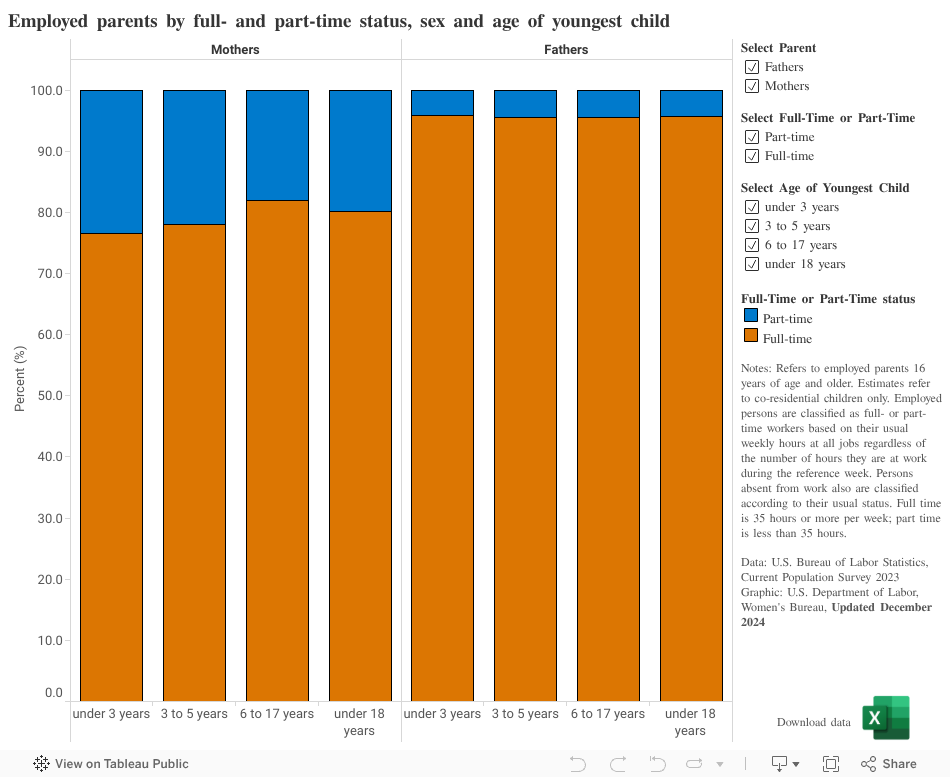
Employed parents by full-time and part-time status, sex and age of youngest child

Subscribe to Women's Bureau