


The FMLA entitles eligible employees of covered employers to take unpaid, job-protected leave for qualifying family and medical reasons and requires continuation of their group health benefits under the same terms and conditions as if the employee had not taken leave. Check with your State Labor Department to determine if you have additional or greater protections under state law.
What Does the FMLA Provide?
For eligible employees, up to 12 workweeks of leave in a 12-month period for any of the following qualifying reasons:
- The birth of a child and to care for the newborn child within one year of birth,
- The placement with the employee of a child for adoption or foster care and to care for the newly placed child within one year of placement,
- To care for the employee's spouse, child, or parent who has a serious health condition,
- A serious health condition that makes the employee unable to perform the functions of his or her job, and
- Any qualifying exigency arising out of the fact that the employee's spouse, son, daughter, or parent is a covered military member on covered active duty or call to covered active duty status.
An eligible employee who is the spouse, son, daughter, parent, or next of kin of a covered servicemember with a serious injury or illness may take up to 26 workweeks of leave during a single 12-month period to care for the servicemember.
Eligible employees may use FMLA leave intermittently or on a reduced schedule when medically necessary and for qualifying exigencies. An employee also may use FMLA leave intermittently or on a reduced leave schedule for bonding with a newborn or newly placed child when the employer and employee agree.
The FMLA applies to covered employers, which include:
- Private-sector employers who employ 50 or more employees in 20 or more workweeks in either the current calendar year or the previous calendar year,
- Public agencies (including federal, state, and local government employers), regardless of the number of employees, and
- Local educational agencies (including public school boards, public elementary and secondary schools, and private elementary and secondary schools), regardless of the number of employees.
Learn more about when two (or more) businesses may simultaneously employ an employee.
Employees are eligible if they:
- Work for a covered employer for at least 12 months,
- Have at least 1,250 hours of service with the employer during the 12 months before their FMLA leave starts, and
- Work at a location where the employer has at least 50 employees within 75 miles.
In determining employee eligibility, the Uniformed Services Employment and Reemployment Rights Act (USERRA) requires that a person reemployed under its provisions be given credit for months and hours of service he or she would have been employed but for the USERRA-covered service.
Airline flight crew employees have special hours of service eligibility requirements.
The FMLA provides job-protected leave from work for certain qualifying family and medical reasons.
An eligible employee may take up to 12 workweeks of leave in a 12-month period for:
- A serious health condition affecting the employee or the employee’s child, parent, or spouse,
- The birth, adoption, or foster care placement of a child,
- Qualifying exigencies when the employee’s child, parent, or spouse is on covered active duty or under an impending call to covered active duty.
An eligible employee may take up to 26 workweeks of military caregiver leave during a single 12-month period if the employee is the child, parent, spouse, or next of kin of a:
- Current servicemember with a serious injury or illness, or
- Covered veteran with a serious injury or illness.
Family Relationships under the FMLA
Child means a biological, adopted or foster child, stepchild, legal ward, or child of a person standing in loco parentis (in the role of a parent), who is either under age 18, or age 18 or older and incapable of self-care because of a mental or physical disability at the time that FMLA leave is to commence. For military family leave, the child of an eligible employee may be of any age.
Related resources:
Parent means a biological, adoptive, step or foster parent, or any other individual who stood in loco parentis (in the role of a parent) to the employee when the employee was a child. This term does not include parents-in-law.
Related resources:
Spouse means a husband or wife as defined or recognized in the state where the individual was married and includes a same-sex or common law marriage. Spouse also includes a husband or wife in a marriage that was validly entered into outside of the United States if the marriage could have been entered into in at least one state.
Next of kin, which only applies to military caregiver leave, is the nearest blood relative, other than the servicemember's spouse, parent, or child.
Eligible employees are entitled to up to 12 workweeks of leave in a 12-month period and up to 26 workweeks of military caregiver leave during a single 12-month period.
Employees may use FMLA leave in whole weeks, single days, hours, or in some cases less than an hour. When an employee takes FMLA leave for less than one full workweek, the amount of leave used is determined as a proportion of the employee's actual workweek. Only the amount of leave an employee actually takes from work may be counted against an employee's FMLA leave entitlement.
Related resources:
Special rules apply to:
- Airline flight crew employees regarding their entitlement and calculation of FMLA leave, and
- Instructional employees of public school boards or private elementary and secondary schools when using intermittent or reduced schedule FMLA leave, and when taking FMLA leave near the end of an academic term.
Using intermittent FMLA leave means taking FMLA leave periodically in separate blocks of time due to a single qualifying reason. Using reduced schedule FMLA leave means taking FMLA leave while working fewer hours per workweek or workday.
An eligible employee may take FMLA leave on an intermittent or reduced schedule basis when medically necessary for the:
- Employee's own or family member's serious health condition, and for the
- Care of a covered servicemember with a serious injury or illness.
An eligible employee may also use intermittent or reduced schedule leave for qualifying exigencies when a family member is on covered active duty or under an impending call to covered active duty.
An eligible employee may not take intermittent leave for the birth or placement of a child unless the employer agrees to the arrangement.
Information about the FMLA for employees:
WHD’s FMLA employee guide booklets and mini cards are designed to provide plain language answers to common questions about who can take FMLA leave and protections the FMLA provides.
- Need Time? The Employee's Guide to the Family and Medical Leave Act(PDF)
- Need Time? The Employee’s Guide to Military Family Leave (PDF)
- Guía del Empleado sobre el Permiso Familiar Militar (PDF) (español)
- Protections for Workers under the FMLA – Small Card (PDF)
- Military Family Leave – Small Card(PDF)
- Ausencia Para Familias de Militares – tarjeta pequeña (PDF) (español)
To request FMLA leave or find out if you qualify to take FMLA leave, employees must communicate with their employer about their leave needs.
Related resources:
Information about the FMLA for employers:
Covered employers are obligated to provide employees with general information about the FMLA, and to respond individually to employees who request leave with specific notices. Employers are required to provide FMLA leave where all requirements are met. Employers are also required to communicate with employees if, related to a leave request, the employer will require the employee to verify the need for leave with information from a third party, such as a health care provider.
Related resources:
The Employer’s Guide to the Family and Medical Leave Act is designed to provide employers with essential information about the FMLA, including information about employer obligations under the law and options available in administering FMLA leave.
Other resources for learning about the FMLA:
- Statute: 29 U.S.C. 2601, et. seq., the Family and Medical Leave Act
- Regulations: 29 CFR Part 825
- Field Operations Handbook: Chapter 39 (PDF)
FMLA Interpretive Guidance:
- FMLA Administrator Interpretations
- Opinion Letters from the Administrator
- Non-Administrator Opinion Letters
Field Assistance Bulletins:
Featured FMLA Resources
FMLA Forms

Employers may use WHD forms to inform employees of their rights and request certifications.
Employee Guide to Military Family Leave (PDF)

Read about qualifying exigency and military caregiver leave under the FMLA.


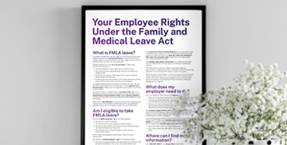

Order printed FMLA posters and guides for employers and employees.
Need help or more information?
- Find your local WHD office
- Submit a question online
- Call 1-866-487-9243 (toll-free)
- Sign up for WHD email updates
- Resolve FLSA and FMLA violations quickly and avoid litigation
Last updated on January 26, 2026.