


GENERAL QUESTIONS
- What is this rulemaking about?
- What is joint employment?
- What are the consequences of joint employment under the FLSA, FMLA, and MSPA?
- Why is joint employment important?
- What is the difference between "vertical" and "horizontal" joint employment?
- What is the need for this rulemaking?
- What are the policy goals of this rulemaking?
- Why is the Department proposing to revise its analysis for joint employer status in its current FMLA and MSPA regulations?
- Would the NPRM affect joint employer status under other laws?
- Why isn't the Department proposing to adopt a common law test for joint employer status?
- How can the public submit comments in response to the NPRM?
- I have questions about this rulemaking and/or joint employer status. Who should I contact?
QUESTIONS ABOUT THE NPRM
- Why does the NPRM propose separate analyses to assess horizontal and vertical joint employment?
- What analysis does the NPRM propose to assess horizontal joint employment?
- What analysis does the NPRM propose to assess vertical joint employment?
- What additional factors may be considered to assess vertical joint employment?
- Does the NPRM identify any factors which should not be considered in assessing joint employment?
- Is "reserved control" relevant in assessing vertical joint employment?
- Can indirect control be indicative of vertical joint employment?
- What does the NPRM advise about the relevance of business models or business practices?
- How is this NPRM different from the Department's 2020 Joint Employer Rule?
- What are the expected benefits?
GENERAL QUESTIONS
What is this rulemaking about?
On April 22, 2026, the Department announced an NPRM proposing to revise the Department's analysis for assessing joint employer status under the FLSA, FMLA, and MSPA. In general terms, the NPRM proposes to: (1) implement regulatory guidance for determining joint employer status under the FLSA at 29 CFR part 791; and (2) modify provisions in existing regulations implementing the FMLA and MSPA so that the proposed FLSA analysis would be used to determine joint employer status under those statutes too.
What is joint employment?
Joint employment occurs when two or more employers share legal responsibility for the same employee—i.e., where each employer is jointly and severally responsible for ensuring that the employee receives all the benefits and protections they are owed under the law.
Merely having multiple jobs does not establish that an employee is jointly employed by the employers that provide those jobs. Joint employment is also distinct from situations where an employee has jobs with nominally separate entities which are in fact a single entity and are thus a single employer responsible for ensuring the employee receives all the benefits and protections they are owed under the law with respect to all jobs worked for the employer. For there to be joint employment, each employer must exist as a separate entity.
What are the consequences of joint employment under the FLSA, FMLA, and MSPA?
Under the FLSA, joint employers are jointly and severally liable for any wages, damages, and relief owed to an employee, and the total number of hours the employee worked each week for all joint employers is used to determine the employee's entitlement to overtime pay.
Under the FMLA, an employee who is jointly employed by two or more employers must be counted by all joint employers in determining employer coverage and employee eligibility under the FMLA, though only an employee's "primary employer" is responsible for giving required notices to the employee, providing FMLA leave, and maintaining health benefits. Job restoration is primarily the responsibility of an employee's "primary employer," but in some cases a secondary employer may also be responsible for restoring the employee to the same or equivalent job upon an employee's return from FMLA leave.
Under MSPA, each joint employer must ensure that the employee receives all applicable employment-related rights granted by MSPA, such as accurate and timely disclosure of the terms and conditions of employment, written payroll records, and payment of wages when due.
Why is joint employment important?
When joint employment applies, all employers involved are jointly and severally liable for ensuring workers receive the correct wages and benefits. This is important because it ensures that employees receive all wages and benefits they are owed, even if one employer is unable or unwilling to pay.
Joint employment also affects how an employee's hours worked are counted when determining any overtime pay due. For example, if an employee works for two companies in the same week that jointly employ the employee, the total hours worked for both are considered when calculating whether the employee worked more than 40 hours in a workweek and is therefore entitled to premium pay.
Finally, joint employment liability can also deter child labor violations and help the Department hold businesses accountable when violations do occur.
Confusion and uncertainty over how joint employment is determined, on the other hand, can deter employers from engaging in business activities that directly benefit employees and consumers, including in industries with legitimate franchising or subcontracting arrangements. These benefits include anti-harassment and anti-discrimination policies, safety and health requirements, and other worker-focused practices.
What is the difference between "vertical" and "horizontal" joint employment?
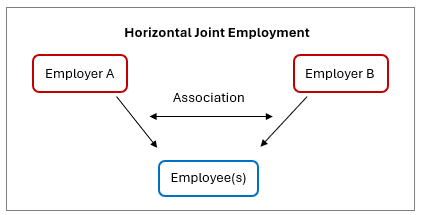
In "horizontal" joint employment relationships, an employee works separate hours for two (or more) employers in the same workweek, and the issue is whether the employers are sufficiently associated with respect to the employment of the employee to be deemed to jointly employ him/her. Typically, it is undisputed that each employer employs the employee for some hours worked, and if the employers are sufficiently associated with each other with respect to the employee, then they are joint employers and must aggregate all hours worked for them by the employee during the workweek to determine legal compliance.
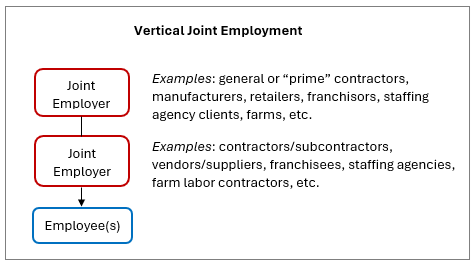
In "vertical" joint employment, an employee is jointly employed by two or more employers that simultaneously benefit from the employee's work. Typically, the employee works one set of hours and there is no dispute that the employee has at least one employer for the work. The issue is whether another person or entity that also benefits from the employee's work is the employee's joint employer. This scenario is described as "vertical" because it often centers around whether business partners that are either higher or lower than the other in a particular business structure—such as general contractors and subcontractors, franchisors and franchisees, or staffing agencies and their clients—are joint employers of the employee.
What is the need for this rulemaking?
As explained more fully in the NPRM, the Department believes that rulemaking is necessary to restore clarity and consistency regarding joint employer status under the FLSA, FMLA, and MSPA. The Department has not maintained generally-applicable regulatory guidance addressing FLSA joint employment since July 2021, when it rescinded its earlier FLSA joint employer regulation. The absence of such guidance has created uncertainty for businesses, workers, and courts, particularly in "vertical" scenarios where multiple entities are simultaneously benefiting from the same work performed by one or more workers. In such FLSA cases, the Department has been applying a vertical joint employment standard consistent with the judicial precedent that may apply in that case, which varies widely throughout the federal circuit courts of appeals. Meanwhile, the Department's existing FMLA and MSPA regulations articulate joint employment standards that are different from each other and from the FLSA standard that the Department is proposing to adopt—an outcome at odds with the understanding that the standard for determining joint employer status should align under all three laws, which share the same statutory definitions of employment. Finally, the Department believes that regulated entities would benefit from regulatory guidance about certain business models and business practices that, standing alone, would not make joint employer status more or less likely under the FLSA, FMLA, or MSPA.
What are the policy goals of this rulemaking?
With this rulemaking, the Department intends to: reduce confusion and uncertainty attributable to the absence of an FLSA joint employer regulation; ensure that DOL enforcement personnel apply the same joint employer analysis nationwide for all its FLSA, FMLA, and MSPA enforcement cases; help workers to better understand their rights and available remedies when employed by joint employers; help businesses by providing greater clarity, particularly by identifying certain general business models and business practices that do not make joint employer status more or less likely; and assist courts by promoting uniformity in the development of future judicial precedent.
Why is the Department proposing to revise its analysis for joint employer status in its current FMLA and MSPA regulations?
The FMLA and MSPA both incorporate the FLSA's broad definition of the term "employ." See 29 U.S.C. 2611(3) (FMLA); 29 U.S.C. 1802(5) (MSPA). Thus, the Department believes the analysis for assessing joint employer status should be the same under all three statutes—i.e., the analysis which applies under the FLSA. The Department's regulations do not currently reflect a single standard for these three statutes. Workers and businesses alike would benefit from the simplicity and certainty provided by aligning the joint employer analysis for all three statutes that use the same relevant statutory definition.
Would the NPRM affect joint employer status under other laws?
No. This rulemaking proposes to revise the Department's analysis for assessing joint employer status under only the FLSA, FMLA, and MSPA, which share the same statutory definitions of employment. For statutes that do not incorporate the FLSA's definitions, the Department applies other standards to assess joint employment. For example, the Department applies "the common law of agency" to assess joint employer status for temporary agricultural workers under the H-2A program. See 20 CFR 655.103(b).
This rulemaking also has no effect on the National Labor Relations Act (NLRA), which has different statutory employment definitions than the FLSA, the FMLA, and MSPA and is interpreted and enforced by the National Labor Relations Board (NLRB).
Finally, this rulemaking has no effect on state wage-and-hour laws. Businesses must comply with all federal, state, and local labor laws that apply and ensure that they are meeting whichever standard provides workers with the greatest protection. See 29 U.S.C. 218.
Why isn't the Department proposing to adopt a common law test for joint employer status?
Unlike other federal employment laws, the FLSA defines the term "employ" broadly as including "to suffer or permit to work." This language was derived from state child labor laws predating the FLSA that were designed to reach businesses that used middlemen to illegally hire and supervise children. Thus, federal courts have interpreted the FLSA's "suffer or permit" language as rejecting a common law test for employment, including for the purposes of joint employment. Adopting a common law standard to assess joint employer status under the FLSA (or, by extension, the FMLA or MSPA) would require Congress to pass amendatory legislation.
How can the public submit comments in response to the NPRM?
The Department encourages interested parties to submit comments on this proposal at www.regulations.gov. The NPRM's 60-day comment period closes at 11:59 pm ET on June 22, 2026. Commenters submitting file attachments on www.regulations.gov are advised that uploading text-recognized documents—i.e., documents in a native file format or documents which have undergone optical character recognition (OCR)—enable staff at the Department to more easily search and retrieve specific content included in your comment for consideration.
I have questions about this rulemaking and/or joint employer status. Who should I contact?
For questions about this NPRM, you may call the Wage and Hour Division's (WHD) Division of Regulations, Legislation, and Interpretation (DRLI) at (202) 693-0406. For questions about the joint employer status of a particular entity, please contact your nearest WHD District Office, as displayed at https://www.dol.gov/agencies/whd/contact/local-offices.
QUESTIONS ABOUT THE NPRM
Why does the NPRM propose separate analyses to assess horizontal and vertical joint employment?
The NPRM sets forth distinct standards for determining joint employer status in "horizontal" and "vertical" scenarios to maintain a distinction that courts and the Department have long drawn. As the NPRM explains, separate analyses for horizontal and vertical joint employment are necessary due to inherent differences between those business relationships.
For example, in a scenario involving potential horizontal joint employment, it is undisputed that an employee is employed by two or more employers for separate work hours; the relevant question is whether the employers are sufficiently associated with each other with respect to the employment of the employee to be deemed to jointly employ him/her. Here, focusing on the employee's relationship with each employer would not be probative of the relationship between the employers. Instead, analyzing the association (or lack thereof) between the employers is indicative of whether they jointly employ the employee and, therefore, must aggregate the hours worked by the employee for each of them.
By contrast, in a scenario of potential vertical joint employment, an employee performs work which simultaneously benefits two or more entities. Typically, the employee works one set of hours and there is no dispute that the employee has at least one employer for the work. Instead, the issue is whether the other entity that also benefits from the work is the employee's joint employer. Here, because entities in a vertically-structured industry—such as a general contractor and subcontractor, or a franchisor and franchisee—necessarily "associate" with each other to some degree over the work at issue, the analysis does not hinge on the employers' relationship with each other. Instead, the proper inquiry in a vertical joint employment case hinges on the employee's relationship with the other entity: whether, as a matter of economic reality, the employee is employed by both purported employers.
Thus, while a horizontal joint employment analysis appropriately focuses on the relationship between the employers, a vertical joint employment analysis appropriately focuses on the relationship between the employee and each potential joint employer.
What analysis does the NPRM propose to assess horizontal joint employment?
The NPRM proposes to advise that horizontal joint employment exists when separate employers are sufficiently associated with respect to the employment of the same employee. Employers will generally be sufficiently associated if:
- There is an arrangement between them to share the employee's services;
- One employer is acting directly or indirectly in the interest of the other employer in relation to the employee; or
- They share control of the employee, directly or indirectly, by reason of the fact that one employer controls, is controlled by, or is under common control with the other employer.
However, the NPRM proposes to clarify that business relationships which have little to do with the employment of specific employees—such as sharing a vendor or being franchisees of the same franchisor—are alone insufficient to establish joint employment.
This guidance reflects the Department's longstanding interpretation of horizontal joint employment as well as its current enforcement policy.
What analysis does the NPRM propose to assess vertical joint employment?
The NPRM proposes to adopt a four-factor analysis for use in every case of potential vertical joint employment, examining whether the potential joint employer:
- hires or fires the employee;
- supervises and controls the employee's work schedule or conditions of employment to a substantial degree;
- determines the employee's rate and method of payment; and
- maintains the employee's employment records.
The NPRM explains that additional factors may be relevant in assessing vertical joint employment, but that a unanimous finding on the four main factors in either direction would establish a "substantial likelihood" regarding whether an individual or entity is a joint employer.
What additional factors may be considered to assess vertical joint employment?
The NPRM proposes that additional factors may be considered to assess vertical joint employment, such as: whether a worker has a continuous or repeated relationship with the potential joint employer; whether the employee works at a location or facility that is owned or controlled by the potential joint employer; indicia of whether the potential joint employer exercises significant control over the terms and conditions of the employee's work; or indicia of whether the employee is economically dependent on the potential joint employer for work.
However, the NPRM proposes to advise that such additional factors are generally less relevant than the four factors proposed for use in every case. For example, the concept of economic dependence is typically more relevant in determining whether workers are employees in the first instance (as opposed to independent contractors), and some degree of economic dependency on the clients or business partners of an employer is true of all labor.
Does the NPRM identify any factors which should not be considered in assessing joint employment?
The NPRM proposes to exclude the consideration of three factors that are relevant only in assessing whether a worker is an employee or independent contractor:
- Whether the employee is in a job that otherwise requires special skill, initiative, judgment, or foresight;
- Whether the employee has the opportunity for profit or loss based on his or her managerial skill; and
- Whether the employee invests in equipment or materials required for work or the employment of helpers.
These three factors are relevant in determining whether a particular worker is an employee (as opposed to an independent contractor), but have no relevance in assessing whether a worker has two or more joint employers.
Is "reserved control" relevant in assessing vertical joint employment?
The NPRM proposes to advise that a potential joint employer's ability, power, or reserved right to act in relation to the employee is relevant for determining joint employer status, but the potential joint employer's actual exercise of control is more relevant than such ability, power, or right. For example, a potential joint employer's contractual authority to supervise, discipline, or fire employees is less relevant if in practice the potential joint employer never exercises such authority. This guidance is consistent with the judicial focus on "economic reality" when assessing joint employment under the FLSA, FMLA, and MSPA.
Can indirect control be indicative of vertical joint employment?
The NPRM proposes to advise that indirect control can be indicative of vertical joint employment when a potential joint employer issues mandatory directions to another employer that controls the employee. However, an employer's voluntary decision to grant a potential joint employer's request, recommendation, or suggestion does not constitute indirect control that can demonstrate joint employer status. Acts that incidentally impact the employee also do not indicate joint employer status.
What does the NPRM advise about the relevance of business models or business practices?
The NPRM proposes to clarify that certain general common business models and business practices, standing alone, do not categorically or in the abstract make joint employer status more or less likely under the FLSA, FMLA, or MSPA. These include:
- certain contractual agreements related to health, safety, or legal compliance, including anti-harassment policies, background checks, and workplace safety protocols;
- providing a sample employee handbook or other forms to another employer;
- offering an association health plan or association retirement plan to another employer or participating in such a plan with the employer;
- jointly participating in an apprenticeship program with another employer;
- operating as a franchisor or entering into a brand and supply agreement, or using a similar business model; and
- quality control standards to ensure the consistent quality of the work product, brand, or business reputation.
This proposed regulation would encourage parties to maintain certain basic—often best—business practices by providing greater clarity and confidence that such responsible behavior itself will not result in joint employer status. The Department notes that many of these identified business practices—such as basic anti-harassment policies, workplace safety measures, providing association health plans, sponsoring apprenticeship programs, etc.—are directly beneficial to workers.
How is this NPRM different from the Department's 2020 Joint Employer Rule?
Unlike the 2020 Rule, the NPRM proposes to amend provisions in the Department's FMLA and MSPA regulations to advise that joint employer status under those statutes would be determined using the Department's FLSA analysis. Broadening the scope of this rulemaking to ensure consistency between the FLSA, FMLA, and MSPA will bring greater clarity to workers and businesses, as well as the Department's enforcement personnel.
The NPRM's proposed analysis for assessing joint employment also differs from the guidance provided in the 2020 Rule in several important ways. For example, unlike the NPRM's proposed analysis, the 2020 Rule: (1) rejected the relevance of the term "employ" in section 3(g) of the FLSA; (2) rejected the relevance of "economic dependence" and related factors; (3) advised that an individual or entity "must actually exercise" one or more of the four factors to be a vertical joint employer; and (4) advised that a business' decision to allow another employer to operate on its premises does not make joint employer status more or less likely under the FLSA.
The Department has omitted these and other aspects of the 2020 Rule in an effort to improve the legal defensibility and influence on the courts of the proposed rule, which in turn would increase the likelihood that this rulemaking achieves the kinds of beneficial outcomes that motivated the 2020 Rule, such as promoting innovation and certainty in business relationships, reducing compliance costs for organizations operating in multiple jurisdictions, and reducing litigation.
What are the expected benefits?
The Department anticipates that the proposed rule would reduce compliance and litigation costs attributable to legal uncertainty about the current standard for joint employment, including misplaced hesitancy to enter into certain relationships or engage in certain kinds of business practices. Relatedly, clarifying the standard for determining joint employment as a general matter would encourage innovation and economic growth, as businesses would be more willing to invest in partnerships that enhance operational efficiency.
At the same time, the proposed rule would help workers to better understand their rights and available remedies, while enhancing the Department's ability to enforce the FLSA, FMLA, and MSPA in a consistent fashion. Finally, the proposed rule would benefit courts by giving them an informed analysis for assessing joint employment that is the product of public notice and comment, which could lead to greater uniformity in the courts as opposed to the currently fractured landscape among the federal circuit courts.