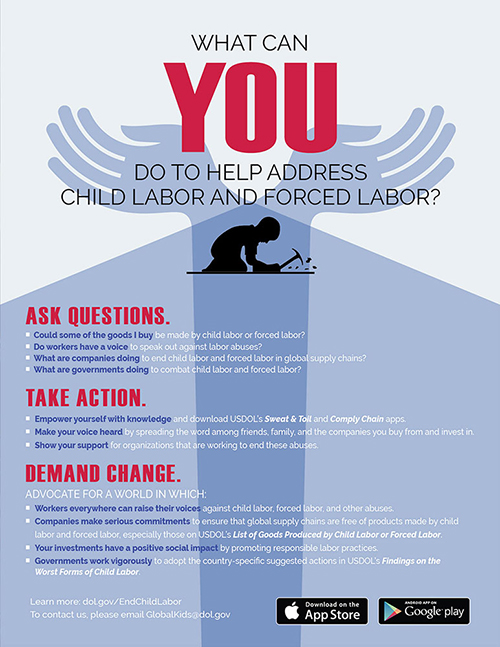
List of Goods Produced by Child Labor or Forced Labor
The Bureau of International Labor Affairs (ILAB) maintains a list of goods and their source countries which it has reason to believe are produced by child labor or forced labor in violation of international standards, as required under the Trafficking Victims Protection Reauthorization Act (TVPRA) of 2005 and subsequent reauthorizations. The List of Goods Produced by Child Labor or Forced Labor comprises 159 goods from 78 countries and areas, as of September 28, 2022.
ILAB maintains the List primarily to raise public awareness about forced labor and child labor around the world and to promote efforts to combat them; it is not intended to be punitive, but rather to serve as a catalyst for more strategic and focused coordination and collaboration among those working to address these problems.
Publication of the List has resulted in new opportunities for ILAB to engage with foreign governments to combat forced labor and child labor. It is also a valuable resource for researchers, advocacy organizations and companies wishing to carry out risk assessments and engage in due diligence on labor rights in their supply chains.


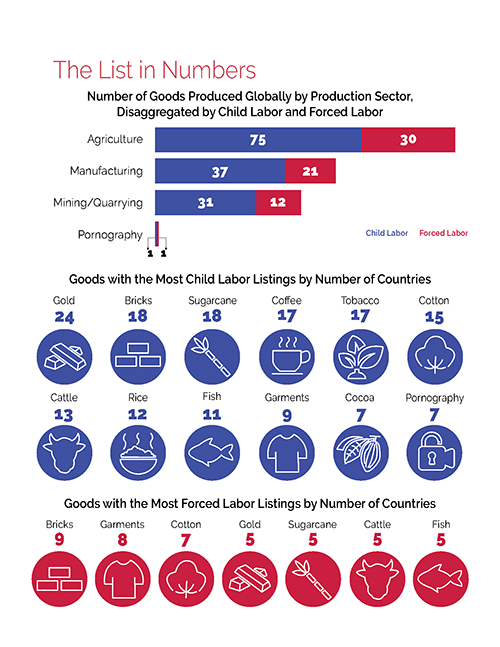
The countries on the List span every region of the world. The most common agricultural goods listed are sugarcane, cotton, coffee, tobacco, cattle, rice, and fish. In the manufacturing sector, bricks, garments, textiles, footwear, carpets, and fireworks appear most frequently. In mined or quarried goods, gold, coal and diamonds are most common.
ILAB published the initial TVPRA List in 2009 and updated it annually through 2014, following a set of procedural guidelines that were the product of an intensive public consultation process. ILAB now updates and publishes the List every other year, pursuant to changes in the law.
Procedural Guidelines
On January 25, 2024, ILAB's Office of Child Labor, Forced Labor, and Human Trafficking published Procedural Guidelines for the development and maintenance of the List of Goods from countries produced by child labor or forced labor in violation of international standards.
| Country/Area Sort descending | Good | Exploitation Type |
|---|---|---|
| Congo, Democratic Republic of the (DRC) | There are reports that children ages 5-17 are forced to work in the production of coltan, or tantalum ore, in some mines in the Democratic Republic of the Congo. Reports from the U.S. Department of State and NGOs state that many children have been identified working in conditions of forced labor in the mines in Eastern Congo, particularly in North and South Kivu. Some children are forced to work at the mines with their families in situations of bonded labor, while other children are sent away to the mines by their parents to pay off the family's debt. These children are paid little, if at all. In addition, many mines are controlled by military officers or armed groups, which are known to round up villagers, including children, at gunpoint and force them to work with threats of violence. These forcibly-recruited children do not have freedom of movement and do not receive payment for their work. |
Child Labor, Forced Labor |
| Congo, Democratic Republic of the (DRC) | Child Labor | |
| Congo, Democratic Republic of the (DRC) | There are reports that children ages 5-17 are forced to work in the production of cassiterite, or tin ore, in some mines in the Democratic Republic of the Congo. Reports from NGOs and the U.S. Department of State indicate that many children have been identified working in conditions of forced labor in the mines in Eastern Congo, particularly in North and South Kivu. Some children are forced to work at the mines with their families in situations of bonded labor, while other children are sent away to the mines by their parents to pay off the family's debt. These children are paid little, if at all. In addition, many mines are controlled by military officers or armed groups, which are known to round up villagers, including children, at gunpoint and force them to work with threats of violence. These forcibly-recruited children do not have freedom of movement and do not receive payment for their work. |
Child Labor, Forced Labor |
| Congo, Democratic Republic of the (DRC) | Child Labor | |
| Congo, Democratic Republic of the (DRC) | There are reports that children ages 5-17 are forced to work in the production of wolframite, or tungsten ore, in some mines in the Democratic Republic of the Congo. Based on estimates from NGOs and the U.S. Department of State, hundreds of children are working in conditions of forced labor in the mines in Eastern Congo, particularly in North and South Kivu. Some children are forced to work at the mines with their families in situations of bonded labor, while other children are sent away to the mines by their parents to pay off the family's debt. These children are paid little, if at all. In addition, many mines are controlled by military officers or armed groups, which are known to round up villagers, including children, at gunpoint and force them to work with threats of violence. These forcibly-recruited children do not have freedom of movement and do not receive payment for their work. |
Child Labor, Forced Labor |
| Congo, Democratic Republic of the (DRC) | There are reports that children ages 10-16 are forced to work in the production of gold in some mines in the Democratic Republic of the Congo. Based on the most recently available NGO evidence, thousands of children are working in conditions of forced labor in the mines in Eastern Congo, particularly in North and South Kivu. Some children are forced to work at the mines with their families in situations of bonded labor, while other children are sent away to the mines by their parents to pay off the family's debt. Child miners are paid little if at all. Many mines are controlled by military officers or armed groups which force children to work. Some children are abducted to work in the mines. |
Child Labor, Forced Labor |
| Congo, Democratic Republic of the (DRC) | Child Labor | |
| Costa Rica | Child Labor | |
| Costa Rica | There are reports that children ages 5 to 17 cultivate coffee in Costa Rica. Based on an analysis by international organizations of the Government of Costa Rica’s National Household Survey (ENAHO) 2011, published in 2015, 8.8 percent of child laborers in the country, or approximately 1,422 children ages 5-14, were in child labor in coffee production in Costa Rica. The ENAHO 2011 counts as child labor all work performed by a child below age 15. In addition, the analysis indicates that 5.2 percent of working adolescents ages 15 to 17, or 1,625 adolescents, were also engaged in coffee production. The analysis noted that 78 percent of children and adolescents in child labor in Costa Rica work with their families. Although more recent national surveys have shown a 65 percent decrease in the number of children ages 12 to 17 working in agriculture from 13,866 in 2011 to 4,853 in 2015, these surveys do not provide the number of children in child labor in the coffee sector. Data from the 2016 ENAHO, which included a child labor module, is expected to be released in early 2017. |
Child Labor |
| Côte d'Ivoire | There are reports that children ages 14-17 and younger in Côte d'Ivoire are forced to work on coffee plantations. Based on a research study, thousands of children are involved in this type of labor. Some children are forcibly recruited, or recruited through deceptive means, and transported to coffee plantations in Côte d'Ivoire from nearby countries including Benin, Mali, Togo, and Burkina Faso. These children are sold to traffickers. Other children leave their home countries or communities voluntarily, but end up in situations where they are not paid and have no means to return home. Some children are forced to work for three or four years before receiving payment or returning home. Others are forced to work, even if sick, and prevented from leaving the plantations through threat of physical violence, withheld payments, or denial of food. |
Child Labor, Forced Labor |
your hand? Download ILAB's Sweat & Toil App today!
Are you a company looking to fight child labor and forced labor in supply
chains?
Related
- Findings on the Worst Forms of Child Labor
- Executive Order 13126 List of Products Produced by Forced or Indentured Child Labor
- Against Their Will: The Situation in Xinjiang
Further Resources
- Supply Chain Storyboards
Previous TVPRA List of Goods Produced by Child Labor or Forced Labor
- 2020
- Full Report (PDF)
- Excel format (XLS)
- Bibliography (PDF)
- 2018
- Full Report (PDF)
- Excel format (XLS)
- Bibliography (PDF)
- 2016
- Full Report (PDF)
- Excel format (XLS)
- Bibliography (PDF)
- 2014
- Full report (PDF)
- Excel format (XLS)
- Bibliography (PDF)
- 2013
- Infographic (PDF)
- Excel format (XLS)
- Bibliography (PDF)
- 2012
- Full Report
- Bibliography (PDF)
- List in Excel Format (XLS)
- 2011
- Full Report
- Bibliography (PDF)
- List in Excel Format (XLS)
- 2010
- Full Report (PDF)
- Bibliography (PDF)
- List in Excel Format (CSV)
- 2009 Full Report (PDF)
Public Comments & Submissions
ILAB accepts public submissions for the TVPRA List on an ongoing basis, and reviews them as they are received. Submissions will continue to be taken into account as ILAB works to release periodic updates to the List. To submit information, please send an email to ILAB-TVPRA@dol.gov; fax to 202-693-4830; or mail to ILAB, U.S. Department of Labor, c/o OCFT Research and Policy Unit, 200 Constitution Ave NW, S-5315, Washington, DC 20210. View the list of submissions.
The List in Numbers
What You Can Do