


State Employee Ownership Programs (SEOPs) are state-funded initiatives that promote employee ownership. They are typically run by state agencies, universities, or nonprofits. SEOPs aim to educate the public and support businesses transitioning to employee ownership. Some offer grants or tax credits to facilitate that transition.
Why SEOPs matter: Through SEOPs, states help business owners plan for the future and give workers a path to ownership. These efforts keep local businesses open, protect jobs in the community, and give workers a financial stake in the success they help build.
Federal Support of SEOPs is now in place: The U.S. Department of Labor has established a Division of Employee Ownership within the Employee Benefits Security Administration (EBSA) to assist states in promoting employee ownership. This division consults with state officials considering or implementing employee ownership initiatives.
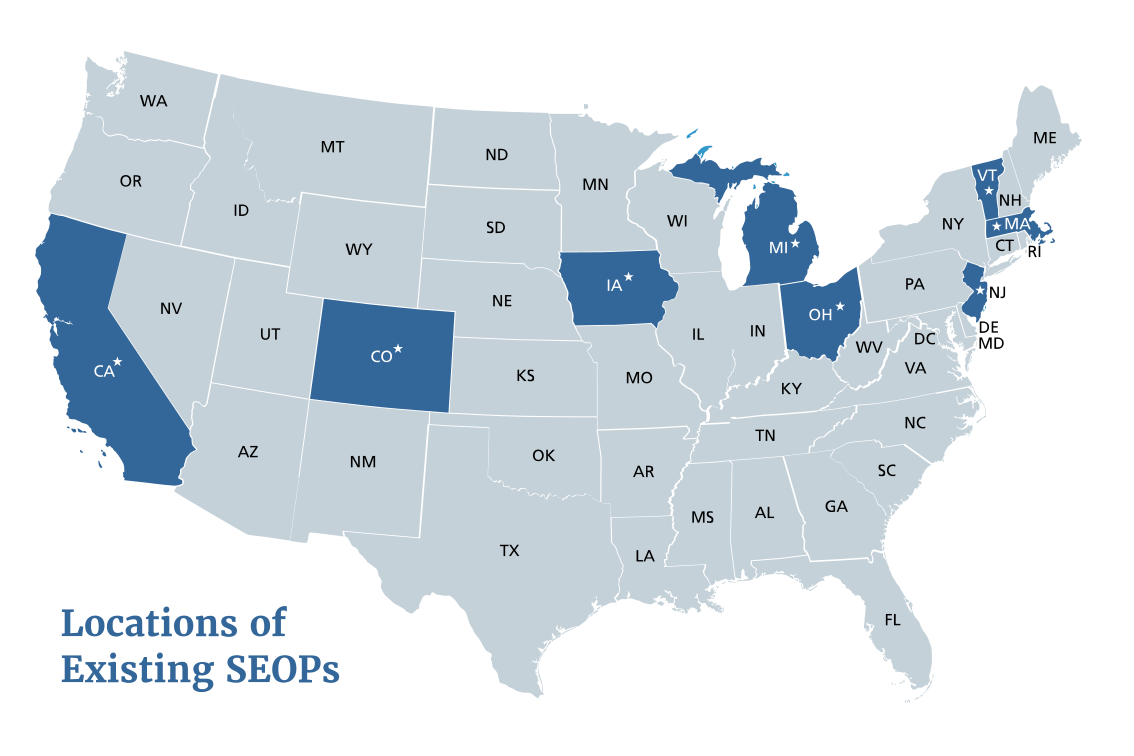
States Expanding Support for Employee Ownership: As of December 2025, at least eight states have state-funded employee ownership initiatives. These fall into three categories, with some states included in more than one:
- State agency programs: California, Colorado, Massachusetts, and Michigan house employee ownership efforts within state agencies.
- Centers at public universities: Iowa, New Jersey, and Ohio host employee ownership centers at their public universities.
- Nonprofits with state funding: California, Colorado, Michigan, New Jersey, and Vermont fund employee ownership education and technical assistance through grants or contracts.
Since 2019, these states and at least fifteen others have passed or considered employee ownership legislation, often with strong bipartisan support. These developments reflect growing interest in employee ownership across the country. In addition, about half of states have a nonprofit center for employee ownership, most of which do not receive state funding.
As interest in employee ownership grows, more states are actively promoting it. Common approaches include:
- Creating permanent employee ownership programs within state agencies, often in small business or economic development offices.
- Funding nonprofits or university-based centers to run education campaigns and provide technical assistance to businesses.
- Offering financial assistance to businesses transitioning to employee ownership through tax credits, grants, or reimbursements for professional services. This often begins with feasibility studies, which identify what’s needed for a successful transition.
State leaders know their communities best. But for states that are new to employee ownership, learning from others is a great way to start. The charts below show how eight states are putting different strategies into action to promote employee ownership.
California Employee Ownership Hub | In 2022, legislation created an Employee Ownership Hub within the California Office of the Small Business Advocate. The office developed an employee ownership webpage and provided a grant to the nonprofit Project Equity to provide technical assistance related to employee ownership. The Employee Ownership Hub has not received funding for dedicated staff or programs. |
Colorado Employee Ownership Office | In 2019, Colorado’s governor created the Colorado Employee Ownership Commission by executive order. The commission’s work paved the way for legislation that established employee ownership tax credits and a permanent employee ownership office in the state’s Office of Economic Development and International Trade. Over time, the state has expanded both the size and the eligible uses of the tax credits. |
Iowa Center for Employee Ownership | The University of Northern Iowa established the Iowa Center for Employee Ownership in 2023. The center conducts outreach statewide, hosts an annual employee ownership conference, and is working with the university to engage researchers and students. It also provides technical assistance to small and rural businesses to help them transition to employee ownership and guides larger firms through consultations and facilitations. |
Massachusetts Center for Employee Ownership | In 2022, the Economic Development bill established the Massachusetts Center for Employee Ownership, an office within the Massachusetts Office of Business Development, and created a 19-member advisory board. Going back to 1989, the state had intermittently funded external partners to deliver employee ownership programs, but this new phase makes the effort permanent. |
Michigan Employee Ownership Pilot Program | In July 2025, Michigan’s Department of Labor and Economic Opportunity announced a $500,000 pilot program to support employee ownership. Eighty percent of funds are designated for technical assistance to businesses exploring or transitioning to employee ownership. The rest is a grant to the nonprofit Michigan Center for Employee Ownership for outreach and program administration. |
New Jersey ESOP Assistance Program | The New Jersey Economic Development Authority launched a $2.7 million ESOP Assistance Program in 2024. The Rutgers University-based New Jersey/New York Center for Employee Ownership, which was established in 2017, provides outreach and education on all forms of employee ownership. New Jersey has also contracted with two firms to conduct ESOP feasibility studies for qualifying businesses. |
Ohio Employee Ownership Center | Founded in 1987, the Ohio Employee Ownership Center at Kent State University received state grants for many years, along with infrastructure support from the university. Today, with income from programs and philanthropy, the center conducts outreach and research; provides technical assistance to prospective employee-owned companies; and delivers programs including conferences and events, leadership roundtables, retreats for employee-owners, and training for ESOP fiduciaries. |
Vermont Employee Ownership Center | The Vermont Employee Ownership Center (VEOC) started in 2001 with support from local employee-owned businesses, and it has received funding from the state since the mid-2000s. It hosts an annual conference and provides technical assistance to businesses exploring or transitioning to employee ownership. VEOC currently gets about one third of its funding from the state’s Agency of Commerce and Community Development. |
One additional state, Washington, created an employee ownership program, tax credit, and commission in 2024, then de-funded these efforts in 2025. The program remains in statute and may be revived in the future.
From initial feasibility studies to training new employee-owners, employee ownership transitions can be expensive. To ease this burden, some states have created financial support programs through tax credits, grants, and cost reimbursements. The chart below highlights how these states are helping businesses offset transition costs at different stages
State programs that offset costs | Key features |
| Colorado provides two employee ownership tax credits. The “Establish or Expand” credit covers costs of implementing employee ownership for the first time or expanding the percent of a company that is employee-owned. Amounts: up to $150K for new ESOPs, $40K for new co-ops or EOTs, and $25K for new “alternative equity structures.” The “Strengthen and Thrive” credit gives up to $50k to support activities that are essential to the success and sustainability of employee ownership in the first seven years after the transition. |
|
| Iowa offers up to $25,000 in reimbursement to businesses for the cost of completing an ESOP feasibility study. |
|
| Michigan’s pilot program provides grants to help businesses assess whether employee ownership is a good fit. Grant amounts are flexible and evaluated on a case-by-case basis. |
|
| New Jersey’s ESOP Assistance Program provides up to $35,000 for professional services related to ESOP feasibility assessment. |
|
The federal government has supported forms of shared ownership since the nation’s founding. In the 1790s, Congress created an incentive to revive the cod fishing industry after the Revolutionary War. To qualify, ship captains had to share profits with their crew—an early example of broad-based profit sharing.
Modern employee ownership, as we know it today, has largely taken shape over the past 50 years. Private, nonprofit, and public sector actors have all played important roles. Below are some highlights of how federal and state governments have contributed.
- 1974: Congress passed the Employee Retirement Income Security Act, formally recognizing employee stock ownership plans (ESOPs) as qualified retirement plans with tax benefits.
- 1983: Several states passed laws to support employee buyouts aimed at preventing plant closures. Over time, states shifted their focus to encouraging transitions of thriving businesses to employee ownership.
- 1984 and 1986: The Tax Reform Acts of 1984 and 1986 introduced new incentives for employee ownership, including capital gains tax deferrals for business owners selling stock to an ESOP or qualified worker cooperative and favorable interest income exclusions for lenders financing ESOP transactions.
- 1987: Ohio launched the Ohio Employee Ownership Center, the first university-based SEOP, which received state funding for many years.
- 1990: The U.S. Department of Agriculture created the Rural Cooperative Development Grant program, which supports cooperative development centers, including those serving employee-owned cooperatives.
- 1996: New legislation allowed Sub-chapter S corporations to sponsor ESOPs, expanding employee ownership opportunities for small and closely held businesses.
- 2006: Vermont provided funding to the Vermont Employee Ownership Center, an independent nonprofit formed five years earlier. State funding for the center has continued until today, with modest increases over time.
- 2012: Iowa created its first state incentive for ESOPs. Nebraska and Missouri soon followed.
- 2018: Congress passed the Main Street Employee Ownership Act to expand education and lending access for employee ownership transitions, but it did not appropriate funding for implementation.
- 2019: Colorado established the Colorado Employee Ownership Commission by executive order and created an Employee Ownership Office on the Commission’s recommendation. Later legislation made the office permanent and created, then expanded, tax credits for business transitions to employee ownership across several eligible business models.
- 2022: California and Massachusetts passed bills creating employee ownership initiatives within state agencies. Maine enacted a law to encourage purchasing from employee-owned companies.
- 2022: The National Defense Authorization Act created a pilot program allowing the Department of Defense to renew contracts on a non-competitive basis with 100% employee-owned businesses. In 2024, the pilot program was extended through 2029.
- 2022: Congress passed the SECURE 2.0 Act of 2022, which included Worker Ownership, Readiness, and Knowledge (WORK) provisions to promote employee ownership and help both workers and employers understand the options available.
- 2023: The U.S. Department of Labor launched its Employee Ownership Initiative to fulfill the WORK Act.
- 2023: A new Minnesota law set up a Community Wealth Building Loan Fund that supports employee-owned businesses.
- 2023: Legislation established the Washington State Employee Ownership Program and Commission and a tax credit to support conversion costs for ESOPs, EOTs, and co-ops. The tax credit was reversed through a new law in 2025, and the Employee Ownership Program went dormant due to budget constraints but remains in statute.
- 2024: A new North Carolina law enabled employee-owned businesses to access procurement programs for historically underutilized businesses (HUBs).
- 2025: Michigan’s economic development arm joined New Jersey’s in making grants to support businesses’ EO transition costs, alongside funding for education and outreach. Oregon passed a law giving a 5% preference in state procurement to majority employee-owned businesses.