


Child Labor and Forced Labor Reports
Gambia, The
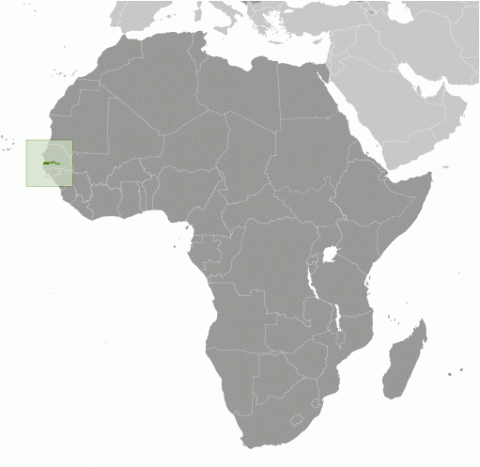

Moderate Advancement
In 2024, The Gambia made moderate advancement in efforts to eliminate the worst forms of child labor. The government established a shelter specifically dedicated to survivors of human trafficking, which can house up to 12 survivors. The government also launched the National Development Plan 2023–2027, which focuses on education access; child protection from violence and abuse; and prevention, combat, and eradication of trafficking in persons. In addition, National Assembly members received trainings on children’s rights and integrating those rights in future policy development. However, despite these efforts, gaps remain in the country’s legal framework. Laws do not explicitly specify at what age basic education begins or how many years it should last. Additionally, a current policy mandates school attendance only until the age of 16 which makes children ages 16 and 17 vulnerable to child labor, as they are not required to attend school but are not legally permitted to work since the minimum age for work is set at 18. Reports also show that the National Coordination Committee on Child Labor is mostly inactive. Finally, insufficient human and financial resource allocation hindered the labor inspectorate’s ability to fulfill its mandate.
| Children | Age | Percent and Population |
|---|---|---|
| Working | 5 to 14 | 23.0% (154,677) |
| Boys | 23.2% | |
| Girls | 22.9% | |
| Urban | 9.7% | |
| Rural | 38.5% | |
| Hazardous Work by Children | 15 to 17 | 5.4% (9,275) |
| Boys | 7.7% | |
| Girls | 3.4% | |
| Urban | 3.8% | |
| Rural | 7.8% | |
| Attending School | 5 to 14 | 72.0% |
| Combining Work and School | 7 to 14 | 17.8% |
| Sector/Industry | Percent of Population |
|---|---|
| Agriculture | 86.3% |
| Industry | 8.0% |
| Services | 5.7% |
| Sector/Industry | Activity |
|---|---|
| Agriculture | Farming, including protecting crops against animals. |
| Industry | Working in carpentry, masonry, sewing, plumbing, and in metal welding workshops.† |
| Services | Domestic work and street work, including begging and vending. Scavenging at dump sites, markets, and car parks. Working as attendants to commercial vehicles in the transportation sector, and working as auto mechanics.† |
| Categorical Worst Forms of Child Labor‡ | Commercial sexual exploitation, sometimes as a result of human trafficking. Forced begging by Koranic teachers. Forced labor in domestic work, farming, and street vending. |
† Determined by national law or regulation as hazardous and, as such, relevant to Article 3(d) of ILO C. 182.
‡ Child labor understood as the worst forms of child labor per se under Article 3(a)–(c) of ILO C. 182.
Children at Higher Risk
The Gambia is considered a place of origin, transit, and destination for trafficking in persons. Senegalese children trafficked to The Gambia are exploited for domestic labor, fishing, and street work such as begging or shoe shining. Both Gambian children and children from nearby West African countries, in particular Nigeria, are at risk of commercial sexual exploitation, sometimes as a result of human trafficking, as sexual tourism is reported to be on the rise. Research finds that poverty sometimes leads parents to encourage their child to seek relationships with tourists for financial gain. Finally, children from West African countries born in The Gambia are at risk of statelessness, as Gambian law only grants citizenship to children with a Gambian parent and not to all children born in the country. Individuals without birth registrations, especially children of single mothers and those in rural areas, are vulnerable to exploitation, including child labor. Reports indicate that child labor is predominant in rural areas, and most particularly in the cities of Mansakonko, Kuntaur, and Janjanbureh.
Barriers to Education Access
Unequal access to educational resources and opportunities has been a barrier to accessing education in The Gambia. Even though Gambian legislation mandates free compulsory primary and lower-secondary education, existing fees, such as for supplies, books, uniforms, and exams, impact school enrollment rates. As reported, these extra costs and cultural norms often lead parents to prioritize the education of boys over girls. In addition, the scarcity of funding for schools has also been an issue, with a lack of equipment, poor infrastructure, a lack of reliable water supply and sanitary toilet facilities, and inadequate classrooms. Research also found that low salaries for teachers cause absenteeism and a shortage of teachers. Children with disabilities and children living in rural areas are particularly affected and face problems of overcrowded classrooms, limited facilities, and a lack of transportation. Finally, beginning in grade four, teachers are required to teach in English, which can limit learning for students who speak local languages.
| Standard | Age | Meets International Standards | Legislation |
|---|---|---|---|
| Minimum Age for Work | 18 | ✓ | Articles 2 and 54 of the Labor Act |
| Minimum Age for Hazardous Work | 18 | ✓ | Articles 2 and 44 of the Children’s Act; Articles 55 and 59 of the Labor Act |
| Identification of Hazardous Occupations or Activities Prohibited for Children | ✓ | Articles 42, 44, and 45 of the Children’s Act | |
| Prohibition of Slavery, Debt Bondage, and Forced Labor | ✓ | Article 20 of the Constitution; Articles 2, 39–41, 47, and 58 of the Children’s Act; Articles 2 and 28 of the Trafficking in Persons Act | |
| Prohibition of Child Trafficking | ✓ | Articles 2, 30, and 39 of the Children’s Act; Articles 2, 28, 29, 38(c), and 56 of the Trafficking in Persons Act; Article 13 of the Tourism Offenses Act | |
| Prohibition of Commercial Sexual Exploitation of Children | ✓ | Articles 26, 29–32, and 34 of the Children’s Act; Articles 7–9 of the Tourism Offenses Act | |
| Prohibition of Using Children in Illicit Activities | ✓ | Articles 31 and 37 of the Children’s Act | |
| Minimum Age for Voluntary State Military Recruitment | 18 | ✓ | Article 59 of the Children’s Act |
| Prohibition of Compulsory Recruitment of Children by (State) Military | ✓ | Article 59 of the Children’s Act | |
| Prohibition of Military Recruitment by Non-state Armed Groups | ✓ | Article 31(c) of the Children’s Act | |
| Compulsory Education Age | ✗ | Article 18 of the Children’s Act | |
| Free Public Education | ✓ | Article 30 of the Constitution; Article 18 of the Children’s Act |
The Gambia permits children as young as age 16 to engage in light work, and children as young as age 12 to work as child apprentices in the informal sector. While the Children’s Act generally prohibits children from working in conditions that would be harmful to their health, education, or development, the Act does not determine the activities in which light work or apprenticeships may be permitted, prescribe the number of hours per week for light work or apprenticeships, or specify the conditions in which light work or apprenticeships may be undertaken. The Children’s Act provides for compulsory basic education. However, the law does not explicitly specify at what age basic education begins or how many years basic education lasts. In addition, while children in The Gambia are required to attend school up to age 16 based on current policy, this standard makes children ages 16 and 17 vulnerable to child labor, as they are not required to attend school but are not legally permitted to work.
| Organization/Agency | Role & Activities |
|---|
| Department of Labor: Receives complaints about child labor. Conducts labor inspections in the formal sector, mediates disputes between employers and labor representatives, and refers serious cases to the labor courts and the Industrial Tribunal. The Inspectorate Unit is understaffed and lacks resources such as vehicles that inhibit carrying out routine inspections. |
| Children’s Court: Adjudicates criminal, civil, and care and protection cases involving children. Coordinates with social welfare officers from the Department of Social Welfare for the referral and care of children. |
| Overview of Enforcement Efforts | 2024 |
|---|---|
| Has a Labor Inspectorate | Yes |
| Able to Assess Civil Penalties | Yes |
| Routinely Conducted Worksite Inspections | Yes |
| Unannounced Inspections Permitted | Yes |
| Has a Complaint Mechanism | Yes |
| Imposed Penalties for Child Labor Violations | No |
| Conducted Criminal Investigations for Worst Forms of Child Labor Crimes | Yes |
| Imposed Penalties for Worst Forms of Child Labor Crimes | Yes |
In 2024, 5 labor inspectors conducted an unknown number of worksite inspections, finding 0 child labor violations. The government also conducted 9 investigations into suspected cases of the worst forms of child labor, initiated 9 prosecutions, and convicted 1 perpetrator.
| Coordinating Body | Role & Activities |
|---|
| National Coordination Committee on Child Labor: Coordinates child labor enforcement processes, including prosecutions of the worst forms of child labor. Led by the Department of Social Welfare and supported by UNICEF, comprises representatives from the Department of Labor, UNICEF, the Department of Social Welfare, the National Agency Against Trafficking in Persons (NAATIP), Action Aid, the Ministry of Basic and Secondary Education, the Gambia Teachers Union, Young People in the Media, and the Inspector General of Police. Research reports that no activities were undertaken due to a lack of funding and ineffective coordination. |
| Policy | Description & Activities |
|---|
| National Action Plan Against Trafficking in Persons (2021–2025): Directs governmental efforts to address human trafficking. Includes strategies to improve legal framework, training of law enforcement and social services personnel, prevention and awareness, and protection for human trafficking survivors. In 2024, a shelter specifically dedicated to survivors of trafficking, regardless of the individual circumstances or status, was established. The shelter, which can house up to 12 persons, is run and maintained by NAATIP, and 2 social workers from the Department of Social Welfare are present to provide additional support and counseling services to survivors, in addition to the weekly counseling services offered to support their healing and reintegration into society. During the reporting period, NAATIP also provided training for shelter staff on improving the quantity and quality of services for survivors of trafficking. |
| National Development Plan 2023–2027: Charts the recovery of The Gambia from natural disasters and other shocks. The plan is a successor to the lapsed National Development Plan 2018–2021/22 developed under the leadership of the Ministry of Finance and Economic Affairs. Among the priorities it establishes are equal access to education; promotion of child protection from violence and abuse and security of the rights of vulnerable and marginalized children; and prevention, combat, and eradication of trafficking in persons. Adopted in 2023, it was launched in February 2024. |
| Code of Conduct of The Gambia Tourism Authority for the Protection of Children: Raises awareness of commercial sexual exploitation of children in the tourism industry and among tourists. Research was unable to determine whether activities were undertaken to implement the Code of Conduct of The Gambia Tourism Authority for the Protection of Children during the reporting period. |
† The government had other policies that may have addressed child labor issues or had an impact on child labor.
| Program | Description & Activities |
|---|
| Blue Heart Campaign:‡ NAATIP program, in partnership with the UN Office on Drugs and Crime, to provide support for trafficking in persons survivors, including children. Research could not determine what actions were taken to implement this program during the reporting period. |
| Zero Out of School Project: Three-year project helps identify and enroll all primary school-age children who are not in school and provides services to help children enroll at the right time and stay in school. During the reporting period, the project built disability-friendly latrines in schools, and provided some children with cash transfers, bicycles, and supplies. The Gambian National Assembly and UNICEF also discussed mechanisms to further enhance social protection mechanisms and the welfare of children. |
| Support Project for the Protection of Children Victims of Violations of their Rights (PAPEV): Implemented by the Ministry of Gender and financed by the Italian Agency for Development Cooperation through the Office of the UN High Commissioner for Human Rights, and a grant to the Economic Community of West African States to support and strengthen reception services for child survivors of human rights violations. PAPEV partners with the Ministry of Women, Children and Social Welfare for concerted efforts to protect and safeguard the rights of children in The Gambia. During the reporting period, the first Committee Steering Meeting was held, during which Phase II of the project was launched. During Phase I, PAPEV has supported the maintenance of child centers and provided material and equipment to ensure quality care of children in the care centers. |
‡ Program is funded by the Government of The Gambia.
† The government had other programs that may have addressed child labor issues or had an impact on child labor.
| Area | Suggested Action |
|---|---|
| Legal Framework | Ensure that the law’s light work and child apprenticeship provisions specify the activities and conditions in which work may be undertaken and prescribe the number of hours per week such work may be undertaken. |
| Establish by law a compulsory education age of 18 years old to align with the minimum age for work, which is 18 years. | |
| Enforcement | Ensure that agencies responsible for criminal law enforcement—including the Children’s Court—are active and have adequate staff, funding, and resources (including vehicles) to fulfill their mandates. |
| Implement a digital tracking system for civil worst forms of child labor inspections. | |
| Publish information on labor inspectorate funding and the number of child labor penalties imposed that were collected. | |
| Strengthen the labor inspectorate by initiating routine inspections in all sectors rather than performing inspections solely based on complaints received and at formal registered worksites, and ensure that these inspections target sectors in which child labor is known to occur, including in private homes and on farms. | |
| Increase the number of labor inspectors from 5 to 17 to ensure adequate coverage of the labor force of approximately 666,000 people, and ensure that labor inspectors receive adequate training and sufficient funding and resources to fulfil their mandate, including vehicles and fuel. | |
| Provide criminal law enforcement officers with training that covers all worst forms of child labor, including commercial sexual exploitation, forced labor, and the use of children in illicit activity. Also, provide sufficient material resources and capacity building for prosecutors, law enforcement officers, and judges to streamline the handling of trafficking in persons cases in their daily work. | |
| Impose and apply criminal penalties for the worst forms of child labor consistently to deter violations. | |
| Coordination | Provide sufficient funding to the National Coordination Committee on Child Labor so that it is active and able to carry out its intended mandate of coordinating child labor enforcement processes, including prosecutions of the worst forms of child labor. |
| Government Policies | Implement the Code of Conduct of The Gambia Tourism Authority for the Protection of Children and publish results from activities implemented each reporting period. Ensure that adequate funding and resources are allocated to implement policies. |
| Adopt a policy that addresses all relevant worst forms of child labor, such as commercial sexual exploitation of children. | |
| Provide public copies of the Pre-Departure Training Manual to provide individuals traveling for work purposes with information on the process. | |
| Social Programs | Enhance opportunities for children to access education by providing adequate classroom facilities, clean water, and sanitation; ensuring accessibility for students with disabilities; increasing the number of teachers in rural areas; and ensuring that language barriers do not limit instruction. Ensure that students receive consistent instruction by providing support to teachers to decrease absenteeism and remove barriers to education by subsidizing or defraying the cost of supplies, uniforms, transportation, and other fees, so that children can complete education through high school. |
| Ensure that activities are undertaken to implement the Blue Heart Campaign and make information about implementation measures publicly available. | |
| Expand existing social programs to address the full scope of the child labor problem, including all worst forms of child labor. Specifically, ensure that social programs address children in agriculture, domestic work, commercial sexual exploitation, forced begging, and street work. | |
| Develop programs to increase protections for and provide assistance to the most vulnerable groups of children, including those from low-income families, rural areas, children without birth registration, and children from West African countries. |