


Child Labor and Forced Labor Reports
Sierra Leone








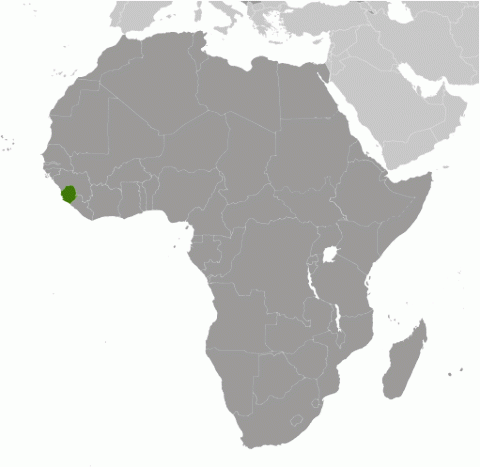

Moderate Advancement
In 2024, Sierra Leone made moderate advancement in efforts to eliminate the worst forms of child labor. The government enacted the Prohibition of Child Marriage Act 2024, which establishes age 18 as the minimum age for marriage without exception and empowers designated officials to raise awareness about the risks of child marriage, which include reduced educational attainment and increased risk of child labor for both boys and girls. Criminal enforcement officials received specialized trainings on the Anti-Human Trafficking and Migrant Smuggling Act and the National Referral Mechanism for victim identification and protection. The multi-stakeholder Anti-Trafficking in Persons Task Force adopted a new National Action Plan Against Trafficking in Persons Especially Women and Children for 2024–2028. The government also held stakeholder engagements in child-trafficking and child labor hotspots, educating community members about anti-trafficking laws, the National Referral Mechanism and how to use it, and best practices for victim identification, referral, assistance, and protection. Finally, authorities expanded services to two additional shelters for trafficking victims outside the capital, in the districts of Kambia and Bo. Although the government made meaningful efforts in all relevant areas during the reporting period, the education law does not provide free basic education, which does not meet international standards, and enforcement authorities did not impose any penalties on or obtain any convictions of individuals or entities subjecting children to any of the worst forms of child labor. Gaps also remain in interagency coordination and data sharing on child labor, and Sierra Leone lacks policies to address all relevant worst forms of child labor, including commercial sexual exploitation, mining, and quarrying.
| Children | Age | Percent and Population |
|---|---|---|
| Working | 5 to 14 | 35.1% (Unavailable) |
| Hazardous Work by Children | 15 to 17 | Unavailable |
| Attending School | 5 to 14 | 78.2% |
| Combining Work and School | 7 to 14 | 32.2% |
| Sector/Industry | Activity |
|---|---|
| Agriculture | Working in agriculture, including cultivating palm fruit, cocoa, and coffee, and processing harvested produce. Fishing,† including artisanal fishing. Forestry, including working in logging. |
| Industry | Mining,† including for diamonds. Quarrying† and crushing stone, including granite, and shoveling gravel. Construction, including housing construction and serving as laborers for contractors. Working in manufacturing.† |
| Services | Scavenging scrap metals and recyclable materials from dumpsites. Domestic work and street work, including begging, trading, and selling goods. Portering, including carrying heavy loads.† Working as apprentices, including in auto repair shops, and on transportation vehicles, including minibuses and motorbike taxis. |
| Categorical Worst Forms of Child Labor‡ | Forced begging. Forced domestic work. Commercial sexual exploitation, sometimes as a result of human trafficking. Forced labor in street hawking, quarrying, mining (including for alluvial diamonds), rock breaking, agriculture, scavenging for scrap metal, and motorbike taxi driving. Use in illicit activities, including the cultivation and trafficking of drugs. |
† Determined by national law or regulation as hazardous and, as such, relevant to Article 3(d) of ILO C. 182.
‡ Child labor understood as the worst forms of child labor per se under Article 3(a)–(c) of ILO C. 182.
Children at Higher Risk
Children in men pikin arrangements face heightened risk of labor exploitation in Sierra Leone. Men pikin is a Krio term for foster care, in which family members send children to relatives in urban areas with promises of better educational opportunities. However, some children are instead subjected to forced labor by their host families. Unhoused children and children living with disabilities also face increased risk of exploitation in street begging. In addition, children sent to Koranic schools face heightened risks of labor trafficking.
Barriers to Education Access
Over the past several years, the government has implemented significant initiatives to make education free through secondary school and improve access for girls and children with disabilities. While primary enrollment has increased, barriers to access remain, including indirect costs (food, uniforms, supplies), illegitimate fees charged by schools, a lack of teachers and secondary schools, insufficient transportation for rural students, a lack of adequate facilities and teachers for children with disabilities, and violence (both physical and sexual) perpetrated by teachers and other students.
| Standard | Age | Meets International Standards | Legislation |
|---|---|---|---|
| Minimum Age for Work | 15 | ✓ | Sections 125, 129, and 131 of the Child Rights Act; Section 95 of the Employment Act |
| Minimum Age for Hazardous Work | 18 | ✓ | Sections 126, 128, and 131 of the Child Rights Act; Section 175 of the Mines and Minerals Development Act |
| Identification of Hazardous Occupations or Activities Prohibited for Children | ✓ | Sections 128 and 131 of the Child Rights Act | |
| Prohibition of Slavery, Debt Bondage, and Forced Labor | ✓ | Sections 1 and 12–14 of the Anti-Human Trafficking and Migrant Smuggling Act; Section 19 of the Constitution of Sierra Leone | |
| Prohibition of Child Trafficking | ✓ | Sections 1, 12–14, and 17 of the Anti-Human Trafficking and Migrant Smuggling Act | |
| Prohibition of Commercial Sexual Exploitation of Children | ✓ | Sections 1, 12–14, and 17–19 of the Anti-Human Trafficking and Migrant Smuggling Act; Sections 26–34 of the 2012 Sexual Offenses Act | |
| Prohibition of Using Children in Illicit Activities | ✓ | Sections 7 and 13 of the National Drugs Control Act | |
| Minimum Age for Voluntary State Military Recruitment | 18 | ✓ | Section 28 of the Child Rights Act |
| Prohibition of Compulsory Recruitment of Children by (State) Military | ✓* | Section 28 of the Child Rights Act | |
| Prohibition of Military Recruitment by Non-state Armed Groups | ✓ | Sections 1 and 12 of the Anti-Human Trafficking and Migrant Smuggling Act | |
| Compulsory Education Age | 15 | ✓ | Section 125 of the Child Rights Act; Section 24 of the Basic and Senior Secondary Education Act |
| Free Public Education | ✗ | Sections 1 and 22(2) of the Basic and Senior Secondary Education Act |
* Country has no conscription
On July 1, 2024, the government enacted the Prohibition of Child Marriage Act 2024, after extensive engagement by civil society and support from the First Lady of Sierra Leone. The law establishes age 18 as the minimum age for marriage without exception and extends the same prohibition to cohabitation with a child. It empowers dedicated Ministry of Gender and Children's Affairs officials to sensitize communities about the risks of child marriage, which include, among others, reduced educational attainment for both boys and girls. Both the current Child Rights Act and the draft Child Rights Act 2024 set the minimum age for light work at age 13, but they do not limit the number of hours per week for light work, determine the activities in which light work may be permitted, or specify the conditions in which light work may be undertaken, which is not in compliance with international standards. In addition, the list of hazardous occupations prohibited for children does not cover scavenging at dumpsites, an activity for which there is evidence that children in Sierra Leone are exposed to hazardous medical waste. Finally, the Basic and Senior Secondary Education Act of 2023 does not guarantee free basic education.
| Organization/Agency | Role & Activities |
|---|
| Ministry of Employment, Labor and Social Security (MELSS): Through its Occupational Safety and Health/Child Labor Unit, formulates, implements, and monitors compliance with child labor regulations. Enforces labor laws in the formal sector via its District Labor Officers. Local-level District Councils handle enforcement of child labor laws in the informal sector. Currently working to put in place a Labor Market Information System intended to serve as an online labor violation information hub and complaint mechanism. Insufficient training and allocation of financial, human, and material resources hindered its efforts to enforce child labor laws. |
| Sierra Leone Police: Investigate child labor crimes through their Family Support Unit. Through the Transnational Organized Crime Unit, enforce human trafficking laws and provide statistical data and general information on cases of human trafficking. Refer cases for legal advice and prosecution to the Ministry of Justice's Director of Public Prosecution. Work with the Ministry of Social Welfare and the Ministry of Gender and Children's Affairs to identify cases and coordinate services for victims. However, even when police forces have identified suspected perpetrators of child labor crimes, gaps in coordination with and follow-through by investigators and prosecutors have prevented successful prosecution of the alleged crimes. |
| Overview of Enforcement Efforts | 2024 |
|---|---|
| Has a Labor Inspectorate | Yes |
| Able to Assess Civil Penalties | Yes |
| Routinely Conducted Worksite Inspections | Yes |
| Unannounced Inspections Permitted | Yes |
| Has a Complaint Mechanism | Yes |
| Imposed Penalties for Child Labor Violations | No |
| Conducted Criminal Investigations for Worst Forms of Child Labor Crimes | Yes |
| Imposed Penalties for Worst Forms of Child Labor Crimes | No |
In 2024, 28 labor inspectors conducted 340 worksite inspections, finding an unknown number of child labor violations. The government conducted 14‡ investigations into suspected worst forms of child labor crimes, initiated an unknown‡ number of prosecutions, and convicted 0‡ perpetrators.
‡ Data are for the period January to September 2024.
| Coordinating Body | Role & Activities |
|---|
| National Technical Steering Committee on Child Labor: Coordinates efforts to address child labor. Led by MELSS, with representatives from the Ministry of Social Welfare, the Ministry of Gender and Children's Affairs, the National Commission for Children, the Sierra Leone Police Family Support Unit, the Ministry of Basic and Senior Secondary Education, the Ministry of Health and Sanitation, international organizations, and civil society organizations. Meets quarterly to advise on policies related to child labor. In 2024, the steering committee advised the government to empower and fund child labor programs and enforcement. |
| Policy | Description & Activities |
|---|
| National Action Plan for the Elimination of the Worst Forms of Child Labor, Including Child Trafficking (2022–2026): Outlines actions to be taken to close gaps in national and community-level legal frameworks, expand access to education, increase social protection for the most vulnerable households, strengthen systems and coordination across the country, and provide services to victims and survivors. However, insufficient financial and human resources limited the government's ability to implement the action plan. |
| National Action Plan Against Trafficking in Persons Especially Women and Children (2024–2028):* Developed by the Anti-Trafficking in Persons Task Force Secretariat with the support of the International Organization for Migration (IOM) and officially launched in July 2024. Details specific actions to be taken to meet objectives in seven strategic areas: public awareness raising, stakeholder capacity building, livelihood and income support for vulnerable populations, victim services, criminal investigations, prosecutions and convictions, and data collection for policy formulation and programming. Includes a monitoring framework to support stakeholders in tracking progress toward targets. During the reporting period, community awareness-raising activities were conducted in human trafficking hotspots, including Waterloo, and new communications channels were created on social media to share anti-trafficking information with the public. |
| National Migration Policy: Rights-centered policy established by the government with support from the EU, IOM, and the United States Department of State. Makes specific reference to trafficking survivors, asylum seekers, and children. Also seeks to increase public awareness of human trafficking and build the capacity of law enforcement personnel to detect and prevent trafficking, especially child trafficking. Over several weeks in April, the Anti-Trafficking in Persons Secretariat and IOM held stakeholder engagements in key border districts of Kono, educating community members about the Anti-Human Trafficking and Migrant Smuggling Act, the National Referral Mechanism and how to use it, and best practices for victim identification, referral, assistance, and protection. |
* Policy was approved during the reporting period.
† The government had other policies that may have addressed child labor issues or had an impact on child labor.
| Program | Description & Activities |
|---|
| Child Trafficking Shelters:‡ Provide accommodation and care to survivors of forced labor and human trafficking, including mental health services, trauma-informed care, family tracing, and reintegration assistance. In addition to funding the Freetown shelter operated by World Hope International, in 2024 the government expanded services to a shelter in Kambia district and another in Bo district, each with capacity for approximately 30 people, many of whom are children. However, shelter space remained insufficient to accommodate all victims in need, especially male victims. |
| Free Quality School Education Program:‡ A Ministry of Basic and Senior Secondary Education program intended to cover the costs of school tuition and fees and provide meals, textbooks, and some teaching materials in remote communities. Allocates over 20 percent of the country's budget to education. During the reporting period, the government trained pre-primary and early-grade teachers and reintegrated 3,079 out-of-school adolescent girls into formal education with support from UN agencies, and with funding from the World Bank it developed a training program for 8,037 primary school teachers focused on student literacy. However, the subsidies paid to government and government-assisted schools through this program reportedly do not cover all costs, and some families are still required to pay fees. |
| School Feeding Program:‡ Ministry of Agriculture and Food Security program that supplies a combination of home-grown crops and partner-donated foods to schools. Aims to provide free, nutritious meals to schoolchildren to increase school attendance and improve academic performance. In 2024, reached over 500,000 students across the country. |
‡ Program is funded by the Government of Sierra Leone.
† The government had other social programs that may have included the goal of eliminating or preventing child labor.
| Area | Suggested Action |
|---|---|
| Legal Framework | Ensure that the light work provisions in the Child Rights Act and the Employment Act specify the number of hours, activities, and conditions in which light work may be undertaken. |
| Ensure that hazardous work occupations prohibited for children are comprehensive, including by prohibiting scavenging at dumpsites. | |
| Ensure that free basic public education is guaranteed by law for all children in Sierra Leone. | |
| Enforcement | Provide the labor inspectorate with regular training and sufficient financial, material, and human resources to adequately enforce child labor laws, including in the informal sector, aiming to increase the number of labor inspectors from 28 to at least 70 to ensure adequate coverage of the labor force of approximately 2.8 million people. |
| Collect and publish complete information on labor law enforcement efforts, including the number and type of inspections conducted, the number of violations found, and the penalties imposed and collected. | |
| Impose penalties on individuals or entities employing children against the law, including in the informal sector and in hazardous activities such as mining. | |
| Ensure that unannounced inspections are conducted, and cease the practice of informing employers ahead of time. | |
| Ensure that complaint mechanisms for the public to report suspected cases of child labor and the worst forms of child labor are operational and well known. | |
| Institutionalize training for criminal law enforcement personnel, including police, investigators, prosecutors, judges, and chiefs, to ensure that worst forms of child labor violations are adequately investigated and prosecuted. | |
| Improve criminal law enforcement data collection and sharing between the Sierra Leone Police, the Director of Public Prosecution, and border and immigration authorities to better track and prosecute the worst forms of child labor crimes, including forced domestic labor, forced begging, and commercial sexual exploitation. | |
| Increase efforts to prosecute and convict perpetrators of the worst forms of child labor, including forced begging, other forms of forced child labor, and commercial sexual exploitation, to hold offenders accountable, build trust in the judicial system, and serve as a deterrent to future offenders. | |
| Coordination | Ensure that village-level and chiefdom-level Child Welfare Committees are established and operational in all districts. |
| Improve interagency coordination to ensure that child labor violations identified by any stakeholder across government and civil society are properly monitored and victims are referred to appropriate services. | |
| Government Policies | Adopt policies to address the worst forms of child labor in all relevant sectors, including mining, quarrying, and commercial sexual exploitation. |
| Implement actions detailed in the National Action Plan for the Elimination of the Worst Forms of Child Labor, and send periodic reports to the Ministry of Labor on activities and outcomes. | |
| Social Programs | Remove barriers to education by reducing school-related costs, providing transportation to schools in rural areas, increasing the number of teachers and secondary schools, improving facilities for students with disabilities, and eliminating abuse, including sexual and other violence perpetrated by teachers and other students. |
| Increase the availability of and funding for shelters and safe houses for survivors of forced labor and children removed from street work. | |
| Institute programs to address child labor in agriculture, domestic work, and street work. | |
| Create public outreach and education campaigns to provide youth and their families with more information on their rights, responsibilities, and risks in relation to men pikin (foster care) arrangements. |