


Child Labor and Forced Labor Reports
Pakistan




















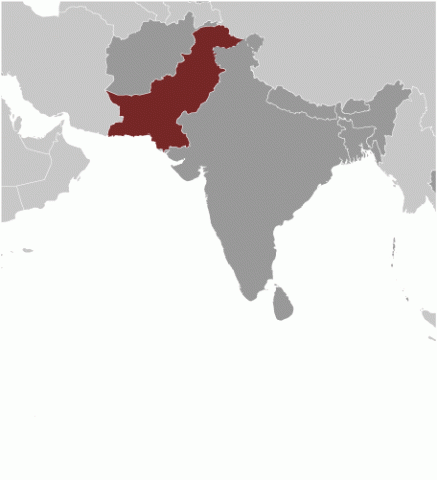

Moderate Advancement
In 2024, Pakistan made moderate advancement in efforts to eliminate the worst forms of child labor. From April 2023 to October 2024, Pakistani authorities investigated 2,688 suspects and convicted 805 human trafficking offenders. Between February and November 2024, the Pakistan Railway Police rescued and reunited 684 children with their legal guardians and welfare institutions. The Federal Investigation Agency also conducted several anti-trafficking trainings involving police, social welfare departments, and child protection authorities, and a new forced and bonded labor unit was stood up in Balochistan. However, Pakistan's federal and provincial laws do not meet international standards for the minimum age for work or hazardous work, as they both do not extend to all children in the country. In addition, neither the country's federal nor provincial laws prohibit the use of children in illicit activities, provincial labor inspectorates lack sufficient human and financial resources, and national enforcement data are unavailable. Finally, police corruption, particularly the taking of bribes from suspected perpetrators to ignore child labor crimes, and a lack of willingness to conduct criminal investigations, hindered Pakistan's ability to address child labor throughout the country.
| Children | Age | Percent and Population |
|---|---|---|
| Working | 10 to 14 | 9.8% (2,261,704) |
| Hazardous Work by Children | 15 to 17 | Unavailable |
| Attending School | 10 to 14 | 78.0% |
| Combining Work and School | 10 to 14 | 0.8% |
| Sector/Industry | Percent of Population |
|---|---|
| Agriculture | 69.4% |
| Industry | 10.9% |
| Services | 19.7% |
| Sector/Industry | Activity |
|---|---|
| Agriculture | Farming, including planting, harvesting, and tending crops such as sugarcane, wheat, and rice. Fishing, including deep-sea fishing,† sorting, and peeling fish. Livestock farming, including raising bovines. |
| Industry | Manufacturing glass bangles,† electronics, and surgical instruments.† Weaving carpets,† producing garments and textiles, and tanning leather.† Producing furniture, bricks, baked goods, and dairy products. Mining coal.† Construction. |
| Services | Domestic work. Working in hotels, wedding venues, food stalls, small shops, restaurants, and gas stations. Automobile repair and shoe shining. Scavenging† and sorting garbage and recyclables, begging, and street vending. |
| Categorical Worst Forms of Child Labor‡ | Forced labor in brickmaking, carpet weaving, fishing, and coal mining. Forced domestic work. Commercial sexual exploitation, sometimes as a result of human trafficking. Forced begging. Recruitment of children by non-state armed groups for use in armed conflict. Use in illicit activities, including the trafficking and production of drugs. |
† Determined by national law or regulation as hazardous and, as such, relevant to Article 3(d) of ILO C. 182.
‡ Child labor understood as the worst forms of child labor per se under Article 3(a)–(c) of ILO C. 182.
Children at Higher Risk
Some children from Pakistan are kidnapped or sold into organized begging rings, domestic servitude, gangs, and sex trafficking in Iran. Traffickers also force Afghan, Iranian, and Pakistani children into drug trafficking, drug and contraband production, and smuggling of goods in the border areas. Natural disasters have increased Pakistani children's vulnerability to child labor. Stateless children, many of whom are ethnic Bengali born in Pakistan, as well as Afghan and Rohingya children, are vulnerable to child labor in the fishing industry near coastal areas due to a lack of identity documents that limits their access to government services. Afghan children may engage in scavenging, whereas Pakistani children with disabilities are used for begging, exposing them to criminal organizations. Moreover, non-state armed groups reportedly kidnap children as young as age 12, coerce parents with threats to turn over their children, and recruit children forcibly from madrassas—Islamic religious schools—to spy, fight, and carry out suicide attacks.
Barriers to Education Access
The Federal Ministry of Education has estimated that 26 million children in Pakistan were out of school in 2024. Insufficient internet coverage in rural areas, especially in the merged tribal districts of the former Federally Administered Tribal Areas, hampers children's access to learning. Many other children, including those with disabilities and experiencing poverty, face barriers to education, including societal stigma, inadequate and inaccessible facilities, a lack of trained teachers and transportation, school fees, corporal punishment, and sexual abuse, all of which may deter them from attending school. Children from minority ethnic groups, including native speakers of Sindhi, Pashto, Saraiki, Balochi, and others, have difficulty accessing education, which is offered in Urdu and English. Non-Muslim and Ahmadi Muslims are sometimes denied enrollment in schools because of their religious identity. Stateless children, including ethnic Bengali children born in Pakistan and some Afghan and Rohingya children, cannot access school due to lack of identity documents. Sexual abuse of children in madrassas is also of significant concern. Reports suggested that 230,000 children in Sindh lost access to schools due to monsoon flooding during the reporting period.
| Standard | Age | Meets International Standards | Legislation |
|---|---|---|---|
| Minimum Age for Work | 14 | ✗ | Sections 3 and 11 of the Road Transport Workers Ordinance; Sections 1–3, 6–9, and 14 of the Pakistan Employment of Children Act |
| Minimum Age for Hazardous Work | 14 | ✗ | Sections 2 and 3 of the Employment of Children Act |
| Identification of Hazardous Occupations or Activities Prohibited for Children | ✓ | Parts 1 and 2 of the Schedule of the Employment of Children Act | |
| Prohibition of Slavery, Debt Bondage, and Forced Labor | ✓ | Sections 2, 3, 4, and 7 of the Prevention of Trafficking in Persons Act; Sections 2, 4, 11–12 of the Bonded Labor System (Abolition) Act; Sections 367, 370, and 374 of the Penal Code | |
| Prohibition of Child Trafficking | ✓ | Sections 2–4, and 7 of the Prevention of Trafficking in Persons Act; Sections 366A, 366B, 370, 371, 371A, and 371B of the Penal Code | |
| Prohibition of Commercial Sexual Exploitation of Children | ✓ | Sections 366A, 366B, 371A, 371B, and 377A-B of the Penal Code; Sections 2–4, and 7 of the Prevention of Trafficking in Persons Act | |
| Prohibition of Using Children in Illicit Activities | ✗ | ||
| Minimum Age for Voluntary State Military Recruitment | 16 | ✗ | |
| Prohibition of Compulsory Recruitment of Children by (State) Military | N/A | ||
| Prohibition of Military Recruitment by Non-state Armed Groups | ✗ | ||
| Compulsory Education Age | 16 | ✓ | Section 3 of the Right to Free and Compulsory Education Act |
| Free Public Education | ✓ | Section 3 of the Right to Free and Compulsory Education Act |
In March 2025, Pakistan ratified three key labor-related international standards, including the ILO Protocol of 2014 to the Forced Labor Convention, 1930, the Maritime Labor Convention, as amended (MLC, 2006), and the Labor Statistics Convention, 1985 (No. 160), strengthening labor protection for workers in Pakistan, including minimum age for children. In February 2025, the Pakistan National Assembly passed two bills to strengthen human trafficking laws in the country, the Prevention of Trafficking in Persons (Amendment) Bill, 2025 and the Prevention of Smuggling of Migrants (Amendment) Bill, 2025, but they have not yet been assented to by the President and are therefore not in effect. The Prevention of Trafficking in Persons (Amendment) Act 2025 would increase penalties for trafficking in persons and add “organized beggary” to the list of crimes related to trafficking.
The Employment of Children Act does not set a minimum age for light work and sets the minimum age for hazardous work at just age 14. Other than prohibiting hazardous work, the Employment of Children Act does not specify the activities school-age children may undertake; children under age 14 are permitted to work up to 7 hours a day, including a rest hour, for up to 6 days per week, which is not in accordance with international standards limiting light work for children under age 15 to 14 hours per week; and provisions do not specify conditions of light work so as not to prejudice attendance at school. The minimum age for work is age 14, which is younger than the compulsory education age of 16. The federal and Khyber Pakhtunkhwa and Sindh provincial minimum age for work laws do not extend to work outside of establishments, such as domestic work. In addition, the minimum age for hazardous work at the federal level and in Balochistan Province is less than age 18, which does not meet international standards. While the federal government and the four provinces have identified hazardous occupations and activities for children, hazardous work prohibitions do not cover brickmaking, for which there is evidence that children are exposed to environmental health hazards, or child domestic work, for which there is evidence that children are exposed to physical abuse. Punjab limits domestic work for children ages 15 to 18 to part-time work that is not likely to harm their health, safety, and education, but does not prevent children under age 18 from engaging in this work. Although laws in Khyber Pakhtunkhwa, Punjab, and Sindh Provinces prohibit children under age 18 from working in underground mines or above-ground quarries, federal law—which also applies in Balochistan—does not prohibit children ages 15 to 18 from working in mines, and there is evidence that children in Balochistan are engaged in coal mining, in which they are exposed to hazardous substances, underground work, and lethal accidents.
Research was unable to locate laws explicitly establishing a minimum age for voluntary state military recruitment or prohibiting the compulsory recruitment of children by the state military, though Pakistan currently does not have military conscription. The federal and provincial governments in Balochistan and Khyber Pakhtunkhwa have not enacted laws that prohibit the recruitment and use of children in armed conflict by non-state groups. In addition, federal and provincial laws in Balochistan and Khyber Pakhtunkhwa Provinces do not prohibit the use of children in illicit drug production and drug trafficking. Moreover, as the minimum age for work is lower than the compulsory education age, children may be encouraged to leave school before the completion of compulsory education.
| Organization/Agency | Role & Activities |
|---|
| Provincial and Regional Labor and Criminal Law Enforcement Agencies: Pakistan's provinces are responsible for enforcing labor laws. Provincial labor inspectors inspect industrial areas and markets to identify child labor violations, pursue legal action against employers, collect enforcement data at the district level, and refer children taken into custody to Child Protection Officers. Provincial labor courts assess penalties for labor violations. In addition, provincial and regional police enforce violations of federal and provincial criminal laws concerning child labor. |
| Federal Investigation Agency, Anti-Trafficking Unit: Operates under the Ministry of Interior and enforces transnational human trafficking-related laws, particularly the Prevention of Trafficking in Persons Act. Oversees the implementation of the National Action Plan to Combat Human Trafficking and Migrant Smuggling (2021–2025) and publishes an "Annual Red Book" of the government's most wanted human traffickers and smugglers. In 2024, the Federal Investigation Agency conducted in-person and online trainings on anti trafficking-in-persons standard operating procedures with police, social welfare and labor departments, and child protection bureaus. The Federal Investigation Agency also collaborated with the UN's International Organization of Migration to provide training on identifying, screening, and referring victims of human trafficking, including child labor victims. In November 2024, the agency organized trainings with Interpol's Anti-Crime Division on commercial child sexual exploitation. |
| Overview of Enforcement Efforts | 2024 |
|---|---|
| Has a Labor Inspectorate | Yes |
| Able to Assess Civil Penalties | Yes |
| Routinely Conducted Worksite Inspections | Yes |
| Unannounced Inspections Permitted | Yes |
| Has a Complaint Mechanism | Yes |
| Imposed Penalties for Child Labor Violations | Unknown |
| Conducted Criminal Investigations for Worst Forms of Child Labor Crimes | Yes |
| Imposed Penalties for Worst Forms of Child Labor Crimes | Unknown |
In 2024, it is unknown how many labor inspectors conducted worksite inspections or whether child labor violations were found at the federal level or in Balochistan and Khyber Pakhtunkhwa provinces. It is also unknown how many investigations into suspected child labor crimes were conducted, prosecutions were initiated, or perpetrators were convicted either at the national or provincial levels. However, Punjab inspectors conducted 82,000 child labor inspections under the Punjab Restriction on Employment of Children Act and 5,700 inspections under the Punjab Prohibition of Child Labor at Brick Kiln Act 2016, finding 1,209 violations, including 511 child labor violations, filing 1,565 First Investigation Reports, and making 441 arrests. The Sindh Labor Department reported it has 128 inspectors, conducted 50,000 inspections, and initiated 120 cases of child labor violations in court. However, research could not determine the number of prosecutions initiated based on the First Investigation Reports, arrests, or results of court cases.
| Coordinating Body | Role & Activities |
|---|
| Child Coordination Bodies: Provincial Child Protection Units coordinate interventions at the provincial level; take into custody at-risk children, including those rescued from exploitative labor situations; provide case management services; and present cases to the Child Protection Court or other authorities. There are 14 Child Protection Units in Balochistan, Sindh, and Khyber Pakhtunkhwa, with additional Child Protection Units in Punjab. However, district-level Child Protection Units have remained unstaffed and non-functioning in 15 of the 36 provincial districts during the reporting period. In addition, Pakistan has several provincial child protection commissions, bureaus, and authorities in each province with different mandates related to enhancing safety and rights of children, such as Child Protection and Welfare Bureaus (CPWBs) and Child Protection Institutes. In 2024, CPWBs took custody of more than 844 children, providing them with temporary shelter and taking steps to reunite them with family members; research was unable to determine how many of the rescued children were survivors of child labor. CPWBs also organized 6 awareness walks, 14 seminars, 140 awareness sessions, and an unknown number of campaigns. The National Commission on the Rights of the Child (NCRC) examines the existing legislation, administrative instruments, and proposals related to child rights to make appropriate recommendations for effective implementation. In 2024, NCRC launched a policy brief on child trafficking in Pakistan. |
| Policy | Description & Activities |
|---|
| Khyber Pakhtunkhwa Labor Policy: Seeks to eradicate child labor, collect child labor statistics, enforce the compulsory education law, assist children through referral mechanisms, and educate families and other stakeholders about the negative effects of child labor. In January 2024, the Khyber Pakhtunkhwa Labor Department released the results of its 2022–2023 child labor survey, which showed that 9 percent of the children in the province were engaged in child labor. In some areas of the province, the percent of working children was close to 30 percent. |
| Punjab Labor Policy: Seeks to improve working conditions; eradicate child and bonded labor, including in brick kilns; and establish social safety nets for workers and their families. Implemented by independent monitoring groups that include members of government, police, and civil society and are responsible for carrying out inspections, victim identification, and rehabilitation of survivors. In 2024, the Punjab Labor Department held awareness and special campaigns to address child labor. The Punjab government released the findings of its latest Child Labor Survey in early 2025. However, reports suggest that the survey, which was conducted in 2019–2020, contains outdated information. |
| Sindh Labor Policy: Seeks to protect vulnerable workers by enforcing hazardous child labor laws, extending the minimum age for employment to domestic and home-based work, ensuring minimum wages for working children, and increasing access to education and training. In 2024, the Sindh government continued drafting the child labor survey results for the province. |
| Program | Description & Activities |
|---|
| Bait-ul-Mal Programs for Rehabilitation of Child Labor:‡ Aim to remove children from child labor and increase access to education. During the reporting period, Schools for the Rehabilitation of Child Labor enrolled over 17,000 children in 159 schools. The schools have served over 45,000 students since the program's inception. |
| Hotlines: Ministry of Human Rights-operated helpline for reporting human rights violations, including child labor, and for providing referrals to legal aid and a network of NGOs. The ministry also operates the Zainab Alert mobile application, used by district police stations to track missing children and child labor cases. In 2024, this application received over 5,000 complaints, including reports of child labor. The Federal Investigation Agency also operates a 24/7 hotline to address human trafficking. The Khyber Pakhtunkhwa government has a dedicated helpline for child protection and labor issues. Punjab Labor Department's 1314 helpline helps eradicate child, bonded, and forced labor. Since its launch in 2023, it has received approximately 2,000 complaints and has resolved 1,800 cases. In the last 5 years, the Sindh Protection Authority's 1121 Child Helpline addressed 6,780 child protection cases while assisting 30 child protection units across the province. |
‡ Program is funded by the Government of Pakistan.
| Area | Suggested Action |
|---|---|
| Legal Framework | Institute a minimum age for light work of at least 12 years old and determine the activities in which light work may be permitted; limit light work for children to less than 14 hours per week; and specify the conditions in which light work may be undertaken so as not to prejudice children's school attendance. Raise the minimum age for work from age 14 to age 16 to align with the compulsory education age. Ensure that the minimum age provisions apply to all children in all sectors, including informal work, work outside of commercial establishments, and work at small establishments. |
| Prohibit the employment of children under age 18 in hazardous work. Ensure that hazardous work lists applicable to all provinces prohibit children under age 18 from working in brickmaking, mining, and domestic work. | |
| Criminally prohibit the use of children in illicit activities, including the production and trafficking of drugs, at the federal level and in Balochistan and Khyber Pakhtunkhwa Provinces. | |
| Criminally prohibit the recruitment and use of children under age 18 by non-state groups, including at the federal level and in Khyber Pakhtunkhwa and Balochistan Provinces. | |
| Ensure that the law establishes age 16 as the minimum age for voluntary recruitment by the state military with safeguards for voluntariness, in accordance with international standards. | |
| Enforcement | Increase the number of labor inspectors to 5,462 to ensure adequate coverage of the labor force of 81.9 million people, and ensure that provincial labor inspectorates have enough financial and human resources to conduct training and inspections, including funding for travel outside of major cities. |
| Ensure that labor inspectors receive adequate training on regional child labor laws, including laws pertaining to minimum age, and that these laws are adequately enforced. | |
| Ensure that law enforcement authorities have adequate training, guidance, and resources to enforce recently passed trafficking laws such as Prevention of Trafficking in Persons (Amendment) Bill, 2025 and the Prevention of Smuggling of Migrants (Amendment) Bill, 2025. | |
| Create a centralized repository for enforcement data and a mechanism for reporting enforcement data, including information about funding for provincial labor inspectorates; the number of labor inspectors, worksite inspections conducted, child labor violations found, and unannounced inspections conducted; and whether penalties were imposed and collected. | |
| Conduct unannounced inspections in the formal and informal sectors and increase enforcement and inspections of sectors in which child labor is found at a higher rate, including agriculture, brick kilns, mining, street work, fishing, and the textile and garment industry. Hold accountable individuals preventing labor inspectors from accessing worksites; and allocate adequate funding for training and provide labor inspectors with regular training on child labor issues. | |
| Ensure that criminal law enforcement agencies have adequate human and financial resources and training to carry out investigations and prosecute perpetrators. Publish information about investigations conducted, prosecutions initiated, convictions achieved, and sentences imposed. | |
| End police corruption, particularly the taking of bribes from suspected perpetrators to ignore alleged human trafficking crimes and not to pursue criminal cases against released bonded laborers. | |
| Investigate, prosecute, and, when appropriate, convict and sentence members of non-state armed groups complicit in facilitating child labor, including the recruitment of children and those who employ bonded laborers and ensure that survivors are protected from retaliation. | |
| Coordination | Establish an adequate coordination mechanism between different federal and provincial departmental coordinating bodies, including a standard referral mechanism, between law enforcement and social services. |
| Establish an adequate number of Child Protection Units in all provinces and ensure that they receive sufficient human and financial resources. Additionally, ensure that the Child Protection Welfare Commissions are adequately staffed. | |
| Social Programs | Improve and expand existing programs to address the scope of Pakistan's child labor problem, including providing adequate protection and rehabilitation services for child domestic workers, bonded child laborers, children working and begging in the streets, children involved in drug trafficking, and other children working in the informal sector. |
| Ensure that workers, including workers in rural areas, can formally register their employment with the government and access social welfare benefits under provincial laws, and expand existing programs to address the prevalence of child labor in sectors in which children are known to work in high numbers, such as in agriculture, domestic work, brick manufacturing, glass bangle manufacturing, carpet weaving, leather tanning, fishing, transportation, auto repair, gas stations, hotels and restaurants, truck loading, and deep-sea fishing. | |
| Provide rehabilitation and reintegration services for children who were kidnapped or forcibly recruited to join Islamic religious schools. | |
| Accurately collect data on commercial sexual exploitation of children and establish programs that ensure children are protected from sexual abuse in schools and workplaces, especially in madrassas, transportation, restaurant industries, and deep-sea fishing, and children working along the Pakistan-Afghanistan border. | |
| Ensure that all children, regardless of background, have access to free and compulsory education, as required by law, by implementing programs to address teacher absenteeism, inadequate facilities, school fees, lack of transportation, lack of classes in minority languages, unreliable internet access in rural areas—especially in the former Federally Administered Tribal Areas and in Khyber Pakhtunkhwa Province—and the use of corporal punishment. |