


Child Labor and Forced Labor Reports
Nicaragua








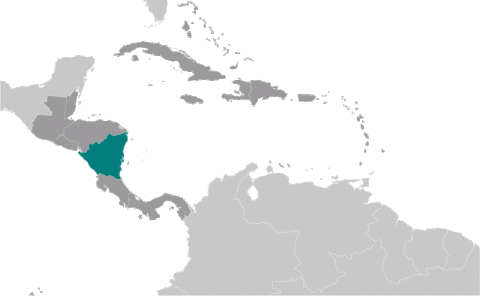

Minimal Advancement – Efforts Made but Continued Practice that Delayed Advancement
In 2024, Nicaragua made minimal advancement in efforts to eliminate the worst forms of child labor. The government implemented the National Strategy for Education in all its Modalities 2024–2026. The plan includes 16 lines of action, including promoting the integration of children with disabilities and children living in remote rural areas into the education system. However, Nicaragua is assessed as having made only minimal advancement, because the government continues to impede the work of civil society organizations, including those that provide social services to child labor survivors and those that work to address the root causes of child labor, and forcibly close and expropriate assets of thousands of organizations deemed in opposition to the government. The government also withholds official data which could help better understand the breadth of child labor, readdress resources, and define public and private efforts to combat the problem. In addition, the country's laws do not establish a clear compulsory education age, and the government lacks adequate services for human trafficking survivors, such as shelters. Further, labor and criminal law enforcement agencies also lack the financial and human resources necessary to fulfill their mandates with regard to child labor. Lastly, the government does not have a specific and consistent mechanism to coordinate efforts to address child labor.
| Children | Age | Percent and Population |
|---|---|---|
| Working | 10 to 14 | 47.7% (342,076) |
| Hazardous Work by Children | 15 to 17 | Unavailable |
| Attending School | 10 to 14 | 88.3% |
| Combining Work and School | 10 to 14 | 40.3% |
| Sector/Industry | Percent of Population |
|---|---|
| Agriculture | 53.5% |
| Industry | 8.7% |
| Services | 37.8% |
| Sector/Industry | Activity |
|---|---|
| Agriculture | Working in agriculture, including raising livestock, and in the production of bananas, coffee, and tobacco.† Fishing, including collecting shellfish.† |
| Industry | Mining† of gold. Production of gravel (crushed stones).† Quarrying† of pumice. Construction.† |
| Services | Domestic work and street work. Work in transportation,† tourism, the hotel industry, and restaurants. |
| Categorical Worst Forms of Child Labor‡ | Forced labor in domestic work, agriculture, construction, mining, and begging. Commercial sexual exploitation, sometimes as a result of human trafficking. Use in illicit activities, including in the production and trafficking of drugs, sometimes as a result of human trafficking. |
† Determined by national law or regulation as hazardous and, as such, relevant to Article 3(d) of ILO C. 182.
‡ Child labor understood as the worst forms of child labor per se under Article 3(a)–(c) of ILO C. 182.
Children at Higher Risk
Children in rural areas, particularly children from the Northern and Southern Autonomous Caribbean Coast, are particularly vulnerable to child labor due to a lack of government oversight and services, poor infrastructure, sparsely populated areas, poverty, and cultural and linguistic differences. In addition, children from the northwestern border of Nicaragua are increasingly vulnerable to child labor due to changes in weather patterns that have negatively affected agriculture and increased food insecurity in the region. Children from poor rural areas, those in the Caribbean Autonomous Regions, and those from Northern Central American countries are particularly vulnerable to commercial sexual exploitation, as well as children in tourist destinations such as Granada, Léon, Rivas, and San Juan del Sur. In addition, children who lack identification documents, sometimes due to a lack of birth registration, may not have access to social services and are at an increased risk of human trafficking and commercial sexual exploitation.
Barriers to Education Access
Education is free and compulsory in Nicaragua; however, children from rural areas must travel long distances and may lack secure transportation to attend school. There are also reports of poor pre-school education, particularly among disadvantaged rural households, as well as insufficient learning materials, a lack of teachers, and limited school infrastructure. Only 50 percent of schools in the country provide basic drinking water, and school infrastructure is very susceptible to damage or destruction during natural disasters.
| Standard | Age | Meets International Standards | Legislation |
|---|---|---|---|
| Minimum Age for Work | 14 | ✓ | Articles 130 and 131 of the Labor Code; Articles 2 and 73 of the Childhood and Adolescence Code; Article 84 of the Constitution |
| Minimum Age for Hazardous Work | 18 | ✓ | Articles 130, 133, and 135 of the Labor Code; Article 1 of Ministerial Agreement No. JCHG-08-06-10; Articles 2 and 74 of the Childhood and Adolescence Code |
| Identification of Hazardous Occupations or Activities Prohibited for Children | ✓ | Articles 1 and 6 of Ministerial Agreement No. JCHG-08-06-10; Articles 133 and 135 of the Labor Code | |
| Prohibition of Slavery, Debt Bondage, and Forced Labor | ✓ | Article 40 of the Constitution; Part III and Articles 2, 5, 6, and 61 of the Law Against Trafficking in Persons; Articles 16, 182, 182 bis, and 315 of the Penal Code | |
| Prohibition of Child Trafficking | ✓ | Part III and Articles 2, 3, 6, and 61 of the Law Against Trafficking in Persons; Articles 16, 182, and 182 bis of the Penal Code; Article 40 of the Constitution | |
| Prohibition of Commercial Sexual Exploitation of Children | ✓ | Part II and Articles 2, 6, and 61 of the Law Against Trafficking in Persons; Articles 175, 176, 178–180, 182, and 182 bis of the Penal Code; Articles 5 and 26 of the Childhood and Adolescence Code | |
| Prohibition of Using Children in Illicit Activities | ✓ | Articles 6 and 61 of the Law Against Trafficking in Persons; Articles 182, 182 bis, 349, 351, 352, 359, and 362 of the Penal Code | |
| Minimum Age for Voluntary State Military Recruitment | ✗ | Annex 1 of the Code on the Organization, Jurisdiction, and Social Welfare of the Military | |
| Prohibition of Compulsory Recruitment of Children by (State) Military | N/A | ||
| Prohibition of Military Recruitment by Non-state Armed Groups | ✓ | Article 509 of the Penal Code; Article 79 of the Childhood and Adolescence Code; Article 95 of the Constitution | |
| Compulsory Education Age | 12‡ | ✗ | Article 121 of the Constitution; Articles 19 and 23 of the Education Law; Article 43 of the Childhood and Adolescence Code |
| Free Public Education | ✓ | Article 121 of the Constitution; Considerando VIII and Articles 8, 19, and 23 of the Education Law; Article 43 of the Childhood and Adolescence Code |
‡ Age calculated based on available information
Nicaraguan law is unclear on the age up to which education is compulsory. Despite ratifying a new constitution in 2025, there is still no language setting a compulsory education age. Further, the constitution has removed any mention of obligatory primary education. Under Articles 19 and 23 of the Education Law, education is compulsory only through the sixth grade, which the law specifies is up to age 12 and the end of primary school. The Education Law defines secondary education as between the ages of 12 and 17. Meanwhile, Article 43 of the Childhood and Adolescence Code states that both primary and secondary school education are compulsory. If the compulsory education age is 12, children ages 12 to 14 may be vulnerable to child labor and its worst forms because they are not permitted to work but are also not required to be in school. However, if the compulsory education age is 17, the lower minimum age for work may encourage children to leave school before the completion of compulsory education. The law also falls below the international standard because it fails to establish a minimum age of 16 or 17 for voluntary state military recruitment with safeguards for voluntariness.
| Organization/Agency | Role & Activities |
|---|
| Ministry of Labor (MITRAB): Enforces labor laws and sets child labor policy priorities. Conducts labor inspections through its General Labor Inspectorate and conducts child labor inspections through its Child Labor Inspections Unit. In cases of suspected domestic work violations, MITRAB must work with the Nicaraguan National Police and the Prosecutor's Office to obtain a warrant for the inspection. In addition to having a telephone hotline, MITRAB maintains a mailbox in each of Nicaragua's 17 departments to receive complaints of child labor violations. However, the labor inspectorate has insufficient funding and personnel to carry out their mandated duties, and some reports indicate that MITRAB does not adequately respond to labor complaints brought against employers. |
| Prosecutor's Office: The Prosecutor's Office prosecutes cases of child trafficking, commercial sexual exploitation, and the use of children in illicit activities. It contains 2 national-level and 35 department-level prosecutors who prosecute these cases and other crimes. However, very few, if any, investigations result in prosecutions. Moreover, there are very few victims identified by the state. |
| Overview of Enforcement Efforts | 2024 |
|---|---|
| Has a Labor Inspectorate | Yes |
| Able to Assess Civil Penalties | Yes |
| Routinely Conducted Worksite Inspections | Yes |
| Unannounced Inspections Permitted | Yes |
| Has a Complaint Mechanism | Yes |
| Imposed Penalties for Child Labor Violations | Unknown |
| Conducted Criminal Investigations for Worst Forms of Child Labor Crimes | Unknown |
| Imposed Penalties for Worst Forms of Child Labor Crimes | Unknown |
It is unknown how many labor inspectors conducted worksite inspections, or whether child labor violations were found. It is also unknown whether investigations into suspected cases of the worst forms of child labor were conducted, prosecutions were initiated, or perpetrators were convicted.
| Coordinating Body | Role & Activities |
|---|
| National Social Welfare System: Coordinates child labor efforts and ensures that government institutions provide social services to children. Comprises various government ministries, including MITRAB; the Ministry of the Family, Adolescence, and Childhood (MIFAN); the Ministry of Education (MINED); the Ministry of Health; and the Ministry of Governance. There is limited coordination among constituent ministries, a lack of financial resources dedicated to addressing child labor, and no public information on its current work. |
| Policy | Description & Activities |
|---|
| National Strategic Plan for the Prevention, Care, Investigation, Persecution, and Sanction of Human Trafficking (2023‒2027): Seeks to implement actions to prevent, investigate, prosecute, and prosecute human trafficking, as well as to provide assistance and protection to survivors in a comprehensive manner. As part of these efforts, it carries out awareness-raising campaigns, trainings, and capacity-building activities. It also seeks to generate and improve coordination mechanisms between agencies to efficiently respond to complaints. Research was unable to determine whether activities were undertaken to implement this policy during the reporting period. |
| The National Plan for the Fight Against Poverty and for Human Development (2022‒2026): Sets development goals for government ministries, including Ministries of Labor, Education, and Health. Prioritizes reducing poverty and inequality in the country by taking comprehensive steps such as increasing access to education, improving school infrastructure, and providing assistance to individuals and families of limited economic resources. Research was unable to determine whether activities were undertaken to implement this policy during the reporting period. |
| Program | Description & Activities |
|---|
| Love Program (Programa Amor):‡ MIFAN program which supports vulnerable or impoverished children, including children involved in child labor such as street work. Provides support through various means, including educational assistance and vocational training for parents. Also promotes school attendance and extra-curricular activities, and carries out house-to-house and school visits. Its Love Program for the Smallest Ones includes children from birth to age 6. Research was unable to determine whether activities were undertaken to implement this policy during the reporting period. There was no information available on the results of the program in 2024. |
| Educational Bridges (Puentes Educativos):‡ MITRAB and MINED public-private partnership, implemented by World Vision, which provides education to children of coffee workers to prevent child labor during coffee harvests. Services include providing daycare and schooling to children of coffee workers while their parents work in the fields. Research was unable to determine whether activities were undertaken to implement this policy during the reporting period. |
| School Supply and Meal Programs:‡ Aim to improve school attendance and completion rates by assisting children. The Integral School Meal Program (Merienda Escolar) is a MIFAN and World Food Program initiative that provides children and adolescents with meals at school to address poverty and improve attendance. The National School Supply Program (Paquetes Escolares Solidarios) is a MINED program that distributes packages of school supplies to preschool, primary, and secondary school children in the poorest districts to increase attendance and completion rates. Research was unable to determine whether activities were undertaken to implement this policy during the reporting period. |
‡ Program is funded by the Government of Nicaragua.
† The government had other social programs that may have included the goal of eliminating or preventing child labor.
| Area | Suggested Action |
|---|---|
| Legal Framework | Establish a compulsory education age of 14 years old to align with the minimum age for work. |
| Ensure that the law establishes 16 or 17 as the minimum age for voluntary recruitment by the state military with safeguards for voluntariness. | |
| Enforcement | Increase the number of labor inspectors to 211 to ensure adequate coverage of the labor force of approximately 3.2 million people, especially in rural areas and the informal sector. Sufficiently fund the Ministry of Labor to enforce labor laws, including those related to child labor. |
| Train all criminal investigators on child labor and its worst forms. | |
| Collect and publish information on penalties imposed for child labor violations, including its worst forms, trainings provided for criminal investigators, and the number of criminal investigations conducted into the worst forms of child labor. | |
| Collect and publish information on the number of labor inspectors, trainings provided for labor inspectors, child labor penalties, and unannounced inspections. | |
| Ensure that criminal law enforcement efforts are sufficient to address the scope of the problem and that agencies have the funding and resources necessary to carry out their duties. | |
| Implement the National Strategy for Comprehensive Attention to Victims of Trafficking in Persons by identifying victims, including among vulnerable populations, and effectively referring victims to appropriate services. | |
| Establish a digital tracking system for civil worst forms of child labor. | |
| Make information about the extent of use and effectiveness of the reciprocal referral mechanism between criminal authorities and social services in the country publicly available. | |
| Ensure that the number of inspections conducted by each inspector is appropriate to guarantee the quality and scope of inspections. | |
| Coordination | Ensure that the National Social Welfare System effectively and consistently coordinates interagency efforts to address child labor, including with NGOs; is fully funded; and publicly reports on these efforts. |
| Ensure that the Ministry of Interior works with relevant local stakeholders to address human trafficking issues, and ensure that it establishes a person in the position of Executive Secretariat, as mandated by the Law Against Trafficking in Persons. | |
| Government Policies | Ensure that activities are undertaken to implement the National Strategic Plan for the Prevention, Care, Investigation, Persecution, and Sanction of Human Trafficking and the National Plan for the Fight Against Poverty and for Human Development (2022‒2026), and that data on these activities are published on an annual basis. |
| Social Programs | Collect and publish updated and disaggregated data on the prevalence of child labor in the country. The collection of data should not support neighborhood and/or household surveillance. |
| Expand birth registration programs to ensure that children have the necessary documentation required to access basic services. | |
| Ensure that children are able to access education by removing barriers to education, such as a lack of teachers and secure transportation. | |
| Implement the Educational Bridges, School Meal, National School Supply, and Love programs, and make information about implementation measures publicly available. | |
| Develop social services for human trafficking survivors, such as shelters and specialized services, and ensure that services are available throughout the country, especially in areas where children are most vulnerable. | |
| Ensure that civil society organizations and NGOs working on child labor and children's issues are able to carry out their work freely and independently. |