


Child Labor and Forced Labor Reports
Montenegro
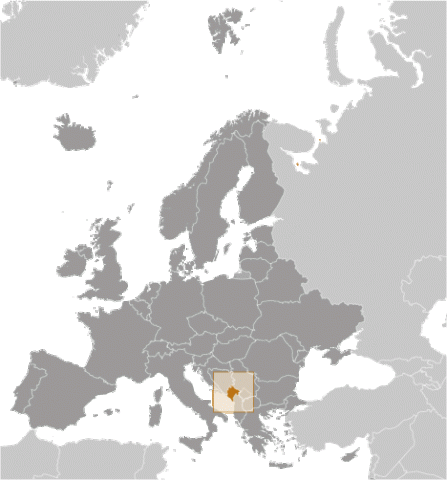

Significant Advancement
In 2024, Montenegro made significant advancement in efforts to eliminate the worst forms of child labor. The government adopted the 2025–2028 Strategy for the Development of the Social and Child Protection System and the Action Plan for 2024–2025 to improve child protection, including increasing the number of shelters for child trafficking victims and building drop-in centers for Roma and Egyptian children subjected to forced begging. Also, the government organized several specialized training sessions for officials, law enforcement, judicial representatives, teachers, and social workers on topics related to eliminating the worst forms of child labor. In addition, representatives from nine state institutions and four non-governmental organizations signed a revised Agreement on Cooperation in the Fight Against Human Trafficking to strengthen cooperation on the prevention and protection of child victims. The government licensed a shelter operated by a non-governmental organization and provided $55,250 for operational costs. However, research found that the scope of programs to address child labor in street work in Montenegro is insufficient. The Hotline for Victims of Human Trafficking SOS Hotline, previously funded by the Office of the National Anti-Trafficking Coordinator, ceased operating in July 2024. Additionally, labor inspectors did not receive training during the reporting period, and sectoral data on children’s work remain unavailable.
| Children | Age | Percent and Population |
|---|---|---|
| Working | 5 to 14 | 17.3% (Unavailable) |
| Hazardous Work by Children | 15 to 17 | Unavailable |
| Attending School | 5 to 14 | 95.0% |
| Combining Work and School | 7 to 14 | 20.5% |
| Sector/Industry | Activity |
|---|---|
| Services | Tourism and trade sectors during the summer season, often as part of family businesses. Street work, including vending small goods and begging. |
| Categorical Worst Forms of Child Labor‡ | Commercial sexual exploitation, sometimes as a result of human trafficking. Forced begging and forced domestic work. |
‡ Child labor understood as the worst forms of child labor per se under Article 3(a)–(c) of ILO C. 182.
Children at Higher Risk
The practice of forced begging is rampant among Romani children who are exploited by their parents. Some Romani girls from impoverished households in Montenegro are sold into domestic servitude within Roma communities in Montenegro and other countries, including Kosovo. Children of minority groups, including Roma, Ashkali, and Balkan Egyptians, are vulnerable to human trafficking, including commercial sexual exploitation.
Barriers to Education Access
The inability to enroll in school makes some Montenegrin children vulnerable to child labor. Some Roma, Ashkali, and Balkan Egyptian children, as well as some Kosovar children displaced due to conflict, have difficulty accessing education, healthcare, and housing because they lack birth registration documents. In addition, some rural children and children with disabilities experience difficulty physically accessing educational facilities and have limited government social services available to them.
| Standard | Age | Meets International Standards | Legislation |
|---|---|---|---|
| Minimum Age for Work | 15 | ✓ | Article 16 of the Labor Law |
| Minimum Age for Hazardous Work | 18 | ✓ | Articles 17, 172, and 173 of the Labor Law |
| Identification of Hazardous Occupations or Activities Prohibited for Children | ✓ | Articles 104 and 106 of the Labor Law; Articles 7 and 8 of the Regulations on Measures of Protection in the Workplace | |
| Prohibition of Slavery, Debt Bondage, and Forced Labor | ✓ | Article 444 of the Criminal Code; Articles 28 and 63 of the Constitution | |
| Prohibition of Child Trafficking | ✓ | Articles 444–446 of the Criminal Code | |
| Prohibition of Commercial Sexual Exploitation of Children | ✓ | Articles 209–211 of the Criminal Code | |
| Prohibition of Using Children in Illicit Activities | ✓ | Articles 300 and 301 of the Criminal Code | |
| Minimum Age for Voluntary State Military Recruitment | 18 | ✓ | Articles 47 and 195 of the Declaration of the Law on the Army of Montenegro; Articles 162 and 163 of the Law on the Armed Forces |
| Prohibition of Compulsory Recruitment of Children by (State) Military | N/A | Articles 47, 188, and 195 of the Declaration of the Law on the Army of Montenegro | |
| Prohibition of Military Recruitment by Non-state Armed Groups | ✓ | Article 444 of the Criminal Code | |
| Compulsory Education Age | 15 | ✓ | Article 4 of the Law on Primary Education |
| Free Public Education | ✓ | Article 75 of the Constitution |
| Organization/Agency | Role & Activities |
|---|
| Labor Inspectorate: Leads and monitors the enforcement of labor laws, including those that protect working children. Has 15 offices that proactively plan labor inspections. Maintains a national call center and an e-mail inbox for receiving complaints. Operated as part of the independent Inspectorate General until October 1, 2024, when the Labor Inspectorate was restructured under the Ministry of Labor, Employment, and Social Dialogue. |
| Ministry of Interior: Houses the Police Directorate and the Office for the Fight Against Trafficking in Humans (Trafficking in Persons Department). An eight-member unit within the Police Directorate investigates human trafficking, forced labor, and illegal migration. This unit also investigates reports of child begging, develops policy to prevent future cases of forced begging, and removes child beggars from the streets through the Beggar Task Force. |
| Overview of Enforcement Efforts | 2024 |
|---|---|
| Has a Labor Inspectorate | Yes |
| Able to Assess Civil Penalties | Yes |
| Routinely Conducted Worksite Inspections | Yes |
| Unannounced Inspections Permitted | Yes |
| Has a Complaint Mechanism | Yes |
| Imposed Penalties for Child Labor Violations | N/A |
| Conducted Criminal Investigations for Worst Forms of Child Labor Crimes | Yes |
| Imposed Penalties for Worst Forms of Child Labor Crimes | No |
In 2024, 26 labor inspectors conducted 5,310 worksite inspections, finding 0 child labor violations. The government also conducted 10 investigations into suspected worst forms of child labor crimes, initiated 5 prosecutions, and convicted 1 perpetrator.
| Coordinating Body | Role & Activities |
|---|
| Coordination Body for the Protocol on the Treatment of Bodies, Institutions, and Organizations in Montenegro with Children Involved in Street Life and Work: Coordinates intergovernmental work on issues specifically affecting children engaged in street labor. The Coordination Body monitored the implementation of the Protocol on the Treatment of Bodies, Institutions and Organizations in Montenegro with Children Involved in Street Life and Work. However, research could not determine the Coordination Body’s activity during the reporting period. |
| Policy | Description & Activities |
|---|
| 2025–2028 Strategy for the Development of the Social and Child Protection System:* Adopted in December 2024, the Strategy aims to build an integrated, effective, and efficient social and child protection system. The Action Plan specifies policy objectives, including improving the management and quality of social services, increasing the number of shelters to accommodate more victims of human trafficking, and building three drop-in centers for Roma and Egyptian children involved in forced street begging by 2025. |
| National Strategy for Combating Human Trafficking (2019–2024): Outlined objectives for addressing human trafficking by raising public awareness, strengthening the capacity for victim identification and services provision, improving interagency coordination, and raising the efficiency of prosecutions. Based on the strategy, the government approved the National Action Plan for 2024 and provided financial and logistical support for the construction of the new shelter for victims of child and youth trafficking, which opened in April 2024. On May 27, nine state institutions and four NGOs signed a revised Agreement on Cooperation in the Fight Against Human Trafficking to strengthen existing cooperation mechanisms and enhance the national response to various forms of trafficking. |
| Strategy for the Social Inclusion of Roma and Balkan Egyptians (2021–2025): Aims to create social inclusion of Roma and Balkan Egyptians by increasing school attendance and birth registration while preventing human trafficking, including child begging. Implemented by the Ministry of Justice, Human, and Minority Rights. During the reporting period, the government continued to implement the strategy by encouraging youth from vulnerable populations to pursue postsecondary educational opportunities. Also, the Ministry of Justice, Human, and Minority Rights continued to provide free preschool education, free textbooks, scholarships for high school students of $70 (€60) per month, and free dormitories for Roma students. |
* Program was launched during the reporting period.
† The government had other policies that may have addressed child labor issues or had an impact on child labor.
| Program | Description & Activities |
|---|
| Shelters for Trafficking Victims:‡ In March 2024, the government licensed a new shelter run by the NGO SOS Helpline for Women and Children Victims of Violence, which can accommodate 3 women and 10 child victims of trafficking. It provided the shelter $55,250 for operational costs and $280 per victim per month. Also in March, the government finished renovating, furnishing, and hiring and training staff for an additional shelter that can provide 10 children with comprehensive support in overcoming trauma, in collaboration with the social welfare center, the Human Trafficking Victims Identification Team, healthcare institutions, schools, and primary families; the government allocated $66,300 for operational costs. However, the shelter is co-located in the Center for Children and Youth with Problematic Behavior “Ljubovic”—a juvenile detention center—in Podgorica, raising concern over child victims’ security and confidentiality. |
| Hotline for Victims of Human Trafficking:‡ SOS Hotline funded by the Office of the National Anti-Trafficking Coordinator, under the Ministry of Interior, and run by the NGO Montenegrin Women’s Lobby. Provides advice, connects victims with service providers, and raises public awareness. However, the Hotline was not operating from July 2024 onward; the government is seeking an interested NGO to manage this service going forward. |
| Quasi-Universal Child Allowance:‡ To improve children’s well-being, every child under 18 can receive $70 (€60) a month under the program. However, the coverage rate is only around 43 percent due to its exclusionary eligibility criteria, whose expansion requires Parliament’s approval. The program provides the allowance for only up to five children in a family, which disproportionately impacts Roma and Egyptian families who tend to have more children. |
‡ Program is funded by the Government of Montenegro.
† The government had other social programs that may have included the goal of eliminating or preventing child labor.
| Area | Suggested Action |
|---|---|
| Enforcement | Provide labor inspectors with training on child labor issues and labor law enforcement. |
| Publish information on the labor inspectorate's funding. | |
| Pursue investigations, prosecutions, and convictions of individuals involved in the worst forms of child labor. | |
| Coordination | Publish the activity of the Coordination Body for the Protocol on the Treatment of Bodies, Institutions, and Organizations in Montenegro with Children Involved in Street Life and Work and adopt multi-disciplinary and multi-sectoral approaches to strengthen interagency coordination. |
| Government Policies | Establish a policy covering all worst forms of child labor. |
| Social Programs | Expand existing programs to address the scope of the child labor problem, especially in street work, forced begging, and sex trafficking. |
| Take steps to increase birth registration for children from the Ashkali, Balkan Egyptian, and Roma communities to ensure children's access to the educational and social welfare systems. | |
| Build the capacity of schools and fund other services and programs to accommodate and expand education access for children with disabilities. | |
| Consistently track and publish information about children involved in the worst forms of child labor, including data on the sectoral distribution of child labor. | |
| Increase the coverage rate of the quasi-universal child allowance to support more children in extreme poverty. | |
| Protect child trafficking victims' security and confidentiality by ensuring that the shelter for child victims is not co-located near a detention center or other facilities that may raise security concerns. |