


Child Labor and Forced Labor Reports
Mauritius


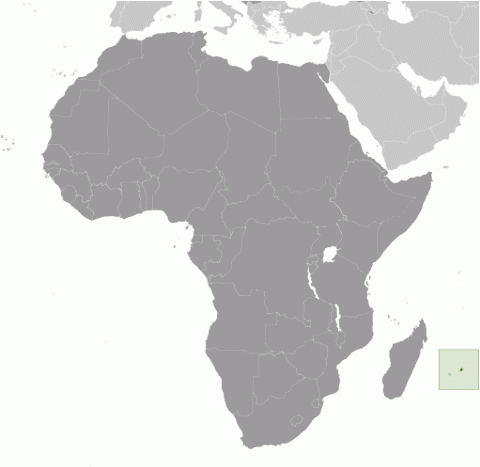

Moderate Advancement
In 2024, Mauritius made moderate advancement in efforts to eliminate the worst forms of child labor. The Office of the Director of Public Prosecutions increased interagency collaboration by establishing a task force to combat trafficking in persons, providing a venue for officials from the Mauritius Police Force, the Ministry of Labor, and other agencies to discuss forced labor cases. The government also enacted the Protection and Promotion of the Rights of Persons with Disabilities Act, which provides additional protections to individuals with disabilities, including enhanced access to education; increases penalties for trafficking crimes perpetrated against individuals with disabilities; and significantly increases the number of labor inspectors, the number of worksite inspections, and the number of investigations conducted. In addition, the government took measures to increase the Child Monthly Allowance and extend the fully subsidized high school examination fees to students retaking examinations. Although the government made meaningful efforts in all relevant areas during the reporting period, it did not impose penalties for violations related to the worst forms of child labor. In addition, although the law prohibits the employment of children below age 16, it does not limit the number of hours these children are permitted to work light jobs, which under the law are allowable for this age group as long as the work is for family businesses that are not harmful to their health, development, or education. There is also a lack of appropriate standards of care, inadequate provision of services, and overcrowding in some centers that house child survivors of commercial sexual exploitation. Finally, the country’s policies do not cover child labor in all sectors, including in agriculture and street work.
| Children | Age | Percent and Population |
|---|---|---|
| Working | 5 to 14 | Unavailable |
| Hazardous Work by Children | 15 to 17 | Unavailable |
| Attending School | 5 to 14 | Unavailable |
| Combining Work and School | 7 to 14 | Unavailable |
| Sector/Industry | Activity |
|---|---|
| Agriculture | Farming, including animal rearing. Fishing,† including diving, and casting nets and traps. |
| Industry | Construction.† |
| Services | Street work, including vending, begging, and food selling. Domestic work. Working in restaurants, small shops, and hardware stores. Working in the transportation sector and as dishwashers in hotels. |
| Categorical Worst Forms of Child Labor‡ | Commercial sexual exploitation, sometimes as a result of human trafficking. Use in illicit activities, including standing watch, as well as use in trafficking, sale, storage, and transport of drugs. |
† Determined by national law or regulation as hazardous and, as such, relevant to Article 3(d) of ILO C. 182.
‡ Child labor understood as the worst forms of child labor per se under Article 3(a)–(c) of ILO C. 182.
Children at Higher Risk
Children from low‐income families in Mauritius are particularly vulnerable to child labor, as well as commercial sexual exploitation. In addition, an increasing number of children are engaged in drug trafficking activities, sometimes through their parents who are drug traffickers. Children from disadvantaged neighborhoods and street children are vulnerable to commercial sexual exploitation, including via online platforms. There is evidence suggesting that taxi drivers, sometimes involved in commercial sex networks, knowingly transport child sex traffickers to victims or victims to traffickers. Furthermore, Creole children are also vulnerable to sex trafficking, particularly in urban areas such as Port Louis, Rose Hill, and Quatre Bornes.
The Mauritian government has never conducted a national child labor survey; therefore, information on the prevalence of child labor in the country is limited.
Barriers to Education Access
Children from low-income families and street children sometimes lack access to educational opportunities and are more likely to experience absenteeism. Although education is free and compulsory until 16 years old, some families do not send their children to school. Reporting shows a rising number of first-born children are kept at home to take care of their younger siblings.
In addition, children of asylum seekers and refugees are not allowed to attend school because they do not have residence permits that would allow them to attend. Similarly, children from other countries that have not been declared at the Office of the Civil Status are denied registration and cannot attend school because they cannot provide a birth certificate. However, during the reporting period, the government took steps to enable children of foreign national survivors of human trafficking in shelters to attend school in Mauritius.
Finally, children with disabilities may face a lack of adequate equipment and support in some educational facilities. However, in 2024, the Government of Mauritius enacted the Protection and Promotion of the Rights of Persons with Disabilities Act in alignment with the UN Convention on the Rights of Persons with Disabilities. The government took an additional step to remedy this problem by conducting trainings and awareness campaigns, as well as providing assistance to teachers.
| Standard | Age | Meets International Standards | Legislation |
|---|---|---|---|
| Minimum Age for Work | 16 | ✓ | Articles 2 and 8 of the Workers’ Rights Act |
| Minimum Age for Hazardous Work | 18 | ✓ | Articles 2 and 9 of the Workers’ Rights Act |
| Identification of Hazardous Occupations or Activities Prohibited for Children | ✓ | Section 8 of the Occupational Safety and Health Act | |
| Prohibition of Slavery, Debt Bondage, and Forced Labor | ✓ | Articles 2, 11, 14, and 21 of the Combating Trafficking in Persons Act; Article 6 of the Constitution | |
| Prohibition of Child Trafficking | ✓ | Article 13A of the Child Protection Act; Articles 2, 11, 14, and 21 of the Combating Trafficking in Persons Act | |
| Prohibition of Commercial Sexual Exploitation of Children | ✓ | Articles 13A and 14 of the Child Protection Act; Article 253 of the Criminal Code; Articles 2 and 11 of the Combating Trafficking in Persons Act; Articles 19–21 of the Children’s Act | |
| Prohibition of Using Children in Illicit Activities | ✓ | Articles 30.1b–e, 38a, 41.1f, and 41.2 of the Dangerous Drugs Act | |
| Minimum Age for Voluntary State Military Recruitment | N/A† | ||
| Prohibition of Compulsory Recruitment of Children by (State) Military | N/A† | ||
| Prohibition of Military Recruitment by Non-state Armed Groups | ✗ | Article 63 of the Criminal Code | |
| Compulsory Education Age | 16 | ✓ | Article 37.2 of the Education Act |
| Free Public Education | ✓ | Articles 2, 35, and 37 of the Education Act |
† Country has no standing military
A November 2023 amendment to the Combating Trafficking in Persons Act went into force on January 15, 2024, mandating the creation of a Combating Trafficking in Persons Unit within the police force to investigate human trafficking crimes and providing stricter penalties for persons convicted of offenses relating to trafficking in persons. In addition, persons convicted of human trafficking are no longer eligible for remission or release on parole under the Reform Institutions Act, and the court no longer has the discretion to impose a term of imprisonment of less than 3 years for the offense.
The Workers’ Rights Act specifies that a child under age 16 may not be employed to work in any occupation but allows for children to do light jobs in family businesses that are not harmful to their health, development, or education. However, the law does not limit the number of hours for light work.
| Organization/Agency | Role & Activities |
|---|
| Ministry of Labor and Industrial Relations (MOLIR): Enforces all labor laws, including those related to child labor. Advises workers and employers of their rights and responsibilities while improving relationships between them. Can initiate civil and criminal proceedings on behalf of workers who have allegedly had their rights violated by employers. During the reporting period, MOLIR carried out a combined 147 seminars, trainings of officers, and sensitization workshops for workers on child labor issues. |
| Office of the Director of Public Prosecutions (DPP): Coordinates with relevant ministries, such as the Brigade for the Protection of the Family, to investigate and prosecute crimes related to the worst forms of child labor. Following the creation of a Trafficking in Persons Unit within the Mauritius Police Force (MPF) that became operative in 2024, the Office of the Director of Public Prosecutions established a subcommittee to monitor cases of trafficking in persons, including those involving child commercial sexual exploitation and forced child labor. During the reporting period, the DPP hosted a conference attended by representatives of the International Organization for Migration (IOM), MOLIR, and MPF. It also established a new task force to liaise with stakeholders, provide quick legal guidance, and improve coordination between the MOLIR and MPF’s trafficking unit on addressing human trafficking cases. |
| Overview of Enforcement Efforts | 2024 |
|---|---|
| Has a Labor Inspectorate | Yes |
| Able to Assess Civil Penalties | Yes |
| Routinely Conducted Worksite Inspections | Yes |
| Unannounced Inspections Permitted | Yes |
| Has a Complaint Mechanism | Yes |
| Imposed Penalties for Child Labor Violations | No |
| Conducted Criminal Investigations for Worst Forms of Child Labor Crimes | Yes |
| Imposed Penalties for Worst Forms of Child Labor Crimes | No |
In 2024, 230 labor inspectors conducted 8,500 worksite inspections, finding 0 cases of child labor. Between January and September 2024, there were 10 investigations into suspected worst forms of child labor crimes, 1 prosecution initiated, and 0 perpetrators convicted.
| Coordinating Body | Role & Activities |
|---|
| Child Services Coordinating Panel: Led by the Ministry of Gender Equality and Family Welfare (MOGE) and launched in October 2021. Includes representatives of six government ministries, the Mauritius Police Force, and NGOs. Responsible for the coordination of public services and collaborating with stakeholders. During the reporting period, MOGE held 15 coordinating panel meetings. |
| Policy | Description & Activities |
|---|
| Nine Year Continuous Basic Education Policy (2017–2030): Aims to enable all students to successfully complete 9 years of basic schooling and forms part of a package of reforms designed to strategically transform the education system in Mauritius. Implemented by the Ministry of Education and Human Resource. During the reporting period, the Prime Minister announced that pre-primary schools are now tuition-free from the start of the 2024 school year and that children aged 3 to 5 will have equal access to pre-primary schooling. |
| National Action Plan to Combat Trafficking in Persons (2022–2026): Aims to protect human trafficking victims, prosecute perpetrators, and gather data on human trafficking crimes. During the reporting period, the Human Rights Division of the Ministry of Foreign Affairs, Regional Integration and International Trade, together with the Mauritian police force, organized a capacity-building workshop in the context of the World Day Against Trafficking in Persons to equip participants from various relevant agencies with new knowledge and best practices for identifying, investigating, and prosecuting cases of trafficking in persons. |
| National Sport and Physical Activity Policy (2018–2028): Provides a structured sports program available to all ages. Focuses on children and young adults, offering after-school recreational activities to help reduce children’s vulnerability to child labor and illicit activities. In 2024, the government continued its collaboration with the Mauritius Sports Council and different organizations to implement sports projects. |
| Program | Description & Activities |
|---|
| National Children’s Council:‡ Overseen by MOGE, offers a wide range of services and facilities, including day care, shelters, creativity centers, children’s clubs, and school child protection clubs around the island. Works to improve the effectiveness of institutional care facilities and shelters. However, evidence suggests that there continues to be a lack of appropriate standards of care, inadequate provision of services, and overcrowding in some centers that house orphans, child survivors of commercial sexual exploitation, and child survivors of other types of abuse. |
| Eradication of Absolute Poverty Program:‡ Provides support to families living in absolute poverty through empowerment and income programs administered by the Ministry of Social Integration, Social Security and National Solidarity. Activities include a monthly child allowance, provision of free school materials, examination fees support, medical screening, housing support, and counseling. In 2024, the government increased social allowances to families to encourage children to attend school and, for the time, extended those allowances to children with disabilities as well. It also fully subsidized high school examination fees for those students retaking examinations. |
| Awareness-Raising Programs on Commercial Sexual Exploitation and Human Trafficking:‡ Educate the public about preventing commercial sexual exploitation of children and human trafficking. In 2024, MOGE’s Child Development Unit raised awareness about commercial sexual exploitation of children, in particular in the tourism sector with the participation of the Child Welfare Officer in a month-long awareness-raising campaign organized by professionals of the tourism industry to share knowledge and collective strategies. |
‡ Program is funded by the Government of Mauritius.
† The government had other social programs that may have included the goal of eliminating or preventing child labor.
| Area | Suggested Action |
|---|---|
| Legal Framework | Criminally prohibit the recruitment of children under age 18 into non-state armed groups. |
| Ensure that the law’s light work provisions limit the number of hours for light work for children under age 16. | |
| Enforcement | Ensure that labor inspections, including those that are unannounced, are conducted in all sectors in which children work, including on private properties that operate farms and throughout the informal sector. |
| Impose penalties for child labor violations, including violations for the worst forms of child labor. | |
| Increase the personnel, training, equipment, and funding for agencies responsible for enforcing criminal laws related to the worst forms of child labor, including training related to child interview techniques and responding to commercial sexual exploitation. | |
| Conduct thorough labor inspections, and take steps to verify whether child labor or hazardous work is taking place. | |
| Coordination | Ensure that coordinating mechanisms to address the worst forms of child labor share information, improve collaboration, and prevent overlap in activities. |
| Government Policies | Adopt a policy that addresses all sectors of child labor, including in agriculture and street work, and covers children at higher risk, such as children from low-income families; compile child labor statistics per sector; and disaggregate the numbers by sex and age. |
| Social Programs | Conduct a comprehensive study of children’s activities to determine whether minors are engaged in or at risk for involvement in child labor. |
| Ensure that all children can access education, including children with disabilities, street children, children living in shelters, and children who lack identity documents. | |
| Ensure that appropriate standards of care are in place for child survivors of commercial sexual exploitation and that they receive comprehensive social services in facilities that are not overcrowded. | |
| Publish activities undertaken to implement the Eradication of Absolute Poverty Program. | |
| Adopt strategies to prevent online commercial sexual exploitation of children, and ensure that existing programs increase protection of children from trafficking, particularly Creole children from urban areas. |