


Child Labor and Forced Labor Reports
Mauritania



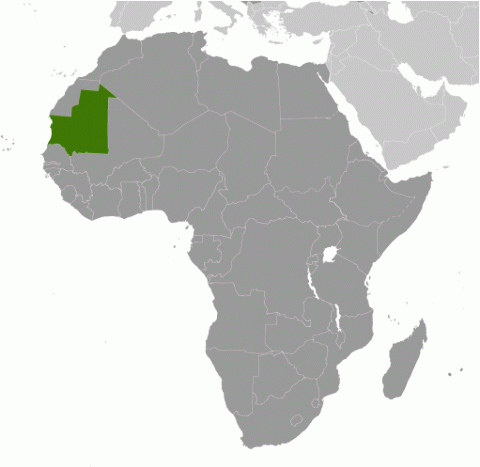

Minimal Advancement – Efforts Made but Continued Law that Delayed Advancement
In 2024, Mauritania made minimal advancement in efforts to eliminate the worst forms of child labor. The government approved the National Action Plan to Combat Trafficking in Persons for 2024–2026, which aims to improve its ability to hold perpetrators accountable and strengthen victim identification, protection, and assistance. Following training of law enforcement officials on a new national referral mechanism for victims of trafficking, police in Nouakchott West identified eight Malian girls who had been subjected to forced domestic work and referred them to the appropriate services. The government also expanded the Tekavoul cash transfer program providing direct assistance to over 140,000 vulnerable families whose children are at risk of engaging in child labor and significantly increased the cash transfer amount. However, despite new initiatives to address child labor, Mauritania is assessed as having made only minimal advancement because its Civil Status Code requires a copy of the biological parents' marriage license for children to obtain a birth certificate. As a result, children born out of wedlock and many Haratine and sub-Saharan children, including those of slave descent, have been unable to be registered at birth. Research is also needed on the prevalence of child labor in the country, and social programs are insufficient to adequately address the extent of the problem. In addition, the government did not publish comprehensive information about its labor law enforcement efforts.
| Children | Age | Percent and Population |
|---|---|---|
| Working | 5 to 14 | 19.7% (Unavailable) |
| Hazardous Work by Children | 15 to 17 | Unavailable |
| Attending School | 5 to 14 | 68.3% |
| Combining Work and School | 7 to 14 | 15.8% |
| Sector/Industry | Activity |
|---|---|
| Agriculture | Farming, including planting, weeding, and harvesting crops. Working in forestry, including in logging and gathering wood. Herding† and caring for livestock, including cattle and goats. Fishing, including handling heavy nets, working on boats,† and selling fish. |
| Industry | Construction.† Working in manufacturing, including assembling products and handling hazardous materials. |
| Services | Domestic work† and working as car mechanics,† painters, and carpenters.† Garbage scavenging and street work, including vending, begging,† and shoe shining. Work in the transportation sector, including as window washers and tour guides. |
| Categorical Worst Forms of Child Labor‡ | Domestic servitude and indentured and hereditary slavery. Forced begging, sometimes as a result of coercion by Koranic teachers. Commercial sexual exploitation and use in illicit activities, including the production of drugs, each sometimes as a result of human trafficking. |
† Determined by national law or regulation as hazardous and, as such, relevant to Article 3(d) of ILO C. 182.
‡ Child labor understood as the worst forms of child labor per se under Article 3(a)–(c) of ILO C. 182.
Children at Higher Risk
Children in Mauritania, especially from the marginalized Haratine ethnic group, continue to be exploited and forced to endure in slavery and slavery-like practices, particularly in rural and remote areas of the country. Some children are born into the illegal practice of hereditary slavery; others are born free but remain in a dependent status and are forced to work with their parents for their former masters in exchange for food, money, and lodging. Enslaved children herd animals, such as cattle and goats, and perform domestic labor. Young girls from families disproportionately affected by poverty, including those from the Haratine, Wolof, Halpulaar, and Soninké communities, are sometimes forced to work as domestic servants in Mauritania's urban areas. There is also a large number of Malian children whose families have fled to Mauritania due to insecurity. These children face heightened risks of child labor due to their displacement.
Barriers to Education Access
Under the Civil Status Code, to obtain a birth certificate, a copy of the biological parents' marriage license and an extract from the birth register from the medical facility where the child was born must both be presented. As a result, children born out of wedlock, children born at home, and many children of Haratine and sub-Saharan origin, including those of enslaved descent, have been unable to be registered at birth. While students no longer need to possess birth certificates to take part in national examinations to obtain the Certificate of Primary Education Studies, birth certificates are still required to take exams necessary to enroll in high school. As a result, many children cannot access secondary education, making them more vulnerable to child labor. Moreover, although all families are required to register children for birth certificates, research found that the civil registration process, which includes obtaining birth certificates, is confusing and time consuming.
Enacted in 2022, Mauritania's Education Reform Law put an end to private education and transitioned all students to public schools. However, the reforms unintentionally created a new barrier to education access by creating an overwhelming demand for public education alongside a scarcity of adequate public school buildings and teachers. Poor sanitation facilities, particularly for girls, and transportation challenges for children in remote areas further hindered access. In addition, children from families of enslaved descent, especially from the Haratine community, face barriers to accessing education due to ethnic discrimination.
| Standard | Age | Meets International Standards | Legislation |
|---|---|---|---|
| Minimum Age for Work | 16 | ✓ | Article 76 of the General Child Protection Code; Articles 153–154 of the Labor Code |
| Minimum Age for Hazardous Work | 18 | ✓ | Article 76 of the General Child Protection Code; Article 247 of the Labor Code |
| Identification of Hazardous Occupations or Activities Prohibited for Children | ✓ | Articles 76 and 77 of the General Child Protection Code; Article 4 of the List of Hazardous Work Forbidden to Children | |
| Prohibition of Slavery, Debt Bondage, and Forced Labor | ✓ | The Anti-Slavery Act and Articles 2, 7, and 21 of the Trafficking in Persons Act | |
| Prohibition of Child Trafficking | ✓ | Articles 2, 4, 7, and 21 of the Trafficking in Persons Act; Articles 18, 43, and 67 of the Migrant Smuggling Act | |
| Prohibition of Commercial Sexual Exploitation of Children | ✓ | Articles 72 and 76 of the General Child Protection Code; Articles 24–26 of the Penal Protection Code for Children; Articles 2, 4, 7, and 21 of the Trafficking in Persons Act | |
| Prohibition of Using Children in Illicit Activities | ✓ | Articles 3–5 and 14 of Law 93-37 on the Prohibition of Production, Trafficking, and Use of Drugs and Illicit Substances | |
| Minimum Age for Voluntary State Military Recruitment | 16 | ✓ | Article 7 of the 1962 Military Recruitment Law |
| Prohibition of Compulsory Recruitment of Children by (State) Military | N/A* | ||
| Prohibition of Military Recruitment by Non-state Armed Groups | ✓ | Article 43 of the Penal Protection Code for Children | |
| Compulsory Education Age | 15 | ✓ | Article 3 of the National Education Law |
| Free Public Education | ✓ | Article 5 of the National Education Law |
* Country has no conscription
In October 2024, the government enacted a law establishing a centralized court for prosecuting all slavery and trafficking in persons cases nationwide. This new special court will replace three regional anti-slavery courts that existed previously, and all open and pending cases will be transferred to the new special court. According to the government, this will streamline prosecution of all cases that fall under the 2020 Trafficking in Persons Act. Mauritania's Labor Code was amended on December 31, 2024, to raise the age at which children are allowed to perform light work from 12 to 14, as long as it does not exceed 2 hours per day, does not impede their school attendance, and is authorized by the Ministry of Labor and Public Service. However, the amended Labor Code does not specify the activities in which light work may be permitted. In addition, children in Mauritania are required to attend school only up to age 15. This leaves children who decide to leave school at age 15 vulnerable to child labor because they are not legally permitted to work full-time until age 16.
| Organization/Agency | Role & Activities |
|---|
| Ministry of Labor and Public Service: Through its Directorate General of Labor, enforces labor laws and investigates labor code infractions, including forced labor and violations related to minimum wage and hazardous work. Comprises 15 regional labor inspectorates, all of which are active. However, reporting indicates that inspectors lack clarity concerning their authority to inspect the informal sector, in which the majority of child labor violations occur. |
| Ministry of the Interior and Ministry of Justice: The Ministry of the Interior's Special Brigade for Minors investigates crimes against children, including those involving human trafficking. Within the Ministry of Justice, the Directorate for the Judicial Protection of Children assists with the enforcement of child protection issues and oversees courts responsible for sentencing offenders. The Ministry of Justice provides free legal aid in the form of court-appointed lawyers for victims; it is also home to the new Special Court to Combat Slavery, Trafficking in Persons, and Smuggling of Migrants. During the reporting period, the Ministry of Justice provided the equivalent of approximately $850,000 for training and awareness-raising on slavery, trafficking in persons, and the worst forms of child labor for judicial and security authorities. |
| Overview of Enforcement Efforts | 2024 |
|---|---|
| Has a Labor Inspectorate | Yes |
| Able to Assess Civil Penalties | Yes |
| Routinely Conducted Worksite Inspections | Yes |
| Unannounced Inspections Permitted | Yes |
| Has a Complaint Mechanism | Yes |
| Imposed Penalties for Child Labor Violations | Unknown |
| Conducted Criminal Investigations for Worst Forms of Child Labor Crimes | Yes |
| Imposed Penalties for Worst Forms of Child Labor Crimes | Yes |
In 2024, 128 labor inspectors conducted 592 worksite inspections, finding an unknown number of child labor violations. The government also conducted 11 investigations into suspected cases of the worst forms of child labor, initiated an unknown number of prosecutions, and convicted 2 perpetrators.
| Coordinating Body | Role & Activities |
|---|
| National Steering Committee on Child Labor: Multistakeholder steering committee instituted under the National Action Plan to Eliminate Child Labor. Chaired by the Director General of Labor and responsible for implementing the components of the plan, coordinating activities of all relevant stakeholders and partners, general monitoring and evaluation, and updating the government on progress and challenges of implementation. Coordinates with the Office of the Commissioner for Human Rights, Humanitarian Action, and Civil Society Relations, the Ministry of Social Affairs, and other relevant stakeholders. |
| Policy | Description & Activities |
|---|
| National Action Plan to Eliminate Child Labor (PANETE-RIM II) (2023–2027): Aims to address forced child labor, forced child begging, commercial sexual exploitation, slavery, and other forms of child exploitation. Overseen by the Ministry of Labor. Under this action plan, the government launched a school integration program for out-of-school children which reintegrated 1,441 children who had dropped out of school in 2023. The program included financial assistance to help children continue their education instead of working. |
| National Child Protection Strategy (2020–2025): Aims to protect children against violence, exploitation, abuse, and neglect. Specifically includes children exploited at work, child survivors of human trafficking, children living on the streets, and children who are survivors of violence or sexual exploitation. Research was unable to determine whether activities were undertaken to implement the National Child Protection Strategy during the reporting period. |
| National Action Plan to Combat Trafficking in Persons (2024–2026):* Developed by the National Authority to Combat Trafficking in Persons and Smuggling of Migrants, in cooperation with the International Organization for Migration, through consultations with government stakeholders, independent national human rights institutions, and national and international civil society organizations. Approved in March 2024, the plan aims to provide a roadmap for the government to effectively identify and protect victims of human trafficking and prosecute perpetrators. During the reporting period, the National Authority conducted capacity-building and training activities for criminal enforcement officials and began a study on illegal gold mining and its intersection with human trafficking. |
* Policy was approved during the reporting period.
† The government had other policies that may have addressed child labor issues or had an impact on child labor.
| Program | Description & Activities |
|---|
| Ministry of Social Affairs, Childhood, and the Family (MASEF) Office of Childhood Programs:‡ Government programs to protect vulnerable children, including victims of the worst forms of child labor. Include educational, medical, legal, and family reunification services at regional MASEF child protection centers. While there is a 1013 hotline to receive child protection concerns, including complaints about child labor, data on the number of calls received and government responses to such complaints have not been published. |
| Tekavoul Social Safety Net Program:‡ Cash transfer program implemented by the National Delegation for the Fight Against Exclusion and National Solidarity (known as TAAZOUR) and jointly funded by the Government of Mauritania and the World Bank. Designed to provide financial support to the most vulnerable families so that their children can stay in school. Expanded in September 2024, it aims to provide 140,297 families (869,841 individuals) $900 a year in direct cash transfers. |
| Program to Eradicate the Effects of Slavery:‡ Government program administered by TAAZOUR that supports the reintegration and rehabilitation of former slaves. During the reporting period, the government used its trafficking victim assistance fund to finance income-generating activities for survivors, provide care for child victims of forced begging, and provide victims of slavery with civil status documents. |
‡ Program is funded by the Government of Mauritania.
† The government had other social programs that may have included the goal of eliminating child labor.
| Area | Suggested Action |
|---|---|
| Legal Framework | Accede to the UN Convention on the Rights of the Child Optional Protocol on Armed Conflict. |
| Specify the activities in which light work is permissible. | |
| Increase the compulsory education age from 15 to 16 to align with the minimum age for work. | |
| Enforcement | Publish complete information on labor law enforcement efforts, including the number of child labor violations found, the number of child labor violations for which penalties were imposed, and the number of child labor penalties imposed that were collected. |
| Carry out inspections and other enforcement actions in the informal sector, both in response to tip line referrals and through planned operations, and impose penalties for child labor violations, including violations involving the worst forms of child labor. | |
| Increase material resources for labor inspectors and the number of worksite labor inspections, especially in remote areas and in the informal sector. | |
| Increase efforts to ensure that cases of the worst forms of child labor, including hereditary slavery and forced begging, are fully investigated, brought to court, and prosecuted in accordance with the law. | |
| Ensure that judicial officials use the pre-trial detention process and leverage extradition agreements with neighboring countries so that perpetrators of slavery cases are held accountable. | |
| Ensure that criminal enforcement officials can properly identify cases of slavery and human trafficking and that they do not improperly dismiss or fail to refer appropriate cases to the special court. | |
| Take appropriate corrective action to hold accountable any government officials who do not properly enforce, or who prevent the enforcement of laws related to the worst forms of child labor, including hereditary slavery. | |
| Coordination | Strengthen coordination and cooperation across the government, especially between agencies responsible for child protection and labor enforcement. |
| Government Policies | Ensure that key policies related to child labor receive sufficient resources, including funds, for effective implementation, and make information about implementation measures publicly available. |
| Social Programs | Continue civil registration campaigns around the country, and ensure that all children are able to obtain birth certificates, especially those born out of wedlock and to the Haratine and other ethnic groups, to increase their access to secondary education and reduce their vulnerability to child labor. |
| Expand the scope of programs to address child labor, including in agriculture, herding, domestic work, and hereditary and indentured slavery. | |
| Conduct research and collect data on hereditary slavery and child labor to inform the development of effective policies and programs to identify and protect children who are at risk. | |
| Increase funding dedicated to improving school infrastructure, sanitation facilities, teacher availability, and transportation, especially in rural areas, and reduce costs to families of uniforms and school supplies to ensure accessibility of education for all children, including those belonging to families of enslaved descent. |