


Child Labor and Forced Labor Reports
Lesotho


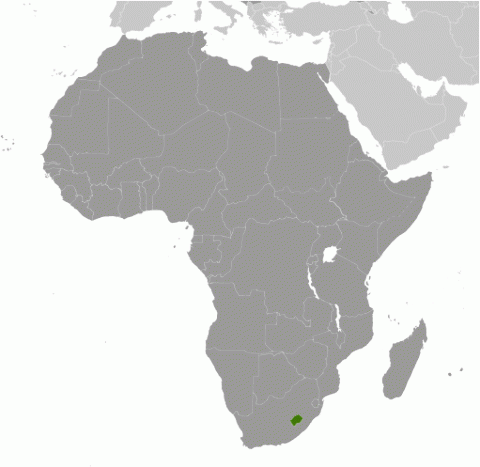

Moderate Advancement
In 2024, Lesotho made moderate advancement in efforts to eliminate the worst forms of child labor. The government enacted a new Labor Act that authorizes labor inspectors to inspect and enforce labor laws in private residences and permits the labor inspectorate to assess civil penalties for child labor violations. The government also enacted a new Occupational Safety and Health Act that allows workers to cease or refuse work in dangerous or hazardous conditions in the informal sector. Furthermore, Lesotho hosted numerous trainings for criminal enforcement officials on investigating, prosecuting, and providing referral and support systems to trafficking survivors, including children. Moreover, the Community Council Child Protection Coordinating Committees provided trainings to journalists, chiefs, and social workers on child labor and child protection issues, thus improving and clarifying participants’ mandates to address child labor. Also, the Program Advisory Committee on Child Labor finalized the National Action Plan on Elimination of Child Labor, forwarded the plan to the cabinet for approval, and approved the National Strategic Development Plan II during the reporting period. Finally, the government developed a new reporting and referral mechanism to strengthen reporting on child exploitation and protection issues. Although the government made meaningful efforts in all relevant areas during the reporting period, it does not meet the international standard for either compulsory education—because the government’s compulsory education age of 13 is below its minimum age for work of 15, leaving children ages 13 and 14 vulnerable to child labor—or free public education, because only primary education is free and compulsory, whereas secondary education is not free. Additionally, Lesotho has not established a digital tracking system for civil worst forms of child labor violations. In addition, the government has not adopted a policy that addresses all relevant worst forms of child labor, such as livestock herding and commercial sexual exploitation. Finally, the government lacks sufficient human and financial resources to conduct labor inspections in rural areas.
| Children | Age | Percent and Population |
|---|---|---|
| Working | 5 to 14 | 30.1% (Unavailable) |
| Hazardous Work by Children | 15 to 17 | Unavailable |
| Attending School | 5 to 14 | 93.8% |
| Combining Work and School | 7 to 14 | 32.1% |
| Sector/Industry | Activity |
|---|---|
| Agriculture | Herding animals, including cattle.† Farming, including planting, applying pesticides, and harvesting. Fishing. |
| Industry | Manufacturing, including carrying heavy loads. Construction, mining, and quarrying. |
| Services | Domestic work and street work, including carrying heavy loads of groceries and bags of flour. |
| Categorical Worst Forms of Child Labor‡ | Commercial sexual exploitation and domestic work, each sometimes as a result of human trafficking. |
† Determined by national law or regulation as hazardous and, as such, relevant to Article 3(d) of ILO C. 182.
‡ Child labor understood as the worst forms of child labor per se under Article 3(a)–(c) of ILO C. 182.
Children at Higher Risk
Due to adults’ high rate of HIV, many children in Lesotho become orphans and vulnerable to human trafficking. Children, especially orphans, also sometimes voluntarily travel to other countries, including South Africa, for domestic work, where traffickers detain them in prison-like conditions or sexually exploit them; in other cases, traffickers exploit Basotho children, especially orphans, in forced labor in domestic servitude, herding, and sexual exploitation, sometimes through deceptive job and scholarship offers. In addition, boys involved in animal herding, including boys from Basotho communities, are exposed to harsh weather conditions, sometimes leading to death.
Barriers to Education Access
In Lesotho, primary education is free; however, there is a fee for secondary education that is prohibitive for many families. Many children also face limited access to education due to poor facilities and a shortage of teachers and schools, particularly in remote areas, which may cause them to travel long distances. In addition, the absence of school sanitation facilities remains a barrier for many children, especially menstruating girls. Children with disabilities also encounter difficulties with ill-equipped educational facilities in mainstream schools. Reporting also indicates that internally displaced children experience abuse in schools. According to the Ministry of Social Development, children must submit copies of birth certificates to qualify for the Orphans and Vulnerable Children program, which provides school fees and uniforms for vulnerable children. Although rural mobile offices provide birth certificates, a low birth registration rate or absence of birth certificates in Lesotho may prevent some children from accessing this program, increasing their vulnerability to child labor because they are unable to attend school. There are also reports that authorities prevent Zulu, Xhosa, and Baphuthi children from attending school because classes are not taught in their native language.
| Standard | Age | Meets International Standards | Legislation |
|---|---|---|---|
| Minimum Age for Work | 15 | ✓ | Article 228(1) of the Children’s Protection and Welfare Act; Article 124(1) of the Labor Code; Sections 10, 195, and 196 of the 2024 Labor Act |
| Minimum Age for Hazardous Work | 18 | ✓ | Article 230(1) of the Children’s Protection and Welfare Act; Article 125(1) of the Labor Code; Sections 10 and 196 of the 2024 Labor Act |
| Identification of Hazardous Occupations or Activities Prohibited for Children | ✓ | Articles 230(3) and 231 of the Children’s Protection and Welfare Act; Section 201 of the 2024 Labor Act | |
| Prohibition of Slavery, Debt Bondage, and Forced Labor | ✓ | Article 7(1) of the Labor Code; Article 9(2) of the Constitution; Article 5 of the Anti-Trafficking in Persons Act; Sections 10 and 202 of the 2024 Labor Act; Sections 10(1), 11, 70, and 71 of the 2024 Occupational Safety and Health Act | |
| Prohibition of Child Trafficking | ✓ | Article 5 of the Anti-Trafficking in Persons Act; Anti-Trafficking in Persons (Amendment) Act (2021); Sections 10 and 202 of the 2024 Labor Act | |
| Prohibition of Commercial Sexual Exploitation of Children | ✓ | Article 77 of the Children’s Protection and Welfare Act; Articles 10–14 of the Sexual Offenses Act; Sections 10, 201(1)(e), and 202 of the 2024 Labor Act | |
| Prohibition of Using Children in Illicit Activities | ✓ | Article 45(b) of the Children’s Protection and Welfare Act; Section 202 of the 2024 Labor Act | |
| Minimum Age for Voluntary State Military Recruitment | 18 | ✓ | Article 22(o) of the Children’s Protection and Welfare Act |
| Prohibition of Compulsory Recruitment of Children by (State) Military | N/A* | Article 22(o) of the Children’s Protection and Welfare Act | |
| Prohibition of Military Recruitment by Non-state Armed Groups | ✓ | Article 22(o) of the Children’s Protection and Welfare Act | |
| Compulsory Education Age | 13‡ | ✗ | Part I Article 3(a), and Part II Articles 6 and 7(3)(c) of the Education Act |
| Free Public Education | ✗ | Part II Articles 4(1)(a) and 4(1)(b) of the Education Act; Article 22(k) of the Children’s Protection and Welfare Act |
* Country has no conscription
‡ Age calculated based on available information
The Government of Lesotho enacted the Labor Act, 2024, which reaffirms existing legal protections against child labor, forced labor, child trafficking, and commercial sexual exploitation of children. The 2024 Labor Act also authorizes labor inspectors to inspect and enforce labor laws in private residences, and establishes a mechanism to assess civil penalties for child labor violations. In addition, the government enacted the Occupational Safety and Health Act, 2024, which extends to informal sector workers the right to cease or refuse work in dangerous or hazardous work conditions. However, free public education does not extend through the basic level because the law delineates primary education as “free and compulsory,” but secondary education as “accessible.”
| Organization/Agency | Role & Activities |
|---|
| Ministry of Labor and Employment (MOLE): Enforces minimum-age requirements and hazardous work prohibitions while conducting general labor inspections. Its Child Labor Unit conducts trainings for child protection workers on the worst forms of child labor. MOLE has insufficient resources, including a lack of vehicles and insufficient computers, office space, and other needed materials, and did not conduct enough inspections in areas in which child labor has occurred, including most of the informal sector. In 2024, MOLE conducted a 5-day training for 34 labor officials including labor inspectors, on the Labor Act, 2024 and the Occupational Safety and Health Act, 2024, including provisions on child labor, forced labor, hazardous employment, and the worst forms of child labor. |
| National Police: Investigate criminal violations related to the worst forms of child labor. Manage and refer human trafficking and child labor cases for prosecution to the Public Prosecutor’s Office. Accompany MOLE officials on inspections related to hazardous work and forced child labor. Insufficient staff, vehicles, computers, and interagency coordination hindered criminal enforcement related to the worst forms of child labor. During the reporting period, officials from various police units and other government offices underwent trainings on human trafficking, covering investigations, prosecutions, victim identification, and victims’ referrals to services, with support from the United Nations Office on Drugs and Crime (UNODC), the International Organization on Migration (IOM), and the EU. |
| Overview of Enforcement Efforts | 2024 |
|---|---|
| Has a Labor Inspectorate | Yes |
| Able to Assess Civil Penalties | Yes |
| Routinely Conducted Worksite Inspections | Yes |
| Unannounced Inspections Permitted | Yes |
| Has a Complaint Mechanism | Yes |
| Imposed Penalties for Child Labor Violations | N/A |
| Conducted Criminal Investigations for Worst Forms of Child Labor Crimes | No |
| Imposed Penalties for Worst Forms of Child Labor Crimes | N/A |
In 2024, 26 labor inspectors conducted 389 worksite inspections, finding 0 child labor violations. The government also conducted 0 investigations into suspected worst forms of child labor crimes, initiated 0 prosecutions, and convicted 0 perpetrators.
| Coordinating Body | Role & Activities |
|---|
| Program Advisory Committee on Child Labor: Led by MOLE’s Child Labor Unit and includes representatives from government ministries, trade unions, NGOs, and international organizations. In 2024, the Committee met to discuss and advanced the National Action Plan on Elimination of Child Labor (NAP II) 2024–2029 to the cabinet for approval. |
| Policy | Description & Activities |
|---|
| National Anti-Trafficking in Persons Strategic Framework and Action Plan (2021–2026): Supports national and international obligations and commitments regarding human trafficking in line with the vision to eliminate all forms of human trafficking in Lesotho. Provides guidelines for victim protection, prosecution of offenders, and prevention. During the reporting period, the government conducted trainings for labor inspectors, police, immigration officers, prosecutors, and social workers on investigating and prosecuting trafficking in persons cases and protective services referrals, with support from the IOM and UNODC. The government also conducted human trafficking awareness campaigns and distributed awareness materials at public spaces, partly with support from World Vision Lesotho. |
| National Strategic Development Plan II (2023/24–2027/28):* Focuses on sustainable and equitable development including through decent work and worker rights. Identifies protection for children, youth, and vulnerable groups from violent crimes as a cross-cutting theme and priority, with interventions planned to eliminate the worst forms of child labor and to enforce international labor standards that Lesotho has signed. Replaces the National Strategic Development Plan. |
* The policy was approved during the reporting period.
† The government had other policies that may have addressed child labor issues or had an impact on child labor.
| Program | Description & Activities |
|---|
| Education Programs:‡ The Child Grant Program, implemented by the Ministry of Social Development and funded by the EU with technical support from UNICEF, provides cash transfers to eligible low-income households to increase school enrollment. In 2024, 42,000 households received $19 to $40 per quarter depending on the household size. Also includes the Orphans and Vulnerable Children Bursary program, which helps increase education by paying for school fees, books, and uniforms for children. In 2024, the program supported 31,668 children. The School Feeding Program, implemented by the Ministry of Education, provides food for primary school-aged children. In 2024, more than 90,000 children benefited from this program. |
| World Food Program: Provides incentives for primary school children from impoverished backgrounds to attend school and improves retention. Approximately 50,670 children benefitted from this program in 2024. |
| Shelter Programs:‡ In collaboration with Beautiful Dream Society, a shelter can house up to 22 female and child human trafficking and sexual assault survivors. The shelter provides life skills and vocation training for residents; children may leave to attend school and access other services. After thorough home assessments conducted in collaboration with the Ministry of Social Development, child survivors may return to their families. The shelter can also house foreign national survivors. In 2024, the shelter housed four child survivors and provided them with therapy, clothing, and skills training, The shelter provides only out-patient services to male survivors, although it can house boys under age 6 if with their mother; the government is partnering with the Catholic Bishops Conference and Catholic Commission for Justice for Peace to establish a shelter for male survivors. |
‡ Program is funded by the Government of Lesotho
| Area | Suggested Action |
|---|---|
| Legal Framework | Ensure that laws establishing free public education extend through the basic level. |
| Increase the compulsory education age from 13 to 15 to align with the minimum age for work. | |
| Enforcement | Provide adequate funding, financial and human resources, and training to labor inspectors to carry out their mandated duties. Ensure that labor inspectors are provided with logistical resources (including vehicles, computers, office space, and personal protective equipment) to access workplaces, including private homes, farms, export processing zones, and special economic zones. |
| Ensure that inspectors carry out their mandated duties and conduct labor inspections in all sectors, including high-risk ones such as the informal sector. | |
| Provide adequate financial and human resources—including by hiring additional prosecutors—and provide training to criminal investigators to carry out their mandated duties. | |
| Establish a digital tracking system for civil worst forms of child labor. | |
| Coordination | Improve coordination and communication among all stakeholders by clarifying mandates and establishing tools to track child labor elimination efforts and address all worst forms of child labor. |
| Government Policies | Adopt a policy that addresses all relevant worst forms of child labor, such as livestock herding and commercial sexual exploitation. |
| Social Programs | Institute programs that mitigate the impacts of HIV and support orphans and vulnerable children so they are not vulnerable to child labor. |
| Increase access to education by eliminating secondary school fees; training and hiring more teachers; increasing the number of schools, particularly in remote areas; and adding more school facilities, including sanitation facilities for menstruating girls so that they are able to stay in school. | |
| Increase efforts to provide birth registration documentation to children to reduce their vulnerability to the worst forms of child labor. | |
| Expand programs to address the full scope of child labor in Lesotho, including child trafficking and the commercial sexual exploitation of children, and publish information on all program activities. | |
| Increase social protections for children vulnerable to human trafficking for forced labor and commercial sexual exploitation, including orphaned and Basotho children, and provide social programming to encourage and support education among boys from Basotho and other herding families. | |
| Establish a shelter for male survivors of the worst forms of child labor. |