


Child Labor and Forced Labor Reports
Kiribati
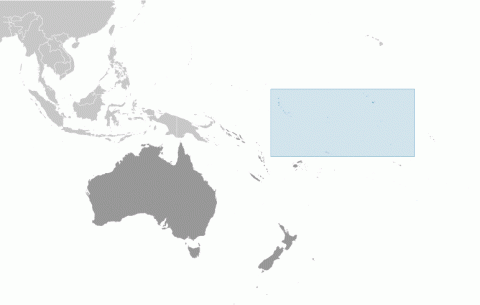

Minimal Advancement
In 2024, Kiribati made minimal advancement in efforts to eliminate the worst forms of child labor. The government made efforts to make education and training a priority, such as partnering with non-governmental organizations to train youth who dropped out of school early in job skills and providing support for out-of-school children who are at high risk of being exploited for child labor. The government also maintained hotlines for children to report violations, request information, or obtain access to services. However, despite these efforts, the government's lack of funds and staffing resources limit labor inspections and civil and criminal law enforcement efforts related to the worst forms of child labor. Additionally, existing laws do not identify hazardous occupations and activities prohibited for children, and the government has not adopted a national policy to address the worst forms of child labor.
| Children | Age | Percent and Population |
|---|---|---|
| Working | 5 to 14 | 14.6% (Unavailable) |
| Hazardous Work by Children | 15 to 17 | Unavailable |
| Attending School | 5 to 14 | 95.8% |
| Combining Work and School | 7 to 14 | 29.7% |
| Sector/Industry | Activity |
|---|---|
| Services | Street work, including vending. |
Barriers to Education Access
Children with disabilities have a high out-of-school rate and face barriers to education. There is currently only one school dedicated to children with disabilities on the main island, primarily funded by donor countries, and seven government-run schools in the outer islands are accessible to children and staff with disabilities. Furthermore, as a nation of several atolls spread across a large area, Kiribati faces geographic challenges to providing education to all students, and older students in the outer islands often lack secondary schools within commuting distance. Thus, bottlenecks exist at the senior secondary level with limited spots in boarding schools and a high demand in schools located in urban centers, leading to a drop in enrollment between junior secondary and senior secondary schools.
| Standard | Age | Meets International Standards | Legislation |
|---|---|---|---|
| Minimum Age for Work | 14 | ✓ | Section 115 of the Employment and Industrial Relations Code |
| Minimum Age for Hazardous Work | 18 | ✓ | Section 117 of the Employment and Industrial Relations Code |
| Identification of Hazardous Occupations or Activities Prohibited for Children | ✗ | ||
| Prohibition of Slavery, Debt Bondage, and Forced Labor | ✓ | Sections 244 and 249 of the Penal Code; Sections 118(1)(a, c, d) and 122 of the Employment and Industrial Relations Code | |
| Prohibition of Child Trafficking | ✓ | Sections 2, 43, and 44 of the Measures to Combat Terrorism and Transnational Organized Crime Act; Section 118(1)(b) of the Employment and Industrial Relations Code | |
| Prohibition of Commercial Sexual Exploitation of Children | ✓ | Sections 136, 141, and 142 of the Penal Code; Sections 118(1)(f), 118(1)(g), and 118(2) of the Employment and Industrial Relations Code | |
| Prohibition of Using Children in Illicit Activities | ✓ | Section 142 of the Penal Code; Sections 118(1)(h) and 118(1)(i) of the Employment and Industrial Relations Code | |
| Minimum Age for Voluntary State Military Recruitment | N/A† | ||
| Prohibition of Compulsory Recruitment of Children by (State) Military | N/A† | ||
| Prohibition of Military Recruitment by Non-state Armed Groups | ✓ | Section 118(1)(e) of the Employment and Industrial Relations Code | |
| Compulsory Education Age | 15 | ✓ | Section 7 of the Education Act |
| Free Public Education | ✓ | Section 11 of the Education Act |
† Country has no standing military
The government has not identified by national law or regulations the types of hazardous work prohibited for children. Also, under Article 116 of the Employment and Industrial Relations Code, the laws do not specify the activities and hours of work per week that are acceptable for children engaged in light work, or the conditions under which light work can be undertaken. In addition, as the minimum age for work of 14 is lower than the compulsory education age of 15, children may be encouraged to leave school before the completion of compulsory education.
| Organization/Agency | Role & Activities |
|---|
| Ministry of Employment and Human Resources: Enforces labor laws, including those related to child labor, and oversees labor inspections. |
| Kiribati Police Services: Enforce criminal laws related to forced child labor, child trafficking, commercial sexual exploitation, and the use of children in illicit activities. |
| Overview of Enforcement Efforts | 2024 |
|---|---|
| Has a Labor Inspectorate | Yes |
| Able to Assess Civil Penalties | Yes |
| Routinely Conducted Worksite Inspections | Unknown |
| Unannounced Inspections Permitted | Yes |
| Has a Complaint Mechanism | Yes |
| Imposed Penalties for Child Labor Violations | N/A |
| Conducted Criminal Investigations for Worst Forms of Child Labor Crimes | No |
| Imposed Penalties for Worst Forms of Child Labor Crimes | N/A |
In 2024, Kiribati had 4 labor inspectors who conducted an unknown number of worksite inspections, finding an unknown number of child labor violations. It is unknown whether investigations into suspected cases of the worst forms of child labor were conducted, prosecutions were initiated, or perpetrators were convicted.
| Coordinating Body | Role & Activities |
|---|
| Child Labor Taskforce: Chaired by the Ministry of Employment and Human Resources. While the Taskforce prepared an action plan with ILO to address child labor in 2023, further activities during the reporting period are unknown. |
| Policy | Description & Activities |
|---|
| Children, Young People, and Families Welfare System (CYPFWS) Policy: Focuses on strengthening the welfare system, in part by implementing services to prevent the abuse, violence, neglect, and exploitation of children and young people, including in hazardous labor. During the reporting period, the government remained active in strengthening child protection activities and in implementing its CYPFWS policy. With support from UNICEF, the Ministry of Women, Youth, Sport, and Social Affairs (MWYSSA) continued discussions and stakeholder consultations on the development of standards and procedures for registering child protection service providers. MWYSSA and UNICEF also provided child counseling, family-based care services, and shelters for children. |
| Kiribati 20 Year Vision (KV20): Running through 2036, KV20 is a long-term development blueprint for the government and guides many of its policy priorities. KV20 places a high emphasis on the development of human capital by promoting inclusive formal education and increasing the number of school-aged children in formal education. Additionally, KV20 highlights the need to effectively enforce labor laws as part of creating decent employment opportunities for the I-Kiribati. |
| Program | Description & Activities |
|---|
| SafeNet and Hotlines:‡ Child Protection Officers, Ministry of Women, Youth, Sports, and Social Affairs, and police-supported 24-hour hotlines are available for children to report violations, request information, or obtain access to services. The hotlines can connect at-risk children to SafeNet, which is a MWYSSA-coordinated program that allows government, churches, and NGOs to provide assistance to victims found in exploitative and violent situations. Both SafeNet and the hotlines remained active during the reporting period. |
| Kiribati Institute of Technology Foundation Skills Program:‡ Bridge program for children who leave school early that provides opportunities to develop marketable skills. During the reporting period, the Kiribati Institute of Technology partnered with NGOs like ChildFund Kiribati to allow participation by youth who had dropped out of school early. |
| Mwakuri Aika Nakoraoi Ibukin Maeuraoimi (MANIM) Project: Translating to “Decent Employment for Everyone’s Development” and funded under the Millennium Challenge Corporation Threshold Program in Kiribati, MANIM is focused on developing employment opportunities for I-Kiribati, domestically and abroad. Under MANIM, the Youth Skills Camps and Scholarship Activity provides programs, scholarships, and activities to equip Kiribati youth with work readiness skills. MANIM was active during the reporting period, with activities focusing on providing employment opportunities. |
‡ Program is funded by the Government of Kiribati.
| Area | Suggested Action |
|---|---|
| Legal Framework | Determine by national law or regulation the types of hazardous work prohibited for children. |
| Ensure that the law specifies the activities and number of hours of work per week that are acceptable for children engaged in light work, and the conditions under which children can engage in light work. | |
| Raise the minimum age for work from 14 to 15 to align with the compulsory education age. | |
| Enforcement | Publish information on child labor law enforcement efforts undertaken, including labor inspectorate funding, the number and type of labor inspections conducted, violations found, and penalties imposed and collected. |
| Institutionalize training on child labor laws for labor inspectors and allocate funding for this training. | |
| Ensure that labor inspectors are inspecting informal sectors in which there is evidence of child labor violations, such as street work and vending. | |
| Publish criminal law enforcement information, including the number of criminal inspections conducted, the number of investigators, and data on the number of prosecutions, convictions, and penalties imposed. | |
| Ensure sufficient funding and staffing resources to enforce the penal law regarding commercial sexual exploitation of children. | |
| Establish a digital tracking system for civil worst forms of child labor inspections. | |
| Government Policies | Adopt a national policy specifically focused on addressing child labor. |
| Social Programs | Collect and publish data on the extent and nature of child labor in all sectors to inform policies and programs. |
| Implement social programs to address all relevant forms of child labor, including street vending. | |
| Eliminate barriers to basic education by ensuring that all schools are accessible for students with disabilities and increase the number and geographic distribution of secondary schools. |