


Child Labor and Forced Labor Reports
Haiti
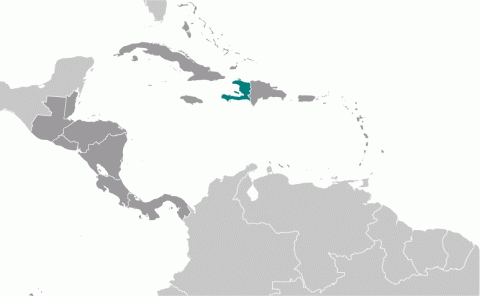

Minimal Advancement
In 2024, Haiti made minimal advancement in efforts to eliminate the worst forms of child labor. The Institute of Social Welfare and Research established an orientation center dedicated to reintegrating children previously associated with armed groups, and 134 children received psychosocial care, 15 of whom were reintegrated into their communities. The United Nations and Haitian government also signed the Protocol on Transfer, Reception, and Leadership for Engagement of Children Associated with Gangs in the Process of Security Operations. The protocol will establish transit centers that provide education, psychosocial services, and vocational training for children previously associated with gangs. However, despite these efforts, government officials may be participating in the supplying of weapons and financial resources to gangs who recruit and coerce children into illicit activity. A growing use of government force against children in gangs is also becoming more prevalent. In addition, Haiti’s laws do not comply with international standards because minimum age and hazardous work protections apply only to children with a formal employment contract. Furthermore, Haiti lacks a list of hazardous occupations and activities prohibited to children.
| Children | Age | Percent and Population |
|---|---|---|
| Working | 5 to 14 | 34.4% (815,993) |
| Hazardous Work by Children | 15 to 17 | Unavailable |
| Attending School | 5 to 14 | 92.4% |
| Combining Work and School | 7 to 14 | 34.9% |
| Sector/Industry | Activity |
|---|---|
| Agriculture | Working in agriculture. Raising livestock. Fishing. |
| Industry | Construction. |
| Services | Domestic work and street work as vendors, beggars, and car washers. Selling alcohol† and tobacco. |
| Categorical Worst Forms of Child Labor‡ | Forced labor in domestic work, agriculture, street vending, and begging. Commercial sexual exploitation, sometimes as a result of human trafficking. Use in illicit activities, including by criminal groups in drug trafficking, sometimes as a result of human trafficking. |
† Determined by national law or regulation as hazardous and, as such, relevant to Article 3(d) of ILO C. 182.
‡ Child labor understood as the worst forms of child labor per se under Article 3(a)–(c) of ILO C. 182.
Children at Higher Risk
Gang recruitment of children has increased by 70 percent over the past year. At present, as many as half of all gang members are children. These children are extremely vulnerable to forced labor and are coerced into performing a wide range of criminal activities, including combat, extortion, looting, killing, kidnapping, spying, and surveillance. Gang members and leaders routinely sexually exploit girls and coerce them into performing house chores. Due to poverty, a significant number of parents who are unable to care for their children send them to residential care centers or to relatives or strangers who are expected to provide the children with food, shelter, and schooling in exchange for household work. In practice, some of these children receive care and access to education, while many others become victims of labor exploitation and abuse. It is estimated that 407,000 children are involved in this, with 286,000 of them being under 14 years old. Children placed in orphanages also face particular vulnerability to the worst forms of child labor. Foreign donations generate steady income for orphanages in Haiti; however, it is estimated that only 15 percent of them have the proper legal authorizations. Children are often sexually exploited, sold for adoption, and/or forced to beg. Haiti has more than 750 orphanages that house more than 30,000 children. Research indicates that some children in orphanages engage in child labor as domestic workers and are prevented from attending school.
Barriers to Education Access
There are significant barriers to education in Haiti, especially in rural areas, including extreme poverty, security risks, language barriers, access to transportation, limited availability of teachers, dilapidated school premises, and an overall lack of school infrastructure. Moreover, because approximately 80 percent of all existing schools are private, most Haitian children are enrolled in private schools that charge tuition and other fees, making education prohibitively expensive for many families. In addition, estimates show that approximately 10 percent of students drop out of school before grade six and 40 percent before the end of grade nine, making these children more vulnerable to child labor, including its worst forms. Research also indicates that less than 14 percent of children with disabilities attend school, with only 3.5 percent of an estimated 120,000 children with disabilities attending school in the capital Port-au-Prince.
| Standard | Age | Meets International Standards | Legislation |
|---|---|---|---|
| Minimum Age for Work | 16 | ✗ | Articles 2, 340, 513, and 515 of the Labor Code; Article 10 of the Law Organizing and Regulating Labor |
| Minimum Age for Hazardous Work | 18 | ✗ | Articles 2, 10, 333–336, 340, 513, and 515 of the Labor Code; Article 2 of the Act on the Prohibition and Elimination of All Forms of Abuse, Violence, Ill Treatment, or Inhumane Treatment Against Children (Act of 2003) |
| Identification of Hazardous Occupations or Activities Prohibited for Children | ✗ | Articles 333–336 of the Labor Code | |
| Prohibition of Slavery, Debt Bondage, and Forced Labor | ✗ | Articles 4, 513, and 515 of the Labor Code; Article 2 of the Act of 2003; Articles 1.1, 11, 15, and 21 of the Anti-Trafficking in Persons Law | |
| Prohibition of Child Trafficking | ✓ | Article 2 of the Act of 2003; Articles 1.1, 11, 12, 15, and 21 of the Anti-Trafficking in Persons Law | |
| Prohibition of Commercial Sexual Exploitation of Children | ✓ | Article 2 of the Act of 2003; Article 281 of the Penal Code; Articles 1.1, 11, 12, and 21 of the Anti-Trafficking in Persons Law | |
| Prohibition of Using Children in Illicit Activities | ✓ | Articles 47–51 and 72 of the Law on the Control and Suppression of Illicit Drug Trafficking; Article 2 of the Act of 2003 | |
| Minimum Age for Voluntary State Military Recruitment | ✗ | ||
| Prohibition of Compulsory Recruitment of Children by (State) Military | ✓ | Article 268 of the Constitution | |
| Prohibition of Military Recruitment by Non-state Armed Groups | ✗ | Article 70 of the Penal Code; Article 2 of the Act of 2003 | |
| Compulsory Education Age | 15 | ✓ | Article 23 of the Decree on the Reorganization of the Haitian Education System |
| Free Public Education | ✓ | Articles 32.1 and 33 of the Constitution |
The Labor Code, which establishes the penalty for violations of the minimum age for work and hazardous work protections, applies only to workers with a formal employment agreement, a stipulation that does not conform to international standards that require all children to be protected under the laws establishing a minimum age for work and hazardous work protections. Furthermore, as the minimum age for work is 16, children aged 15 are vulnerable to exploitative child labor because they are not required to attend school but also are not yet legally permitted to work. The Labor Code prohibits children under age 18 from working in establishments that sell alcohol and from working at night in industrial enterprises. However, the types of hazardous work prohibited for children do not cover agriculture, an economic sector in which children are exposed to hazardous substances and to temperatures that can damage their health. Furthermore, although the Anti-Trafficking in Persons Law criminalizes human trafficking for forced labor, servitude, and debt bondage, it does not criminally prohibit slavery. Moreover, while Haiti’s Constitution establishes the age for compulsory military recruitment at age 18 and sources suggest that recruitment materials set the minimum age for voluntary recruitment at that age, research could not find evidence of a law that establishes the age for voluntary recruitment.
| Organization/Agency | Role & Activities |
|---|
| Ministry of Social Affairs and Labor (MAST): Enforces laws related to child labor by receiving complaints, conducting investigations, referring cases to juvenile courts, and issuing employment permits to approve certain forms of labor for children between ages 15 and 18. Develops and implements programs to raise awareness of child labor and provide social services to child survivors of labor exploitation. Its agents at the Institute of Social Welfare and Research (IBESR) perform child protection inspections, including following up on reported incidents of child labor, and are responsible for accrediting residential care centers. However, the political, social, and security crises have worsened working conditions, limiting inspections, above all outside Port-au-Prince. Reports indicate that a lack of personnel and financial resources to cover the costs of transportation, fuel, and appropriately equipped workplaces, as well as increased gang violence, severely impacted enforcement efforts in 2024. |
| Haitian National Police: Investigate crimes involving the worst forms of child labor, including child trafficking and commercial sexual exploitation through its Brigade for the Protection of Minors (BPM), which submits investigations to judicial authorities for criminal prosecution and refers child survivors to IBESR. BPM maintains 22 offices around the country, including 2 offices along the Haiti-Dominican Republic border. Through its Border Police Unit, POLIFRONT, it enforces Haiti’s Customs Code and investigates transnational crimes, including child trafficking. POLIFRONT is also responsible for referring cases involving vulnerable children to IBESR, and operates at the border crossings of Ouanaminthe, Anse-à-Pitres, and Malpasse. Reports indicate that a lack of personnel and financial resources for things like transportation, fuel, and appropriately equipped workplaces, as well as increased gang violence, severely impacted enforcement efforts in 2024. |
| Overview of Enforcement Efforts | 2024 |
|---|---|
| Has a Labor Inspectorate | Yes |
| Able to Assess Civil Penalties | Yes |
| Routinely Conducted Worksite Inspections | Unknown |
| Unannounced Inspections Permitted | Yes |
| Has a Complaint Mechanism | Yes |
| Imposed Penalties for Child Labor Violations | Unknown |
| Conducted Criminal Investigations for Worst Forms of Child Labor Crimes | Yes |
| Imposed Penalties for Worst Forms of Child Labor Crimes | Unknown |
In 2024 an unknown number of labor inspectors conducted an unknown number of worksite inspections, finding 10 child labor violations. It is unknown how many investigations into suspected cases of the worst forms of child labor were conducted, and whether prosecutions were initiated, or perpetrators were convicted.
| Coordinating Body | Role & Activities |
|---|
| National Tripartite Committee for the Elimination of the Worst Forms of Child Labor: Develops policies, approves programs, and coordinates, monitors, and evaluates efforts to address child labor in Haiti. Chaired by MAST, receives technical support from the ILO. |
| Policy | Description & Activities |
|---|
| National Strategy to Combat Human Trafficking:* Finalized in September 2024, the strategy is divided into four lines of effort over the next decade: prevent human trafficking, protect and care for human trafficking victims, prevent and prosecute human trafficking, and coordinate the fight against human trafficking. A steering committee composed of MAST and National Committee for the Fight Against Human Trafficking (CNLTP) officials will be responsible for the coordination and implementation of the strategy. The activities are estimated to cost hundreds of millions of U.S. dollars, well outstripping the government budget for trafficking-in-persons initiatives. The document does not clarify how the Haitian government will fund these activities. |
| National Social Protection and Promotion Policy: Aims to build institutional resilience for social protection and promotion in response to economic shocks and health crises. The policy included specific elements to promote childhood social care and support employment and employability. Relevant lines of effort include the identification and removal of children from work and vocational training for youth, among other activities. Past efforts include the World Bank partnering with MAST and the UN World Food Program (WFP) to deliver cash transfers to targeted households, and the Inter-American Development Bank partnering with WFP and the Economic and Social Assistance Fund to deliver food and cash to vulnerable households in several departments of the country. Research was unable to determine whether activities were undertaken to implement this policy during the reporting period. |
* Policy was approved during the reporting period.
| Program | Description & Activities |
|---|
| Special Program of Free Education (PROSGATE):‡ Replaced the National Free Education Program and aims to increase poor children’s access to education. Includes school grants intended to eliminate school fees and to cover the costs of accelerated learning programs for students who are behind in school. Research was unable to determine whether program activities were undertaken during the reporting period. |
| UN-Government of Haiti Protocol on Transfer, Reception, and Leadership for Engagement of Children Associated with Gangs in the Process of Security Operations:* In January 2024, UN and Haitian government entities signed the Protocol on Transfer, Reception, and Leadership for Engagement of Children Associated with Gangs in the Process of Security Operations. UNICEF and MAST established an initial transit and reception center for children that can house 50 individuals and where needs can be assessed, including for education and psychosocial services, as well as for potential vocational training. The protocol represents an initial model for demobilizing children in gangs. |
* Program was launched during the reporting period.
‡ Program is funded by the Government of the Republic of Haiti.
| Area | Suggested Action |
|---|---|
| Legal Framework | Ensure that minimum age for work and hazardous work protections apply to all children, including those without formal employment contracts. |
| Adopt a list of hazardous occupations and activities and ensure that the list is comprehensive and covers work in hazardous agricultural environments. | |
| Criminally prohibit slavery. | |
| Establish a minimum age for voluntary recruitment by the state military, at age 18 or at age 16, with safeguards to ensure voluntariness. | |
| Criminally prohibit the recruitment of children under age 18 by non-state armed groups. | |
| Raise the compulsory education age from age 15 to age 16 so that it aligns with the minimum age for work. | |
| Enforcement | Collect and publish information on labor law enforcement efforts, including the number of labor inspectors, labor inspectorate funding, routine inspections carried out, and unannounced inspections conducted. |
| Collect and publish information on the number of criminal investigations undertaken, convictions achieved, the number of violations found, and total penalties imposed and collected. | |
| Ensure that children are not inappropriately detained or incarcerated for their association with gangs. | |
| Ensure that the number of labor and criminal law enforcement agents, training, and material and financial resources for labor and criminal law enforcement agencies are sufficient to adequately enforce laws related to child labor, including its worst forms throughout the country, including in orphanages. | |
| Conduct targeted and routine inspections in orphanages to combat forced begging and exploitation of children. | |
| Expand the reach of hotlines operated by the Brigade for the Protection of Minors and the Institute of Social Welfare and Research to facilitate reporting of child exploitation cases in areas beyond Port-au-Prince, including in rural areas. | |
| Investigate and prosecute government officials involved in supplying weapons and financial resources to gangs who recruit and coerce children into gang activity. | |
| Employ at least 129 labor inspectors to ensure adequate coverage of the labor force of approximately 5.2 million people. | |
| Coordination | Take steps to publish information on the activities implemented by the National Tripartite Committee for the Elimination of the Worst Forms of Child Labor. |
| Government Policies | Implement the National Social Protection and Promotion Policy and publish results from activities undertaken during the reporting period. |
| Ensure that the National Strategy to Combat Human Trafficking is fully funded. | |
| Social Programs | Collect and publish data on the extent and nature of child labor to inform policies and programs. |
| Enhance efforts to eliminate barriers to education and broaden accessibility for all children by increasing the number of public schools and teachers, especially in rural areas; improving school infrastructure and safety; ensuring that public schools address language barriers; and ensuring that schools meet the specific educational needs of vulnerable populations. | |
| Implement the Special Program of Free Education during the reporting period and make information about implementation measures publicly available. |