


Child Labor and Forced Labor Reports
Guatemala







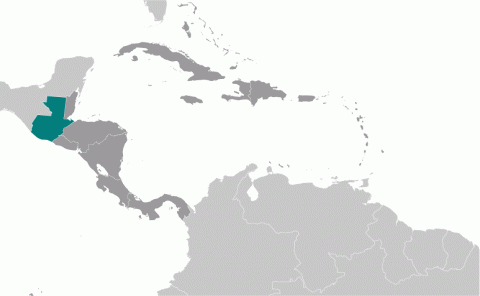

Moderate Advancement
In 2024, Guatemala made moderate advancement in efforts to eliminate the worst forms of child labor. The Ministry of Labor reactivated the Thematic Working Group on the Prevention and Eradication of Child Labor to implement national policies to eradicate child labor. Guatemala also removed barriers to education by renovating 11,000 schools and issuing guidelines for bilingual curriculum to provide education in local languages. In addition, 402,505 students benefited from school feeding and health programs. However, despite these efforts, an insufficient number of labor inspectors and resources limit the Ministry of Labor and Social Welfare’s ability to address child labor. Existing social programs are insufficient to reach all children engaged in exploitative labor, particularly those engaged in domestic work or agriculture.
| Children | Age | Percent and Population |
|---|---|---|
| Working | 10 to 14 | 16.3% (306,555) |
| Boys | 22.2% | |
| Girls | 10.4% | |
| Urban | 10.0% | |
| Rural | 19.6% | |
| Hazardous Work by Children | 15 to 17 | 12.1% (122,724) |
| Boys | 20.3% | |
| Girls | 4.3% | |
| Urban | 7.9% | |
| Rural | 15.0% | |
| Attending School | 10 to 14 | 88.0% |
| Combining Work and School | 10 to 14 | 11.8% |
| Sector/Industry | Percent of Population |
|---|---|
| Agriculture | 50.0% |
| Industry | 18.5% |
| Services | 31.5% |
| Sector/Industry | Activity |
|---|---|
| Agriculture | Working in agriculture, including in planting and harvesting coffee, broccoli, corn, and sugarcane. Ranching, forestry, and fishing. |
| Industry | Construction. Manufacturing gravel† and fireworks.† |
| Services | Domestic work. Street work,† including vending,† performing,† begging, and shoe shining.† Making corn tortillas. Working in restaurants, grocery stores, liquor stores, and tortilla stores. Vehicle and motorcycle repair. Working in garbage dumps.† |
| Categorical Worst Forms of Child Labor‡ | Forced labor in agriculture, domestic work, street begging and vending, and manufacturing food products. Commercial sexual exploitation, sometimes as a result of human trafficking. Use in illicit activities, including drug trafficking, sometimes as a result of human trafficking. |
† Determined by national law or regulation as hazardous and, as such, relevant to Article 3(d) of ILO C. 182.
‡ Child labor understood as the worst forms of child labor per se under Article 3(a)–(c) of ILO C. 182.
Children at Higher Risk
Reports indicate that Garifuna, native children, and children from neighboring countries are particularly vulnerable to child labor due to experiencing higher levels of poverty, language barriers, and poor quality and lack of availability of public education. Child labor mostly occurs in the country’s rural regions, where people often engage in agricultural activities. Traffickers target native children for forced labor. Departments with high numbers of commercial sexual exploitation victims include Alta Verapaz, Escuintla, Guatemala, Huehuetenango, Quiche, and Quetzaltenango. In addition, some children are forced to engage in street begging and vending in Guatemala City and along the border with Mexico.
Barriers to Education Access
Although education is free in Guatemala, students continued to face a lack of teachers, schools, transportation, and adequate sanitation in the public education system. High rates of sexual violence, insecurity, crime, and violence in schools’ surroundings or during students’ travel to school contributed to inadequate learning outcomes and high dropout rates, particularly in rural areas that lacked basic school infrastructure. Some children were unable to access public education in rural areas because their parents could not register them with the National Registry of Persons locally, requiring parents to travel long distances to complete the registry. The education system is unable to address the needs of students with disabilities, and the few existing education programs for children with disabilities rely mainly on non-profit support. In addition, girls in rural areas have lower enrollment rates in secondary school than boys. Furthermore, there are not enough qualified teachers to provide instruction in the predominant native languages, and classroom materials available in these languages are insufficient.
| Standard | Age | Meets International Standards | Legislation |
|---|---|---|---|
| Minimum Age for Work | 14 | ✓ | Articles 31, 148 and 272 of the Labor Code; Article 6 of Government Accord 112-2006; Ministerial Agreement Number 260-2019 |
| Minimum Age for Hazardous Work | 18 | ✓ | Article 148 of the Labor Code; Article 1 of Government Accord 250-2006; Article 32 of Government Accord 112-2006 |
| Identification of Hazardous Occupations or Activities Prohibited for Children | ✓ | Article 4, Section X of Ministerial Accord 154-2008 | |
| Prohibition of Slavery, Debt Bondage, and Forced Labor | ✓ | Article 202 and 202 ter and quater of the Penal Code; Articles 2 and 51 of the Law of Integral Protection of Children and Adolescents | |
| Prohibition of Child Trafficking | ✓ | Article 202 ter and quater of the Penal Code | |
| Prohibition of Commercial Sexual Exploitation of Children | ✓ | Articles 191–194, 193 bis and ter, and 195 bis and ter of the Penal Code | |
| Prohibition of Using Children in Illicit Activities | ✓ | Articles 27, 306, and 307 of the Penal Code | |
| Minimum Age for Voluntary State Military Recruitment | 18 | ✓ | Articles 2 and 57 of the Law of Integral Protection of Children and Adolescents |
| Prohibition of Compulsory Recruitment of Children by (State) Military | ✓ | Articles 68 and 69 of the Constitutive Law of the Guatemalan Army | |
| Prohibition of Military Recruitment by Non-state Armed Groups | ✗ | Article 57 of the Law of Integral Protection of Children and Adolescents; Article 245 of the Constitution | |
| Compulsory Education Age | 15‡ | ✓ | Article 74 of the Constitution; Article 33 of the National Education Law; Ministerial Agreement 1055-2009 |
| Free Public Education | ✓ | Article 74 of the Constitution; Article 1 of Government Agreement 226-2008; Article 33 of the National Education Law |
‡ Age calculated based on available information
Although Articles 32 and 150 of the Labor Code allow the Ministry of Labor and Social Welfare (MTPS) to authorize children under age 14 to work under exceptional circumstances—including if MTPS determines that children must work to support their family due to poverty—the law does not define the total number of hours, kinds of tasks, or age range applicable for this exception, which is inconsistent with international standards on light work. Nonetheless, the MTPS indicated that no such exceptions have been granted since 2016. In addition, the MTPS previously approved Ministerial Agreement Number 260-2019, "Procedure for the effective application of Convention 138 of the International Labor Organization, regarding the Convention on the Minimum Age for Admission of Employment," which sets forth procedures for protecting adolescents between ages 15 and 18 from the worst forms of child labor. However, the agreement does not explicitly cover children aged 14, who are allowed to work under Guatemala’s Labor Code, or children under age 14, who are allowed to work in exceptional circumstances. Therefore, it is unclear if this mechanism effectively raises the minimum age for work to age 15. In addition, as the minimum age for work is lower than the compulsory education age, children may be encouraged to leave school before the completion of their compulsory education.
| Organization/Agency | Role & Activities |
|---|
| Ministry of Labor and Social Welfare’s (MTPS) Inspection Division: Enforces child labor laws, including prohibitions on the worst forms of child labor, by inspecting businesses and responding to child labor complaints. Refers children found engaged in child labor to government social services, complaints of child labor to the MTPS Adolescent Workers Protection Unit, cases of the worst forms of child labor to the Secretariat Against Sexual Violence, Exploitation, and Trafficking in Persons (SVET), and unresolved cases to labor courts for review and sanctions, as appropriate. However, reports indicate labor inspectors encounter barriers when conducting unannounced inspections, and inspections in remote locations are inhibited by funding constraints and violence in departments with high rates of child labor. |
| Public Ministry, Special Prosecutor’s Office: Receives cases of the worst forms of child labor from labor inspectors. Investigates cases of human trafficking and forced labor through the Special Prosecutor’s Office Against Trafficking in Persons. However, law enforcement agencies lack sufficient resources, such as vehicles, fuel, training, and criminal investigators to carry out investigations, particularly outside Guatemala City. Reports also indicate that judges are often unable to schedule hearings and trials in a timely manner, and officials often lack sufficient training to properly identify human trafficking cases and file criminal charges. |
| Overview of Enforcement Efforts | 2024 |
|---|---|
| Has a Labor Inspectorate | Yes |
| Able to Assess Civil Penalties | Yes |
| Routinely Conducted Worksite Inspections | Yes |
| Unannounced Inspections Permitted | Yes |
| Has a Complaint Mechanism | Yes |
| Imposed Penalties for Child Labor Violations | Yes |
| Conducted Criminal Investigations for Worst Forms of Child Labor Crimes | Yes |
| Imposed Penalties for Worst Forms of Child Labor Crimes | Yes |
In 2024, 164 labor inspectors conducted 29,828 worksite inspections, finding 45‡ child labor violations. There were also 173* investigations into suspected worst forms of child labor crimes with 73*prosecutions initiated and 34* perpetrators convicted.
‡ Data are from January 1 to November 21, 2024.
* Data are from January 1 to August 16, 2024.
| Coordinating Body | Role & Activities |
|---|
| The Interinstitutional Coordinator against Labor Exploitation and Child Labor (CICELTI): Joint commission that coordinates the government’s approach to combating and providing services to victims of human trafficking, labor exploitation, forced labor, and the worst forms of child labor. During the reporting period, CICELTI carried out joint operations and coordinated the raids, which involved institutions working together to verify children’s working conditions, calculating benefits owed to them, rescuing minors identified, and prosecuting persons who exploited the minors. |
† The government had other mechanisms that may have addressed child labor issues or had an impact on child labor.
| Policy | Description & Activities |
|---|
| Roadmap for the Prevention and Eradication of Child Labor in all its Forms and the Protection of Adolescent Workers (2022–2025): Serves as the national strategic framework to guide government action aimed at preventing and eradicating child labor and its worst forms in the country. During the reporting period, conducted training sessions on rights of children and adolescents for 19,055 children and adults, with additional sessions of the rights of working adolescents at educational centers. |
| Comprehensive Health Care Protocol with Cultural Relevance for Children and Adolescents in Situations of Child Labor and its Worst Forms: Requires public health workers to enter information into a database about any child whose injuries may have been labor related. Implemented by the Ministry of Public Health and Social Assistance. Although research indicates that this program was active during the reporting period, the government did not report specific activities conducted to implement the policy. |
| Public Policy on Human Trafficking and the Comprehensive Protection of Victims (2014–2024): Aims to guarantee protection for and comprehensive attention to human trafficking survivors, and promote prevention, detection, prosecution, and sanction of this crime. Includes a National Plan of Strategic Action that directs the government’s actions on preventing and addressing human trafficking. Under the National Plan, SVET trained more than 4,000 public employees on human trafficking and reached 225 of 340 municipalities with prevention and training in 2024. |
| Program | Description & Activities |
|---|
| Business Network for the Prevention and Elimination of Child Labor in Guatemala (Red Empresarial): Aims to promote the prevention and eradication of child labor. Members include the Ministries of Education and Agriculture, MTPS, the Thematic Working Group for the Prevention and Eradication of Child Labor, the ILO, UNICEF, the UN Food and Agriculture Organization, and representatives from the private sector. In 2024, members met monthly and included government, private sector, and civil society representatives. |
| Ministry of Development’s Social Poverty Reducing Programs:‡ Conditional Cash Transfer for Education and Health Program (Mi Bono Social) that provides cash assistance to families with school-age children, conditioned on children’s school attendance. Similarly, the Conditional Cash Transfers for Food Assistance Program (Mi Bolsa Social) provides food assistance to poor families, with the requirement that their children attend school. Social Dining Hall (Mi Comedor Social) provides access to food for people in situations of poverty, crisis, and emergency, including children. In 2024, the government continued to support these programs and helped 5,700 youth enroll in formal education and training programs, targeting children engaged in child labor, among others, through the Beca Social program. |
| Mobile Units for the Prevention of Sexual Violence, Exploitation and Human Trafficking: Established by SVET, with support from the UN Refugee Agency. Consists of a fleet of seven vehicles that travel to areas in the country with little national government presence, with the aim of preventing and creating awareness about crimes related to exploitation, trafficking in persons, and sexual violence. Carries out detection and awareness trainings on trafficking in persons within rural and often remote communities and provides information to survivors of crimes of trafficking in persons but does not have authority to accept complaints or make referrals. Since their creation in 2021, the units have reached an estimated 69,000 individuals in 600 communities. During the reporting period, the government continued to deploy mobile units to areas at high risk of sexual violence, exploitation, and child trafficking. |
‡ Program is funded by the Government of Guatemala.
† The government had other social programs that may have included the goal of eliminating or preventing child labor.
| Area | Suggested Action |
|---|---|
| Legal Framework | Criminally prohibit the recruitment of children under age 18 into non-state armed groups. |
| Eliminate the exception allowing some children under age 14 to work or establish a light work framework for children aged 12 to 14 outlining restrictions on working conditions, type of work, and number of hours of work permitted. | |
| Clarify whether Ministerial Agreement 260-2019 raises the minimum working age to 15. If it did not, then raise the minimum age for work from age 14 to 15 to align with the compulsory education age. | |
| Enforcement | Improve the quality of inspections by ensuring that inspectors routinely carry out unannounced labor inspections, reach remote and rural locations, can communicate with local language speakers, and have sufficient office space, fuel, and vehicles to complete their work. |
| Increase the number of labor inspectors from 164 to 478 to ensure adequate coverage of the labor force of approximately 7.2 million workers. | |
| Collect fines for labor violations and ensure that conciliations are properly conducted and in accordance with the labor code and publish that information. | |
| Ensure that hearings and trials addressing human trafficking and violence against girls in specialized courts are scheduled in a timely manner, that judges and officials are trained in trafficking in persons concepts, and that perpetrators are charged appropriately. | |
| Ensure that criminal investigators have sufficient resources and staff to conduct quality criminal investigations in all geographical areas of the country, such as assigning a budget specifically to the Special Prosecutor's Office Against Trafficking in Persons. | |
| Enforce sentences for crimes related to the worst forms of child labor, including ensuring victims receive compensation when due. | |
| Social Programs | Continue efforts to remove barriers to education for all children, including girls, children with disabilities, and children living in rural areas, by recruiting and training more qualified teachers, building additional schools with appropriate facilities, increasing security, providing textbooks to all public schools, and removing school fees and transportation costs. |
| Provide assistance to children removed from the worst forms of child labor with adequate social services and provide high standards of safety and care for children in government-run shelters. | |
| Ensure that social programs are implemented, well-funded, able to carry out their objectives, reach populations outside urban centers, address child labor in agriculture and domestic work, focus on vulnerable groups such as girls, and report on yearly activities. | |
| Ensure the safety of NGO officials, human rights workers, judges, and labor activists so they can continue their work to implement social programs that address and prevent child labor. |