


Child Labor and Forced Labor Reports
Chad




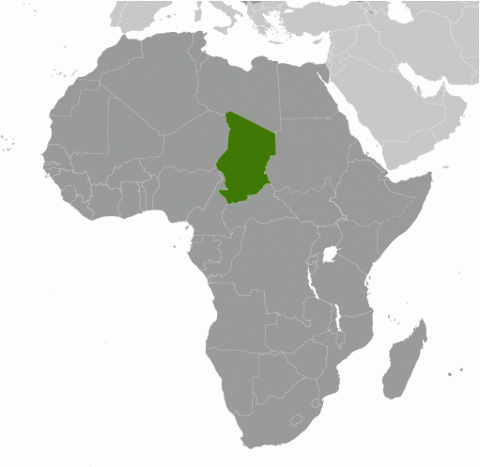

No Advancement – Efforts Made But Complicit in Forced Child Labor
In 2024, Chad is receiving an assessment of no advancement. Despite initiatives to address child labor, Chad is assessed as having made no advancement because it demonstrated complicity in the use of forced child labor. Reports indicate that some officials have participated directly in child trafficking or forced child labor, while others have been complicit by intimidating victims from pursuing criminal cases, covering up allegations of trafficking crimes, intimidating police or prosecutors, or not pursuing cases to protect suspected traffickers. Otherwise, the government expanded its partnership with Education Cannot Wait, enabling delivery of education services to some 66,000 displaced children, which helps prevent them from resorting to child labor and creates a protective environment that reduces their vulnerability to trafficking. However, the government did not publish key data on its civil and criminal child labor law enforcement efforts. In addition, gaps remain in Chad’s legal framework to adequately protect children from the worst forms of child labor, including the lack of prohibition against the use of children in illicit activities and the exclusion of some non-citizens from free public education.
| Children | Age | Percent and Population |
|---|---|---|
| Working | 5 to 14 | 45.8% (Unavailable) |
| Hazardous Work by Children | 15 to 17 | Unavailable |
| Attending School | 5 to 14 | 39.1% |
| Combining Work and School | 7 to 14 | 27.0% |
| Sector/Industry | Activity |
|---|---|
| Agriculture | Farming and forestry. Herding cattle and other livestock. Working in fishing, including in catching, processing/smoking, and selling activities. |
| Industry | Working in mining† and carpentry. Producing construction materials and carrying heavy loads.† |
| Services | Domestic work. Street work, including vending, garbage scavenging, and carrying heavy loads.† Street begging† in urban centers. Working in auto repair shops. |
| Categorical Worst Forms of Child Labor‡ | Commercial sexual exploitation, sometimes as a result of human trafficking. Forced labor in agriculture, livestock herding, begging, domestic work, fishing, forestry, mining, and street vending. Recruitment by non-state armed groups for use in armed conflict. |
† Determined by national law or regulation as hazardous and, as such, relevant to Article 3(d) of ILO C. 182.
‡ Child labor understood as the worst forms of child labor per se under Article 3(a)–(c) of ILO C. 182.
Children at Higher Risk
Children entrusted to extended family or strangers who promise to care for them face increased risk in Chad, as frequently these situations lead to forced labor. Girls in these situations are more likely to be subjected to domestic servitude, while boys are more likely to be exploited in pastoral activities, mining, or construction. Reporting suggests that boys sent to Koranic schools, or mouhadjirin, may be forced to beg and surrender the money they receive to their teachers. Displaced children in Chad’s Lac Region and the border areas with Sudan, the latter of whose numbers have increased significantly due to the ongoing conflict in Sudan, are also vulnerable to recruitment by non-state armed groups, labor exploitation, and human trafficking due to the instability of their situation and lack of access to support systems.
Barriers to Education Access
Poor access to birth registration documents in rural Chad creates an obstacle for children once they reach third grade, when formal identification is required to take year-end exams. While basic education is free by law, indirect costs of schooling represent an insurmountable burden for many families. Other barriers to education include shortages of schools, classrooms, and teachers; lack of transportation; and violence in schools. Girls experience higher dropout rates than boys, and children with disabilities face barriers to school attendance, including inadequate facilities.
| Standard | Age | Meets International Standards | Legislation |
|---|---|---|---|
| Minimum Age for Work | 14 | ✓ | Article 52 of the Labor Code; Article 1 of the Decree Relating to Child Labor |
| Minimum Age for Hazardous Work | 18 | ✓ | Articles 6 and 7 of the Decree Relating to Child Labor |
| Identification of Hazardous Occupations or Activities Prohibited for Children | ✓ | Articles 6 and 10 of the Decree Relating to Child Labor; Articles 5, 19, and 22 of the President’s Ordinance on Trafficking in Persons | |
| Prohibition of Slavery, Debt Bondage, and Forced Labor | ✓ | Article 20 of the Constitution; Chapter 1, Article 5 of the Labor Code; Articles 5–8 and 15 of the President’s Ordinance on Trafficking in Persons; Articles 292(c), 327, 328, 330, and 331 of the Penal Code | |
| Prohibition of Child Trafficking | ✓ | Articles 3, 5, 6.2, and 7.1 of the President’s Ordinance on Trafficking in Persons; Articles 10, 330, and 331 of the Penal Code | |
| Prohibition of Commercial Sexual Exploitation of Children | ✗ | Articles 335, 336(a), 362, 364, 443, and 446 of the Penal Code; Articles 81–85 of the Law on Cyber Security and Fight Against Cyber Criminality; Articles 5–7, 16, and 22 of the President’s Ordinance on Trafficking in Persons | |
| Prohibition of Using Children in Illicit Activities | ✗ | ||
| Minimum Age for Voluntary State Military Recruitment | 18 | ✓ | Article 32 of the Law on the Organization of the Armed Forces; the Ordinance Prohibiting the Use of Children in Armed Conflict; Article 52 of Military Statute N° 006/PR/06; Article 5 of the President’s Ordinance on Trafficking in Persons; Articles 10, 286(cc), 288(g), and 370 of the Penal Code |
| Prohibition of Compulsory Recruitment of Children by (State) Military | ✓ | Article 32 of the Law on the Organization of the Armed Forces; the Ordinance Prohibiting the Use of Children in Armed Conflict; Article 22 of the African Charter on the Rights and Welfare of the Child; Articles 5 and 18 of the President’s Ordinance on Trafficking in Persons; Articles 10, 286(cc), 288(g), and 370 of the Penal Code | |
| Prohibition of Military Recruitment by Non-state Armed Groups | ✓ | Ordinance Prohibiting the Use of Children in Armed Conflict; Articles 5 and 18 of the President’s Ordinance on Trafficking in Persons; Articles 10, 286(cc), 288(g), and 370 of the Penal Code | |
| Compulsory Education Age | 16‡ | ✓ | Articles 21, 23, 25, and 28 of the Law Orienting the Education System; Article 38 of the Constitution |
| Free Public Education | ✗ | Article 9 of the Law Orienting the Education System; Article 38 of the Constitution |
‡ Age calculated based on available information
Chadian law does not fully meet the international standard on commercial sexual exploitation of children because it does not criminally prohibit the use of a child by a client for prostitution, nor does it prohibit the use, procuring, and offering of a child in pornographic performances. Chad also lacks a specific legal prohibition on children being used, offered, or procured for illicit activities. Furthermore, as the minimum age for work is lower than the compulsory education age, children may be encouraged to leave school before completion of compulsory education. Lastly, while Chad’s laws provide for free basic education for citizens and refugees, they do not meet the international standard because they do not cover non-citizen children without refugee status.
| Organization/Agency | Role & Activities |
|---|
| Ministry of Public Service, Employment, and Social Dialogue (MOPS): Oversees Chad’s labor inspectorate and enforces child labor laws. Administers a directorate charged with addressing the worst forms of child labor and maintains a specific point of contact to assist in coordinating child protection and human trafficking issues. Under Chadian law, labor inspectors must refer violations to the Ministry of Justice (MOJ), which is responsible for issuing penalties or pursuing a criminal investigation. However, lack of penalties from MOJ perpetuated a culture of impunity during the reporting period. |
| National Police’s Child Protection Brigade (CPB): Enforces child protection laws. Investigates allegations of child exploitation, including human trafficking and the worst forms of child labor, and removes children from exploitative situations. Includes 100 "focal points" spread throughout all 23 provinces. These focal points are not trained investigators, but they are responsible for coordinating investigations with the country’s seven hub offices and referring allegations to investigators. The CPB is active in Chad’s largest cities (N’Djamena, Moundou, Sarh, Mongo, Mao, and Abéché). The CPB or other local authorities notify MOJ’s Directorate for Protection and Legal Monitoring of Children, UNICEF, and local NGOs when there is a case of child trafficking or exploitation. The government’s regional child protection technical committees also identify and refer child trafficking victims to the CPB and the Ministry of Women, Family, and National Solidarity (MWFNS). The CPB coordinates with MWFNS, MOPS, and MOJ from its UNICEF-funded headquarters in N’Djamena to provide children with shelter, assist with investigations, and search for long-term accommodations. However, lack of resources hampered its ability to effectively fulfill its mandate during the reporting year. |
| Overview of Enforcement Efforts | 2024 |
|---|---|
| Has a Labor Inspectorate | Yes |
| Able to Assess Civil Penalties | Yes |
| Routinely Conducted Worksite Inspections | Unknown |
| Unannounced Inspections Permitted | Yes |
| Has a Complaint Mechanism | No |
| Imposed Penalties for Child Labor Violations | Unknown |
| Conducted Criminal Investigations for Worst Forms of Child Labor Crimes | Unknown |
| Imposed Penalties for Worst Forms of Child Labor Crimes | Unknown |
In 2024, it is unknown how many worksite inspections were performed by Chad’s 30 labor inspectors and how many child labor violations were found. It is also unknown how many investigations were made into suspected worst forms of child labor crimes, how many prosecutions were initiated, and how many perpetrators were convicted.
Complicity in forced child labor and obstruction of justice continue to be significant concerns in Chad, most notably in livestock herding but also, to a lesser extent, in the mining sector. Observers report that complicity exists at multiple levels, including high-ranking military officers, local government officials, and local security forces. Some officials participate directly in child trafficking or forced child labor, while others may intimidate victims from pursuing criminal cases, cover up allegations of trafficking crimes, intimidate police or prosecutors, or not pursue cases to protect suspected traffickers. Despite increased attention brought to the issue by both international partners and local civil society organizations, as well as a robust legislative and penal framework in place since 2018, the Chadian government has continued to allow forced child labor and child trafficking crimes to be perpetrated with impunity by some of its members.
Research found no evidence that Chad established a mechanism to coordinate its efforts to address child labor.
| Policy | Description & Activities |
|---|
| National Road Map to Implement the President’s Ordinance on Trafficking in Persons: Adopted in 2019, with the goal of implementing a National Action Plan and ensuring interagency enforcement of the 2018 President’s Ordinance on Trafficking in Persons. Includes provisions for training members of the courts, local authorities, traditional and religious leaders, members of civil society, and members of enforcement agencies. Under this Road Map, a draft National Referral Mechanism for victims of trafficking was developed in 2021, and a National Action Plan to Combat Migrant Smuggling and Human Trafficking was developed in 2023. However, neither had been approved as of the end of the 2024 reporting period, and the decree establishing the National Commission to Combat Trafficking in Persons—the official body intended to implement and coordinate the government’s anti-trafficking efforts—had still not been signed. |
| National Child Protection Policy (2023–2038): Developed with the support of UNICEF and adopted on March 4, 2023. Aims to strengthen child protection structures in Chad, shift cultural norms such as child labor and child marriage that harm children’s development, and ensure a continuum of services for families, children, and communities. Includes a budgeted 5-year action plan for 2023–2028. During the reporting period, partners submitted proposed revisions to the Child Protection Code to Parliament. |
† The government had other policies that may have addressed child labor issues or had an impact on child labor.
| Program | Description & Activities | |
|---|---|
| Shelters Program: Operated by MWFNS, with financial support from UNICEF and the International Organization for Migration and victim coordination assistance from civil society organizations. Includes nine centers offering temporary assistance to vulnerable populations, including victims of child trafficking, and an additional center serving children experiencing homelessness, including victims of forced begging. Provides housing, food, education, medical and psychological care, and reintegration services. During the reporting period, MWFNS representatives conducted new awareness activities using the radio and public posters to ensure vulnerable populations were aware of these centers. | |
| UNICEF Programs: Multifaceted humanitarian action targeting children, including children displaced due to natural disasters and conflict in Chad. Includes interventions in education, healthcare, nutrition, and other areas of basic need. Extended again in 2024, the now-$61 million Education Cannot Wait program was developed under the Ministry of National Education’s Transitional Education Plan and supports education for over 880,000 at-risk children. Interventions include education services and materials as well as non-formal education and literacy programs for out-of-school adolescent children. UNICEF also supports the digitization of birth registration, providing registration and delivery of birth certificates directly in health centers, and maintains child-friendly spaces to support resilience among crisis-affected children. | |
| World Food Program (WFP) Programs: Aim to provide food security and educational outcomes in Chad among crisis-affected and vulnerable populations. Seek to promote resilient livelihoods and sustainable food systems, including by providing meals to school children. Prioritize strengthening national institutions to manage food security and coordinating cooperation with humanitarian and development partners in Chad. During the reporting period, provided unconditional food assistance and cash transfers to 1.2 million crisis-affected people, including over 730,000 displaced people; supported 193,507 children and school staff in school-based programs; and reached 71,540 people through asset creation and livelihood programs. |
† The government had other social programs that may have included the goal of eliminating child labor.
| Area | Suggested Action |
|---|---|
| Legal Framework | Criminalize the use of a child for prostitution and the use, procuring, and offering of a child for pornographic performances. |
| Ensure that laws specifically prohibit children from being used, offered, or procured for illicit activities. | |
| Raise the minimum age for work from 14 to 16 to align with the compulsory education age. | |
| Ensure that laws providing free basic education include all children in Chad, including non-citizens. | |
| Enforcement | Hold government and military officials accountable for participation or complicity in child labor crimes, including by prosecuting and convicting perpetrators and ensuring penalties are imposed. |
| Collect data on criminal law enforcement efforts in digital format and report it regularly, including the number of investigations conducted, prosecutions initiated, and convictions obtained related to worst forms of child labor. | |
| Establish a tip line or other dedicated mechanism for the public to submit complaints about potential child labor or child trafficking cases and ensure it is well-known and understood by the public. | |
| Ensure that cases of the worst forms of child labor offenses are investigated, prosecuted, and penalized according to the law, including cases that are identified by labor inspectors, those referred by civil society organizations, and those involving Koranic schools complicit in facilitating the worst forms of child labor, such as forced begging. | |
| Ensure that judicial system officials receive sufficient resources, including training on child labor laws, to effectively prosecute cases on the worst forms of child labor. | |
| Adopt a robust standard operating procedure for enforcement officials to use to aid in victim identification and referral to services. | |
| Establish a digital system for tracking civil enforcement efforts and publish data regularly, including information about labor inspectorate funding; the number and type of inspections conducted; and how many civil violations were found, penalties imposed, and fees collected. | |
| Increase the number of labor inspectors from 30 to 156 to ensure adequate coverage of the labor force of approximately 6.2 million workers, and provide inspectors with sufficient resources—including training, transportation, and budget allocations—to conduct inspections in both the formal and informal sectors. | |
| Coordination | Establish and fund a coordinating mechanism to prevent and eliminate child labor and report on its activities. |
| Government Policies | Adopt a policy to address all relevant worst forms of child labor in Chad, including human trafficking. |
| Ensure that activities are undertaken to implement key policies related to child labor and that data on those activities are published on an annual basis. | |
| Social Programs | Ensure access to education for all children by eliminating school-related fees; increasing the number of schools, classrooms, and teachers available throughout the country; providing transportation to cover long distances to schools; eliminating violence in schools; implementing programs to increase enrollment of girls; and providing accommodations for students with disabilities. |
| Ensure that all children are issued birth certificates so they can enroll in school and take year-end exams. | |
| Establish or expand programs to provide services to children subjected to the worst forms of child labor, such as forced child labor in mining, herding, construction, domestic work, and commercial sexual exploitation. | |
| Increase access to social protection for displaced children who may be vulnerable to labor exploitation. |