


Child Labor and Forced Labor Reports
Argentina













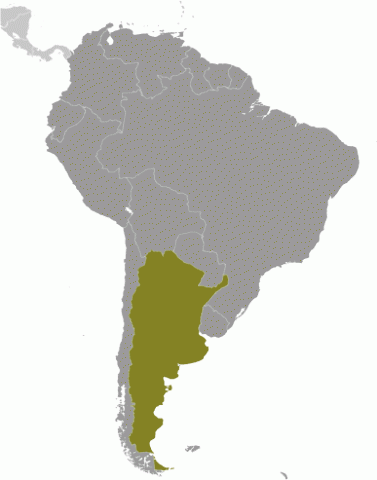

Significant Advancement
In 2024, Argentina made significant advancement in efforts to eliminate the worst forms of child labor. The government accomplished 91 percent of the actions listed under the National Plan Against Human Trafficking and Exploitation 2022–2024 and drafted a new action plan to guide efforts through 2026. Argentina and Paraguay established the first Binational Border Roundtable Against Child Labor in Posadas to facilitate cross-border collaboration and coordination to address child labor issues. The Ministry of Security adopted ministerial regulation 428/2024 which addresses cybercrime, including online activities leading to trafficking in persons crimes. In addition, the National Commission for the Eradication of Child Labor provided trainings to strengthen provincial efforts to eradicate child labor and adjusted the Universal Child Allowance to follow monthly inflation indicators and cover a full basic food basket per child. However, the government reduced funding to some social programs to eliminate child labor such as the Good Harvest Program (Buena Cosecha), which provides childcare to rural families during agricultural harvest. Courts managing trafficking in persons cases also had a vacancy rate of 30 percent for staff members.
| Children | Age | Percent and Population |
|---|---|---|
| Working | 5 to 14 | 5.3% (371,771) |
| Hazardous Work by Children | 15 to 17 | Unavailable |
| Attending School | 5 to 14 | 98.9% |
| Combining Work and School | 7 to 14 | 6.2% |
| Sector/Industry | Activity |
|---|---|
| Agriculture | Harvesting† cotton, grapes, olives, strawberries, tomatoes, tobacco, and yerba mate (stimulant plant); harvesting† and shelling garlic; fishing. |
| Industry | Production of garments and bricks; construction.† |
| Services | Street begging.† Refuse collection, recycling, and garbage scavenging.† Domestic work, including cleaning, doing laundry, and ironing. Selling produce in grocery stores. |
| Categorical Worst Forms of Child Labor‡ | Commercial sexual exploitation, sometimes as a result of human trafficking. Forced labor in agriculture, domestic work, and street vending, and in the production of garments. Use in illicit activities, including trafficking of drugs. |
† Determined by national law or regulation as hazardous and, as such, relevant to Article 3(d) of ILO C. 182.
‡ Child labor understood as the worst forms of child labor per se under Article 3(a)–(c) of ILO C. 182.
Children at Higher Risk
Children from the northern provinces, as well as Bolivia, Paraguay, and Peru, are at risk of forced labor in numerous sectors, including garment production, brick making, agriculture, street vending, domestic work, and in small businesses. During inspections, boys are most often detected as being engaged in child labor.
Barriers to Education Access
Although the school attendance rate is high in Argentina nationally, it is lower in northern provinces for secondary education. In addition, children from other countries in the region attend school at lower rates than other students.
| Standard | Age | Meets International Standards | Legislation |
|---|---|---|---|
| Minimum Age for Work | 16 | ✓ | Article 9 of the Special Code on Contracting Domestic Workers; Article 25 of the Child and Adolescent Rights Protection Law; Article 107 of the Law on Agrarian Work; Article 189 of the Employment Contract Law |
| Minimum Age for Hazardous Work | 18 | ✓ | Article 10 of the Prohibition of Child Labor and Protection of Adolescent Work Law; Articles 176, 189, and 191 of the Law on Labor Contracts; Article 62 of the Law on Agrarian Work |
| Identification of Hazardous Occupations or Activities Prohibited for Children | ✓ | Article 1 of Executive Decree 1117/2016 on Dangerous Work | |
| Prohibition of Slavery, Debt Bondage, and Forced Labor | ✓ | Article 15 of the Constitution; Article 1 of the Modifications to the Prevention of and Sanction Against Trafficking in Persons and Assistance to Victims Law; Articles 140, 145 bis, and 145 ter of the Penal Code; Article 9 of the Child and Adolescent Rights Protection Law | |
| Prohibition of Child Trafficking | ✓ | Article 1 of the Modifications to the Prevention of and Sanction Against Trafficking in Persons and Assistance to Victims Law; Articles 145 bis and 145 ter of the Penal Code; Article 9 of the Child and Adolescent Rights Protection Law | |
| Prohibition of Commercial Sexual Exploitation of Children | ✓ | Article 1 of the Modifications to the Prevention of and Sanction Against Trafficking in Persons and Assistance to Victims Law; Articles 125–128 of the Penal Code; Aisemberg, Aaron s/ recurso de casación (2018) | |
| Prohibition of Using Children in Illicit Activities | ✓ | Article 11 of the Possession and Trafficking of Drugs Law | |
| Minimum Age for Voluntary State Military Recruitment | 18 | ✓ | Article 8 of the Voluntary Military Service Law |
| Prohibition of Compulsory Recruitment of Children by (State) Military | ✗* | Article 19 of the Voluntary Military Service Law | |
| Prohibition of Military Recruitment by Non-state Armed Groups | ✓ | Article 10 of the Law on the Implementation of the Rome Statute | |
| Compulsory Education Age | 16 | ✓ | Articles 16, 29, and 134 of the National Education Law; Article 2 of the Law on Early Education |
| Free Public Education | ✓ | Articles 15 and 16 of the Child and Adolescent Rights Protection Law |
* Country has no active conscription
While Argentina does not have active conscription, the law permits the Executive Branch to conscript 17 year olds if they turn 18 in the year of service, which is inconsistent with international standards.
| Organization/Agency | Role & Activities |
|---|
| Secretariat of Labor, Employment, and Social Security (SOL): Leads labor law enforcement efforts to eradicate child labor and protect adolescent labor through prevention, investigations, and by coordinating with other governmental and nongovernmental entities as part of the Ministry of Human Capital. Includes the Coordination of Inspection of Child and Adolescent Labor and Indications of Labor Exploitation, which trains labor inspectors and manages a registry for complaints of child labor. In 2024, SOL led meetings of the Federal Labor Council for representatives across the country to strengthen coordination on the eradication of child labor between jurisdictions. |
| Public Prosecutor’s Office: Detects, investigates, and prosecutes cases of human trafficking and labor exploitation through its Special Prosecutor’s Office for Human Trafficking and Exploitation. Enforces policies to hold individuals criminally accountable for sexual exploitation and forced labor in supply chains. In addition, the Ministry of National Security’s National Office of Human Trafficking and Sexual Integrity Crimes Investigation assists with human trafficking investigation and prevention activities, and runs the Integrated System for Criminal Investigation in the Human Trafficking Crime. However, delays in the selections of judges, prosecutors, and defenders remained a problem and led to a 30 percent staff vacancy rate in federal courts that prosecute transnational organized crime, including human trafficking cases. |
| Overview of Enforcement Efforts | 2024 |
|---|---|
| Has a Labor Inspectorate | Yes |
| Able to Assess Civil Penalties | Yes |
| Routinely Conducted Worksite Inspections | Yes |
| Unannounced Inspections Permitted | Yes |
| Has a Complaint Mechanism | Yes |
| Imposed Penalties for Child Labor Violations | Yes |
| Conducted Criminal Investigations for Worst Forms of Child Labor Crimes | Yes |
| Imposed Penalties for Worst Forms of Child Labor Crimes | Yes |
In 2024, 321 federal labor inspectors conducted 146,938 worksite inspections, finding 17 child labor violations. There were also 75 investigations into suspected worst forms of child labor crimes with 58 prosecutions initiated and 5 perpetrators convicted. In addition to this, each provincial government’s labor inspectorate conducted worksite inspections, but these data are not centrally aggregated.
| Coordinating Body | Role & Activities |
|---|
| National Commission for the Eradication of Child Labor (CONAETI): Coordinates federal efforts to prevent and eradicate child labor. Includes representatives from 25 government agencies, workers' representatives from unions, and business representatives, in addition to benefitting from the advice of the ILO and UNICEF. Each provincial government also has a coordination office to combat child labor, known as COPRETIs. In 2024, CONAETI provided training and materials for government officials to strengthen provincial COPRETI offices, under the National Plan for Prevention and Eradication of Child Labor and the Protection of Adolescent Labor. |
| Policy | Description & Activities |
|---|
| Fourth National Plan for the Prevention and Eradication of Child Labor and the Regulation of Adolescent Work (2024–2028): Aims to prevent and eliminate child labor, including its worst forms, and to regulate adolescent work. Promotes the dissemination of information on child labor, efforts to strengthen the labor inspectorate, civil society engagement on child labor issues, education, and institutional and legislative reform. The government implemented activities under the plan during the reporting period. |
| Federal Strengthening Program for the Eradication of Child Labor: Supports leaders at the sub-national level to improve strategies to prevent and detect child labor and irregular adolescent work. Aims to coordinate efforts among COPRETIs, civil society organizations, labor unions, and companies in common geographic areas and sectors that show high risks of child labor. Research was unable to determine whether activities were undertaken to implement this policy during the reporting period. |
| National Plan Against Human Trafficking and Exploitation, and for Protection and Assistance of Victims (TIP Action Plan 2022–2024): Managed by the Federal Council to Fight Human Trafficking and to Protect and Assist Victims, this program focuses on prevention, assistance, prosecution, and institutional strengthening. In 2024, the government reported it had accomplished 91 percent of the existing plan, and had finished drafting a new version for 2024–2026 that will focus on technological approaches to increase early detection and prevention. |
| Program | Description & Activities |
|---|
| Universal Child Allowance Program (Asignación Universal Por Hijo) (AUH):‡ Government program funded in part by the World Bank that provides a conditional cash transfer to unemployed parents and workers in the informal economy, contingent upon parents’ fulfillment of health and education requirements for their children. In 2024, the amount of the monthly payment increased to cover 100 percent of the basic food basket for the first time since the government introduced the AUH program. |
| CRECER Childcare Centers: National Registry of Rural Workers and Employers (RENATRE)-funded childcare centers that serve the children of agricultural workers. In 2024, RENATRE continued to provide funding for their operation. |
| Good Harvest Program (Buena Cosecha): Provides childcare facilities and services for rural families involved in seasonal harvests. Operates 135 centers, which assisted 9,832 children and adolescents. However, budget cuts and disbursement delays have hampered operations of these centers, many of which relied on private donations and provincial government support to maintain operations in 2024. The federal government continued to support the Buena Cosecha program, though at a reduced level, and opened 42 additional centers in five provinces during the year. |
‡ Program is funded by the Government of Argentina.
† The government had other social programs that may have included the goal of eliminating or preventing child labor.
| Area | Suggested Action |
|---|---|
| Legal Framework | Ensure that the law governing conscription in exceptional cases prohibits compulsory recruitment of children who have not yet turned 18. |
| Enforcement | Ensure that the total number of labor inspectors, including both federal and provincial governments, is about 944 to ensure adequate coverage of the labor force of approximately 14.2 million workers. Provide law enforcement bodies with adequate funding and resources to carry out their operations. |
| Publish information on the labor inspectorate budget, training provided, and the number of child labor penalties imposed that were collected. | |
| Enhance coordination and information-sharing with provincial governments in order to publish information on total labor inspections, the number of child labor violations identified, and the number of child labor penalties that were imposed and collected. | |
| Ensure the number of labor inspections conducted is commensurate to the size of the labor inspectorate to maintain adequate quality and scope of inspections. | |
| Ensure staffing levels and court resources are sufficient to prosecute trafficking in persons cases. | |
| Government Policies | Implement the Federal Strengthening Program for the Eradication of Child Labor and publish results from activities implemented on an annual basis. |
| Social Programs | Develop programs to address sectors in which child labor is prevalent, including street work and begging. |
| Increase funding to social programs, such as the CRECER childcare centers and the Good Harvest Program, that include the goal of preventing child labor. |