List of Goods Produced by Child Labor or Forced Labor
The Bureau of International Labor Affairs (ILAB) maintains a list of goods and their source countries which it has reason to believe are produced by child labor or forced labor in violation of international standards, as required under the Trafficking Victims Protection Reauthorization Act (TVPRA) of 2005 and subsequent reauthorizations. The List of Goods Produced by Child Labor or Forced Labor comprises 204 goods from 82 countries and areas, as of September 5, 2024.
The Frederick Douglass Trafficking Victims Prevention and Protection Reauthorization Act of 2018 directs that the List include, "to the extent practicable, goods that are produced with inputs that are produced with forced labor or child labor."
ILAB maintains the List primarily to raise public awareness about forced labor and child labor around the world and to promote efforts to combat them; it is not intended to be punitive, but rather to serve as a catalyst for more strategic and focused coordination and collaboration among those working to address these problems.


Previous TVPRA List of Goods Produced by Child Labor or Forced Labor
2022
- List of Downstream Goods (Excel)
- List of Goods (Bibliography) (PDF)
Publication of the List has resulted in new opportunities for ILAB to engage with foreign governments to combat forced labor and child labor. It is also a valuable resource for researchers, advocacy organizations and companies wishing to carry out risk assessments and engage in due diligence on labor rights in their supply chains.
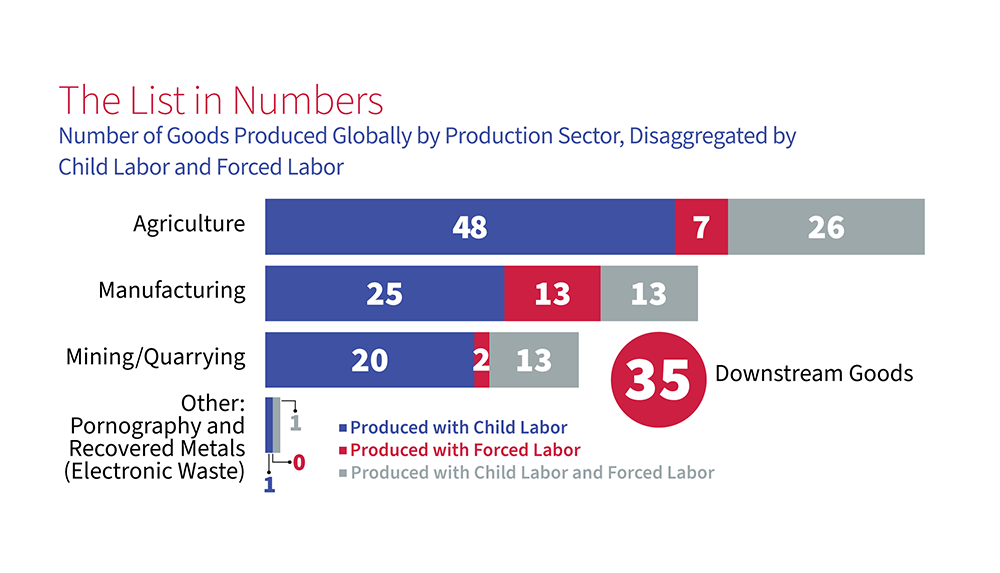
The countries on the List span every region of the world. The most common agricultural goods listed are sugarcane, cotton, coffee, tobacco, cattle, rice, and fish. In the manufacturing sector, bricks, garments, textiles, footwear, carpets, and fireworks appear most frequently. In mined or quarried goods, gold, coal and diamonds are most common.
ILAB published the initial TVPRA List in 2009 and updated it annually through 2014, following a set of procedural guidelines that were the product of an intensive public consultation process. ILAB now updates and publishes the List every other year, pursuant to changes in the law.
Procedural Guidelines
On January 25, 2024, ILAB's Office of Child Labor, Forced Labor, and Human Trafficking published Procedural Guidelines for the development and maintenance of the List of Goods from countries produced by child labor or forced labor in violation of international standards.
DOL's mission is to foster, promote, and develop the welfare of the wage earners, job seekers, and retirees of the United States. This DOL mission is carried out by a variety of sub-agencies and offices (DOL agencies) covering domestic and international policy engagements, workforce development, enforcement, statistics, and benefits. DOL has a responsibility to protect the integrity of scientific information that is produced, communicated, and used across DOL agencies to better carry out its mission. ILAB is committed to using the highest possible scientific integrity and quality standards and practices to conduct our critical work. Scientific integrity is the adherence to professional practices, ethical behavior, and the principles of honesty and objectivity when conducting, managing, using the results of, and communicating about science and scientific activities. Inclusivity, transparency, and protection from inappropriate influence are hallmarks of scientific integrity.
| Country/Area | Good | Exploitation Type |
|---|---|---|
| Paraguay | There is evidence that children ages 5 to 17 grow carrots in Paraguay. In 2016, the Government of Paraguay published representative results from the Survey of Activities of Rural Area Children and Adolescents 2015. The survey considers a working child to be engaged in child labor if the child is below the minimum age for employment of 14 or the child is performing work that is hazardous according to national legislation. The survey estimates that 301,827 children ages 5 to 17 perform hazardous work in rural areas of Paraguay and indicates that children working in agriculture experience accidents and illnesses, including from using dangerous tools and handling chemicals. According to the survey, almost 13 percent of Paraguayan children engaged in child labor in agriculture do not attend school. The survey estimates that 4,877 child laborers grow carrots throughout rural areas in Paraguay. The release of this survey demonstrates the Government of Paraguay’s commitment to addressing child labor and its acknowledgement that data collection is vital to the design and implementation of sound policies and programs. |
Child Labor |
| Brazil | Child Labor | |
| Guinea | Child Labor | |
| Vietnam | There is evidence that children ages 5 to 17 grow cashews in Vietnam. According to the Government of Vietnam’s National Child Labor Survey 2012, the results of which were published in 2014, an estimated 14,469 child laborers work to grow cashews. Approximately 55.7 percent, or 8,059, of these child laborers are under 15 years old, which is the minimum age for employment in Vietnam. Of the estimated 14,469 child laborers who grow cashews, 24.3 percent are 5-11 years old, 31.4 percent are 12-14 years old, and 44.3 percent are 15-17 years old. The survey considers a child to be engaged in child labor if the child is working an excessive number of hours per week for his or her age, or if the child is engaged in work that is prohibited for underage employees according to national legislation. |
Child Labor |
| Bolivia | There are reports that children ages 5 to 17 are involved in cattle-raising activities in Bolivia. Based on an analysis of Bolivia’s 2019 Survey of Girls, Boys, and Adolescents, an estimated 33,806 child laborers are involved in cattle raising. Herding, shepherding, and handling livestock are considered hazardous work for children. Injuries from animals include being bitten, butted, jostled, or stampeded, and diseases can be contracted through routine contact with animals and insects. The release of this survey demonstrates the Government of Bolivia’s commitment to addressing child labor and its acknowledgement that data collection is vital to the design and implementation of sound policies and programs. |
Child Labor, Forced Labor |
| Brazil | Child Labor, Forced Labor | |
| Chad | Child Labor | |
| Costa Rica | There is evidence that children ages 5 to 17 are engaged in cattle raising in Costa Rica. A 2015 analysis by international organizations of the Government of Costa Rica’s National Household Survey (ENAHO) 2011 indicates that 13.8 percent of child laborers in the country, or 2,230 children ages 5 to 14, were engaged in cattle raising, which includes dairy. The ENAHO 2011 counts as child labor all work performed by a child below age 15. In addition, the analysis indicates that 9.3 percent of working adolescents, or 2,905 adolescents ages 15 to 17, were also engaged in cattle raising. The analysis noted that 78 percent of children and adolescents in child labor in Costa Rica work with their families. Although more recent national surveys have shown a 65 percent decrease in the number of children ages 12 to 17 working in agriculture from 13,866 in 2011 to 4,853 in 2015, these surveys do not provide the number of children in child labor in cattle raising. Data from the 2016 ENAHO, which included a child labor module, is expected to be released in early 2017. |
Child Labor |
| El Salvador | There is evidence that children ages 5 to 17 are engaged in cattle raising in El Salvador. According to the Government of El Salvador’s Multi-Purpose Household Survey of 2015, a working child is considered to be engaged in hazardous child labor if the child is performing work that is hazardous according to national legislation. The survey estimates that 123,259 children ages 5 to 17 perform hazardous child labor in El Salvador, including using dangerous tools, carrying heavy loads, working with chemicals, working long or night shifts, and being exposed to dust, smoke, or extreme heat or humidity. Approximately 3,698 of these children in hazardous child labor are engaged in cattle raising. The release of this survey demonstrates the Government of El Salvador’s commitment to addressing child labor and its acknowledgement that data collection is vital to the design and implementation of sound policies and programs. |
Child Labor |
| Ethiopia | Child Labor |
Are you a company looking to fight child labor and forced labor in supply
chains?
Related
- Findings on the Worst Forms of Child Labor
- Executive Order 13126 List of Products Produced by Forced or Indentured Child Labor
- Against Their Will: The Situation in Xinjiang
Further Resources
- Supply Chain Storyboards
Previous TVPRA List of Goods Produced by Child Labor or Forced Labor
- 2022
- Full Report (PDF)
- Excel format (XLS)
- Bibliography (PDF)
- 2020
- Full Report (PDF)
- Excel format (XLS)
- Bibliography (PDF)
- 2018
- Full Report (PDF)
- Excel format (XLS)
- Bibliography (PDF)
- 2016
- Full Report (PDF)
- Excel format (XLS)
- Bibliography (PDF)
- 2014
- Full report (PDF)
- Excel format (XLS)
- Bibliography (PDF)
- 2013
- Infographic (PDF)
- Excel format (XLS)
- Bibliography (PDF)
- 2012
- Full Report
- Bibliography (PDF)
- List in Excel Format (XLS)
- 2011
- Full Report
- Bibliography (PDF)
- List in Excel Format (XLS)
- 2010
- Full Report (PDF)
- Bibliography (PDF)
- List in Excel Format (CSV)
- 2009 Full Report (PDF)
Public Comments & Submissions
ILAB accepts public submissions for the TVPRA List on an ongoing basis, and reviews them as they are received. Submissions will continue to be taken into account as ILAB works to release periodic updates to the List. To submit information, please send an email to ILAB-TVPRA@dol.gov; fax to 202-693-4830; or mail to ILAB, U.S. Department of Labor, c/o OCFT Research and Policy Unit, 200 Constitution Ave NW, S-5315, Washington, DC 20210. View the list of submissions.
The List in Numbers
What You Can Do