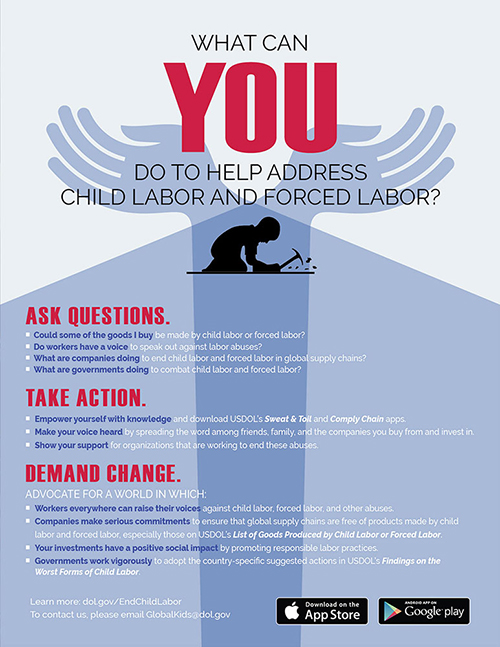
List of Goods Produced by Child Labor or Forced Labor
The Bureau of International Labor Affairs (ILAB) maintains a list of goods and their source countries which it has reason to believe are produced by child labor or forced labor in violation of international standards, as required under the Trafficking Victims Protection Reauthorization Act (TVPRA) of 2005 and subsequent reauthorizations. The List of Goods Produced by Child Labor or Forced Labor comprises 204 goods from 82 countries and areas, as of September 5, 2024.
The Frederick Douglass Trafficking Victims Prevention and Protection Reauthorization Act of 2018 directs that the List include, "to the extent practicable, goods that are produced with inputs that are produced with forced labor or child labor."
ILAB maintains the List primarily to raise public awareness about forced labor and child labor around the world and to promote efforts to combat them; it is not intended to be punitive, but rather to serve as a catalyst for more strategic and focused coordination and collaboration among those working to address these problems.


Previous TVPRA List of Goods Produced by Child Labor or Forced Labor
2022
- List of Downstream Goods (Excel)
- List of Goods (Bibliography) (PDF)
Publication of the List has resulted in new opportunities for ILAB to engage with foreign governments to combat forced labor and child labor. It is also a valuable resource for researchers, advocacy organizations and companies wishing to carry out risk assessments and engage in due diligence on labor rights in their supply chains.
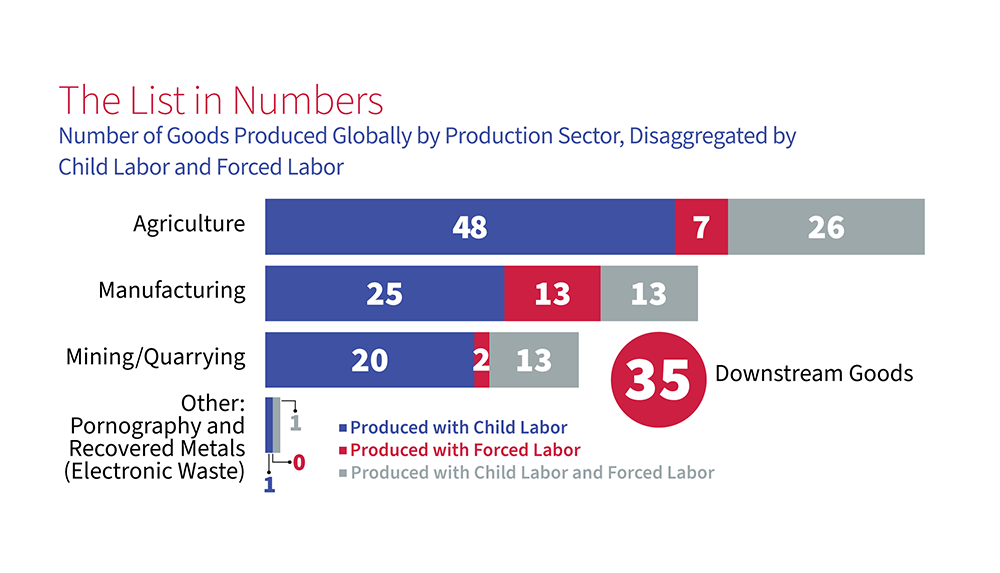
The countries on the List span every region of the world. The most common agricultural goods listed are sugarcane, cotton, coffee, tobacco, cattle, rice, and fish. In the manufacturing sector, bricks, garments, textiles, footwear, carpets, and fireworks appear most frequently. In mined or quarried goods, gold, coal and diamonds are most common.
ILAB published the initial TVPRA List in 2009 and updated it annually through 2014, following a set of procedural guidelines that were the product of an intensive public consultation process. ILAB now updates and publishes the List every other year, pursuant to changes in the law.
Procedural Guidelines
On January 25, 2024, ILAB's Office of Child Labor, Forced Labor, and Human Trafficking published Procedural Guidelines for the development and maintenance of the List of Goods from countries produced by child labor or forced labor in violation of international standards.
DOL's mission is to foster, promote, and develop the welfare of the wage earners, job seekers, and retirees of the United States. This DOL mission is carried out by a variety of sub-agencies and offices (DOL agencies) covering domestic and international policy engagements, workforce development, enforcement, statistics, and benefits. DOL has a responsibility to protect the integrity of scientific information that is produced, communicated, and used across DOL agencies to better carry out its mission. ILAB is committed to using the highest possible scientific integrity and quality standards and practices to conduct our critical work. Scientific integrity is the adherence to professional practices, ethical behavior, and the principles of honesty and objectivity when conducting, managing, using the results of, and communicating about science and scientific activities. Inclusivity, transparency, and protection from inappropriate influence are hallmarks of scientific integrity.
| Country/Area | Good | Exploitation Type |
|---|---|---|
| Nigeria | There are reports that children as young as age 8 mine gold in Nigeria. This practice is especially common in Zamfara state, which has significant gold deposits. Media outlets report hundreds of children work in artisanal and small-scale gold mining (ASGM) throughout Nigeria, causing them to abandon school. ASGM involves physically demanding work due to the un-mechanized nature and often many occupational safety and health risks. Children use their bare hands and tools to dig for gold in tunnels hundreds of meters below ground, without any protective equipment. Children face additional health risks during the processing stage when they handle mercury, a highly toxic substance, using it to extract gold from ore. Crushing ore to extract gold exposes children to lead-contaminated dust. This exposure can lead to acute lead poisoning and in May 2015 the Government announced the deaths of 28 children from lead poisoning as a result of the illegal mining of gold in Nigeria. |
Child Labor |
| Peru | Child Labor, Forced Labor | |
| Philippines | Child Labor | |
| Senegal | Child Labor | |
| Sudan | There are reports that children as young as 10 years old mine gold in Sudan. Children engage in ASGM throughout the country, particularly in River Nile, Blue Nile, West Darfur, and North Darfur states, some of which are currently zones of civil conflict. According to Sudanese government officials, academics, mining sector representatives, international organizations, NGOs, and the U.S. Department of State, thousands of children are working in ASGM throughout the country, resulting in large numbers of students dropping out of school. Artisanal mining poses significant physical and psychological risks to the health and safety of child miners, including exposure to mercury, working underground in confined spaces that risk collapse, transporting heavy loads in high temperatures, inhalation of dust during milling and grinding, and working at night. Children also experience threats and, at times, sexual harassment or abuse. |
Child Labor |
| Suriname | Child Labor | |
| Tanzania | Child Labor | |
| Uganda | There are reports that children as young as age 7 mine gold in Uganda. This practice is especially common in eastern Uganda and in the northeastern Karamoja region, where children typically work alongside family members. According to international organizations and the media, thousands of children abandon school to work in ASGM. One research study found approximately 1,000 children working in gold mines in central Uganda. Boys work in dangerous conditions in the mines, collecting soil from deep, open pits. Children mine gold in riverbeds, use toxic mercury to process gold ore, and carry water from long distances to sift and wash sediment. |
Child Labor |
| Venezuela | There are reports that children as young as 9 years old work in the gold mines of Venezuela. Most of the gold mining in this sector takes place in a region in the south of the country known as the Orinoco Mining Arc. Due to their low weight and small build, children are often utilized in the extraction of the mineral from a network of small, unsupported caves. Children are also tasked with lowering people into the mines, and operating machinery such as electric hammers and gas extractors. These children work long hours, ranging from 10 to 15 hours a day, in dangerous conditions. Children working in this sector do so without access to toilets, safety equipment, first aid, ventilation, or adequate hydration. They run the risk of mining accidents, contracting malaria or mercury poisoning, or being victims of gang violence. Many mines in the region are run by gangs called sindicatos, and increasingly by armed groups such as FARC and ELN. These groups levy taxes and exercise strict control over these mining communities, often under threat of violence. Reports indicate that sometimes children are victims of shootouts between gangs, armed groups, and government forces vying for control of certain mining operations. There are reports that adults are forced to work in the mining of gold in Venezuela. Research indicates that forced labor occurs throughout the Orinoco Mining Arc, a swath of land in Venezuela’s southern Bolivar state, where the majority of Venezuela’s gold is concentrated. It is estimated that there are between 300,000 and 500,000 gold miners in Venezuela. Mines are largely run by armed and violent criminal groups, and research shows evidence that officials from the Government of Venezuela, including members of security forces and local authorities, have colluded with and allowed members of non-state armed groups to commit human rights violations and labor abuses. Miners experience unsafe working conditions, unsafe and degrading living conditions, extortion and financial penalties, limited freedom of communication, and threats of violence and torture. |
Child Labor, Forced Labor |
| Zimbabwe | There are reports that children as young as 8 are engaged in the production of gold in Zimbabwe. Child labor occurs at unregulated artisanal and small-scale gold mining sites, including riverbeds in Mudzi and Mazowe. Sources estimated that thousands of children are working at gold mining sites and doing various work activities, including panning and sieving gold around riverbeds, digging and drilling in pit areas, and collecting and carrying gold ore. Children engaged in gold production in Zimbabwe work in hot climate conditions, lack proper protective equipment, and face exposure to dangerous chemicals, such as mercury. According to NGO reports, at least two children died during a mine shaft collapse. |
Child Labor |
Are you a company looking to fight child labor and forced labor in supply
chains?
Related
- Findings on the Worst Forms of Child Labor
- Executive Order 13126 List of Products Produced by Forced or Indentured Child Labor
- Against Their Will: The Situation in Xinjiang
Further Resources
- Supply Chain Storyboards
Previous TVPRA List of Goods Produced by Child Labor or Forced Labor
- 2022
- Full Report (PDF)
- Excel format (XLS)
- Bibliography (PDF)
- 2020
- Full Report (PDF)
- Excel format (XLS)
- Bibliography (PDF)
- 2018
- Full Report (PDF)
- Excel format (XLS)
- Bibliography (PDF)
- 2016
- Full Report (PDF)
- Excel format (XLS)
- Bibliography (PDF)
- 2014
- Full report (PDF)
- Excel format (XLS)
- Bibliography (PDF)
- 2013
- Infographic (PDF)
- Excel format (XLS)
- Bibliography (PDF)
- 2012
- Full Report
- Bibliography (PDF)
- List in Excel Format (XLS)
- 2011
- Full Report
- Bibliography (PDF)
- List in Excel Format (XLS)
- 2010
- Full Report (PDF)
- Bibliography (PDF)
- List in Excel Format (CSV)
- 2009 Full Report (PDF)
Public Comments & Submissions
ILAB accepts public submissions for the TVPRA List on an ongoing basis, and reviews them as they are received. Submissions will continue to be taken into account as ILAB works to release periodic updates to the List. To submit information, please send an email to ILAB-TVPRA@dol.gov; fax to 202-693-4830; or mail to ILAB, U.S. Department of Labor, c/o OCFT Research and Policy Unit, 200 Constitution Ave NW, S-5315, Washington, DC 20210. View the list of submissions.
The List in Numbers
What You Can Do