Companies have a variety of motivations for implementing due diligence, including managing legal, reputational, operational and other risks described below. Promoting a labor due diligence system ensures voluntary self-assessment of risks of labor abuses and efforts to mitigate them are embedded up and down a company’s supply chain.
Legal
Laws and regulations concerning responsible business conduct encompass diverse and evolving approaches. Some examples of laws and regulations can be found here.
Reputational Risk Management
Businesses invest heavily in their reputations, which can be ruined quickly and decisively if exploitative labor is exposed in their supply chains. Civil society groups and the press routinely conduct investigations, publicize problems, and raise awareness about corporate conduct. Consumers are also demanding that goods be produced ethically and legally. Social media allows conscientious consumers to raise awareness of and advocate for ethical sourcing. A company’s implementation of best practices, or lack thereof, affects consumer spending decisions and the long-term value of their brand.
Marketing and Competitiveness
Companies can set themselves apart by having a labor due diligence system in place, or by excelling in certain areas of labor due diligence and marketing these strengths to their buyers, appropriate demographic groups, or other stakeholders. Large multinational corporations (MNCs) increasingly require strong due diligence systems to be implemented before signing onto purchasing contracts with suppliers and sub-tier suppliers.
Loan Conditionality and Financial Due Diligence
Business entities receiving loans from the U.S. government’s International Development Finance Corporation (DFC) must adhere to specific social and environmental standards in their operations and supply chains, including standards on child labor and forced labor. Other multilateral development banks globally have similar, if varying, requirements. These standards require due diligence to identify problems and focused efforts to remedy them, which can be accomplished with a strong labor due diligence system. In addition, financial institutions globally must adhere to anti-money laundering (AML) requirements to monitor and identify financial activities that potentially relate to criminal activities. Financial institutions disclose these activities as part of a suspicious transaction report to the relevant financial intelligence unit.
Improved Supply Chain Management
Implementing a labor due diligence system requires that a company gain control over complex global supply chains, which can bring additional efficiencies and benefits to its operations. This requires planning, documentation, internal controls, training, communication with company employees, sound analysis of data, and other clearly defined policies and procedures.
Employee Recruitment and Retention
Efforts that engage workers are also linked with improved personnel recruitment, engagement, and retention. A growing body of research shows that U.S. employees, particularly those just entering the workforce, increasingly prefer to work for companies that are socially responsible, and many factor this element into future employment decisions.
Companies without labor due diligence systems face serious business and personnel risks. Higher rates of employee turnover are closely linked with poor working conditions and discriminatory policies. As you will see in our Legal subpage, laws are increasingly encouraging companies to adopt labor due diligence policies that engage workers.
Basics of a Labor Due Diligence System
Businesses should adopt labor due diligence systems that include the following components:






A company’s labor due diligence system should be designed to prioritize those areas of the supply chain where risk of egregious labor abuses is most significant, whether due to the operating context, the products or services involved, or other relevant considerations, and to integrate workers’ and workers organizations’ perspectives across all phases of the due diligence process.
Management Systems
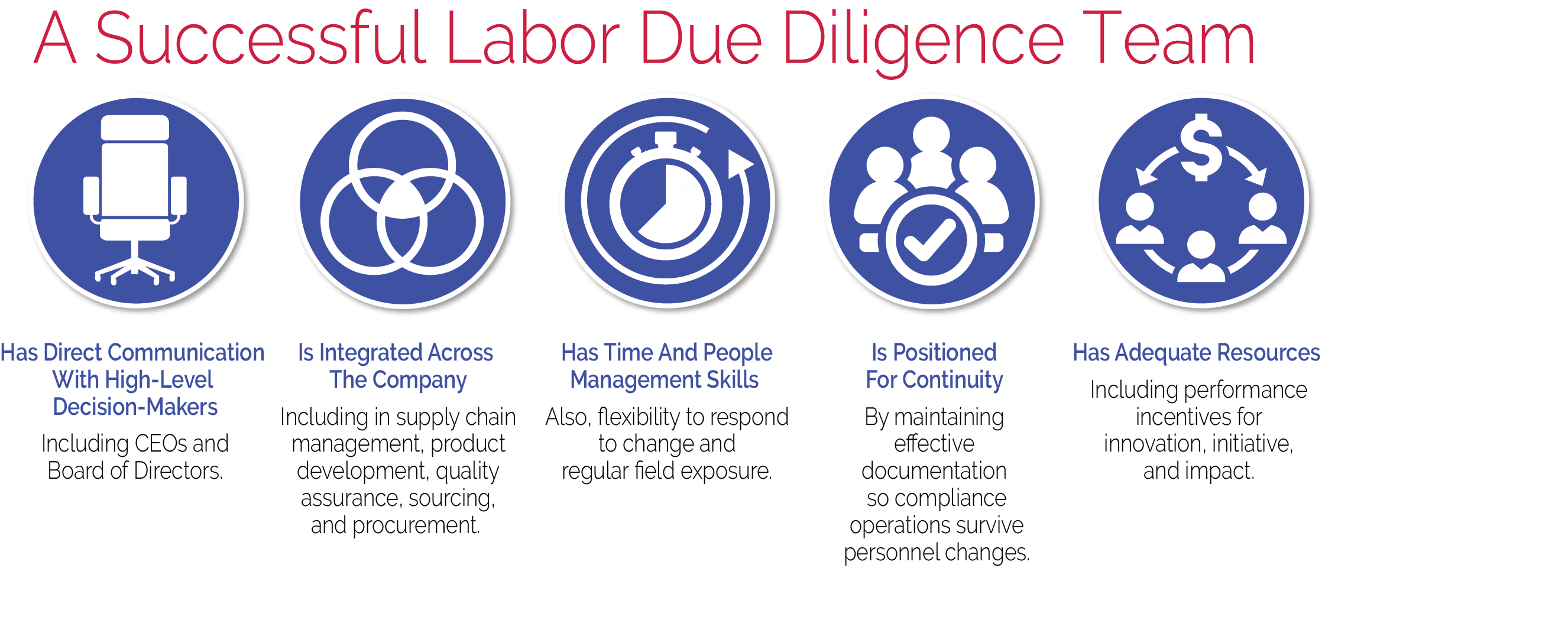
A company should also have a labor due diligence management team with management systems that are fully integrated into the business operations of the company. Key Performance Indicators (KPIs) can be developed for the management team to routinely check progress against those targets or indicators and address areas in which goals have not been met, and workers and workers’ organizations should have the opportunity to weigh in on crafting and monitoring those KPIs wherever possible. To develop robust KPIs, consider the following criteria for building a successful labor due diligence team:
- Direct communication with high-level decision-makers and workers, including workers’ organizations and/or unions;
- Integration across the company;
- The team has time- and people-management skills, the flexibility to respond to change, and regular field exposure;
- The team is positioned for continuity; and
- The team has adequate resources.

Further Resources
- The International Organization for Standardization (ISO) has established a variety of standards for management systems, such as ISO 17021, ISO Guide 65, ISO 9001, and ISO 19011. These standards cover issues such as impartiality and confidentiality, documentation and record control, management reviews, personnel qualification criteria, audit procedures, and appeals and complaints; available from http://www.iso.org/iso/home.html.
- The International Finance Corporation’s Performance Standard 1 discusses the elements of effective Environmental and Social Management Systems (ESMS); available from https://www.ifc.org/wps/wcm/connect/topics_ext_content/ifc_external_corporate_site/sustainability-at-ifc/policies-standards/performance-standards/ps1.
- Responsible Business Alliance Code of Conduct v. 8.0 (2024); available from https://www.responsiblebusiness.org/media/docs/RBACodeofConduct8.0_English.pdf.
UN Human Rights Council. Guiding Principles on Business and Human Rights: Implementing the United Nations “Protect, Respect and Remedy” Framework. New York: March 21, 2011; available from https://www.ohchr.org/Documents/Publications/GuidingPrinciplesBusinessHR_EN.pdf.