


Child Labor and Forced Labor Reports
West Bank and the Gaza Strip
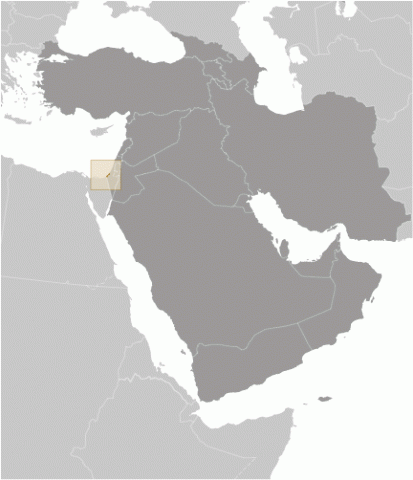

Minimal Advancement
In 2024, the Palestinian Authority made minimal advancement in efforts to eliminate the worst forms of child labor in the areas of the West Bank under its control. The Palestinian Authority identified 342 violations related to child labor. However, labor inspectors opted to not issue civil penalties for child labor violations in 2024 due to the deteriorating economic conditions in the West Bank. There are no criminal penalties for recruitment of children by non-state armed groups.
| Children | Age | Percent and Population |
|---|---|---|
| Working | 5 to 14 | Unavailable |
| Hazardous Work by Children | 15 to 17 | Unavailable |
| Attending School | 5 to 14 | Unavailable |
| Combining Work and School | 7 to 14 | Unavailable |
| Sector/Industry | Activity |
|---|---|
| Agriculture | Fishing† and farming.† |
| Industry | Construction.† |
| Services | Street work, including begging and street vending. Working in shops, hotels, and restaurants. Domestic work. |
| Categorical Worst Forms of Child Labor‡ | Forced recruitment of children in state and non-state armed groups for use in armed conflict. Forced begging, street work, and domestic work. Use in illicit activities, including auto theft. Commercial sexual exploitation. |
† Determined by national law or regulation as hazardous and, as such, relevant to Article 3(d) of ILO C. 182.
‡ Child labor understood as the worst forms of child labor per se under Article 3(a)–(c) of ILO C. 182.
Children at Higher Risk
In the Gaza Strip, where 47 percent of the population are under the age of 18, the large-scale humanitarian crisis has left children particularly vulnerable to exploitative child labor as families seek essentials like food and shelter. An estimated 17,000 children in the Gaza Strip have lost both parents, rendering them significantly more vulnerable to exploitation. Over 1.9 million people have been internally displaced, some multiple times, and nearly 60 percent of the population have lost their homes. High levels of acute food insecurity, affecting approximately 91 percent of the Gaza Strip population as of February 2025, further incentivize child exploitation. Children in the Gaza Strip are also vulnerable to recruitment into the armed wings of Hamas and Palestinian Islamic Jihad and were forcibly used as human shields by all parties.
The economic downturn in the West Bank as a result of the war has led 7.4 percent of workers to send their children to work as a coping mechanism, according to the ILO. Children may be vulnerable to child labor in the agricultural sector, including in Area C. The Palestinian Authority (PA) does not have legal jurisdiction or the resources to enforce laws in Area C’s agricultural fields, or in Israeli settlements in the West Bank, both of which are administered by Israel. Some Palestinian girls from the West Bank can be vulnerable to being exploited for sex and labor in the West Bank and in Israel after family members force them into marriages with older men, in which they may experience physical and sexual abuse, threats of violence, and restricted movement.
Barriers to Education Access
The war in the Gaza Strip has produced dire consequences for children’s education. According to the Palestinian Central Bureau of Statistics, 111 public schools in the Gaza Strip have been destroyed, and 241 severely damaged, leaving 700,000 students without education during the 2024–2025 academic year. Nearly 88.5 percent of schools are entirely destroyed or need major rehabilitation according to the UN Office for the Coordination of Humanitarian Affairs.
In the West Bank, children have also faced increased barriers to education due to further restrictions on movement, military actions, and increased violence, with some schools moving to virtual classrooms. UNICEF reports that between 8 and 20 percent of schools are closed on any given day. In the West Bank, school closures, Israeli demolition and confiscation of schools, and harassment and detention by Israeli security forces at checkpoints prevent some children from attending school. Access to education is key to preventing children’s engagement in child labor.
| Standard | Age | Meets International Standards | Legislation |
|---|---|---|---|
| Minimum Age for Work | 15 | ✗ | Articles 3 and 93 of the Labor Law for the West Bank and the Gaza Strip |
| Minimum Age for Hazardous Work | 18 | ✓ | Article 95 of the Labor Law for the West Bank and the Gaza Strip; Article 14 of the Palestinian Child Law for the West Bank and the Gaza Strip |
| Identification of Hazardous Occupations or Activities Prohibited for Children | ✓ | Article 1 of Minister of Labor’s Decree on Hazardous Work for the West Bank and the Gaza Strip | |
| Prohibition of Slavery, Debt Bondage, and Forced Labor | ✓ | Articles 1 and 48 of the Palestinian Child Law for the West Bank and the Gaza Strip. | |
| Prohibition of Child Trafficking | ✓ | Articles 48 and 49 of the Palestinian Child Law for the West Bank and the Gaza Strip. | |
| Prohibition of Commercial Sexual Exploitation of Children | ✓ | Articles 1 and 48 of the Palestinian Child Law for the West Bank and the Gaza Strip; Articles 306 and 310 of the Jordanian Penal Code for the West Bank; Articles 167 and 172(5) of the Penal Code for the Gaza Strip | |
| Prohibition of Using Children in Illicit Activities | ✓ | Article 48 of the Palestinian Child Law for the West Bank and the Gaza Strip; Articles 27 and 44 of the Palestinian Child Law for the West Bank and the Gaza Strip; Article 389 of the Jordanian Penal Code for the West Bank; Article 193 of the Penal Code for the Gaza Strip | |
| Minimum Age for Voluntary State Military Recruitment | 18 | ✓† | Article 46 of the Palestinian Child Law for the West Bank and the Gaza Strip |
| Prohibition of Compulsory Recruitment of Children by (State) Military | N/A | ||
| Prohibition of Military Recruitment by Non-state Armed Groups | ✗ | Article 46 of the Palestinian Child Law for the West Bank and the Gaza Strip | |
| Compulsory Education Age | 16 | ✓ | Articles 15 and 18 of the Palestinian Education Act for the West Bank and the Gaza Strip |
| Free Public Education | ✓ | Articles 3 and 15 of the Palestinian Education Act for the West Bank and the Gaza Strip; Article 37 of the Palestinian Child Law for the West Bank and the Gaza Strip |
† No standing military in the West Bank
In the West Bank, under the terms of the Oslo-era agreements between the Palestine Liberation Organization (PLO) and the Israeli government, the Palestinian Authority has civil law jurisdiction in the areas of the West Bank designated Area A and Area B, which represent approximately 39 percent of the West Bank’s land area and contain approximately 94 percent of the Palestinian population. The Israeli government has full administrative and security control over the city of Jerusalem and Area C; the latter represents 61 percent of the West Bank’s land area, approximately 6 percent of the Palestinian population, and the vast majority of the West Bank’s agricultural areas. Although under the Oslo Accords the Palestinian Authority’s laws also apply in the Gaza Strip, along with Egyptian, British Mandate and Ottoman statutes, and Sharia law, the courts in the Gaza Strip are not currently functioning.
The minimum age for work is lower than the compulsory education age, and children may be encouraged to leave school before the completion of compulsory education. The Labor Law’s minimum age provision does not apply to minors who work for their first-degree relatives, which is not in line with international standards that limit the exception for family-based work to small-scale holdings producing for local consumption and not regularly employing hired workers. Additionally, there are no criminal penalties for recruiting children into non-state armed groups.
| Organization/Agency | Role & Activities |
|---|
| Ministry of Labor (MOL), General Administration of Labor Inspection and Protection: Enforces labor laws, including those related to child labor. Includes the Juvenile Unit, which specializes in child labor. |
| Police Bureau for the Protection of the Family and Adolescents: Investigates violations of laws, including the commercial sexual exploitation and economic exploitation of children. Coordinates with the Ministry of Social Development (MOSD) to monitor cases of child labor and economic exploitation. |
| Overview of Enforcement Efforts | 2024 |
|---|---|
| Has a Labor Inspectorate | Yes |
| Able to Assess Civil Penalties | Yes |
| Routinely Conducted Worksite Inspections | Yes |
| Unannounced Inspections Permitted | Yes |
| Has a Complaint Mechanism | Yes |
| Imposed Penalties for Child Labor Violations | No |
| Conducted Criminal Investigations for Worst Forms of Child Labor Crimes | Yes |
| Imposed Penalties for Worst Forms of Child Labor Crimes | No |
In 2024, approximately 80 labor inspectors conducted approximately 6,000 worksite inspections, finding 342 violations related to child labor and issuing 0 civil penalties. Also, 6 cases were referred to Juvenile Prosecution, and 1 perpetrator was convicted.
| Coordinating Body | Role & Activities |
|---|
| Ministry of Social Development (MOSD) Child Protection Network: Monitors cases of child labor, ensuring that the MOL’s services are provided to withdraw children from child labor. Includes eight technical committees throughout the West Bank that provide psychological and social support to children and caregivers. Coordinates with the Ministry of Education on cases of school dropouts and child labor. Works with the MOSD’s 13 Youth Social Rehabilitation Centers to provide children who have dropped out of school with social, educational, vocational, and cultural training. Comprising MOSD, MOL, the Ministry of Education, the Ministry of Interior, other PA agencies, and non-governmental organizations. The network did not undertake activities in 2024 due to funding constraints. Although the MOSD Child Protection Network coordinates services, research found no evidence that the network functions as a coordinating mechanism to address all aspects of child labor. |
| Program | Description & Activities |
|---|
| Reference Document for the Work of the Child Protection Networks:* Published by the Ministry of Social Development and identifies six goals in the reduction of child labor. Specifically, the Child Protection Network aims to: strengthen the social and cultural environment surrounding children’s rights; strengthen the rule of law regarding the protection of children; support the Palestinian Child Referral System; raise participating organizations’ capabilities; establish efforts to research child protection; and update and modernize child protection needs using data. Issued in 2024. |
* Policy was approved during the reporting period.
| Program | Description & Activities |
|---|
| MOL’s Vocational Centers:‡ Palestinian Authority program in the West Bank, consisting of 13 employment offices and 9 vocational centers operated by MOL, for children over the age of 15 to enroll in vocational training courses. This program was inactive in 2024 due to lack of funding. |
| UN Education Programs: Appropriate UN agencies that provide educational support for children and youth in refugee camps and across the Gaza Strip when conditions allow, and microfinance and other forms of support to families in the West Bank and the Gaza Strip. Active in 2025. |
‡ Program is funded by the Palestinian Authority.
| Area | Suggested Action |
|---|---|
| Legal Framework | Raise the minimum age for work from age 15 to 16 to align with the compulsory education age. |
| Ensure that the minimum age for work applies to all children, or excepts only those working in family and small-scale holdings producing for local consumption and not regularly employing hired workers. | |
| Ensure that the law criminally prohibits the recruitment of children under age 18 into non-state armed groups. | |
| Enforcement | Ensure that child labor laws are enforced in the West Bank and the Gaza Strip, and to the extent practicable, assess penalties for child labor cases identified during labor inspections. |
| Publish information on labor and criminal law enforcement efforts, including labor inspectorate funding and the number of investigations into the worst forms of child labor. | |
| Increase the number of labor inspectors to 100 to ensure adequate coverage of the labor force of approximately 1.5 million workers, and provide further resources and training to labor inspectors, including budget for overtime hours and vehicles so that the Ministry of Labor can conduct labor inspections in all sectors, including in family-owned businesses and at night. | |
| Ensure that penalties against those who use child labor in contravention of Palestinian Authority laws are levied even if the employer terminates the employment of a child. | |
| Provide further resources, staff, and training to criminal law enforcement agencies so that cases of the worst forms of child labor can be appropriately investigated and prosecuted. | |
| Coordination | Establish a coordinating mechanism to prevent and eliminate all relevant forms of child labor and ensure that the Child Protection Network is active. |
| Government Policies | Adopt policies to address all worst forms of child labor, including in construction, street work, and agriculture. |
| Social Programs | Expand programs to improve access to education, including ensuring that children are not subjected to violence and schools are weatherproof. |
| Ensure that programs such as the Ministry of Labor's Vocational Units have the necessary funding to operate. | |
| Expand programs to further address child labor, specifically in construction, street work, and agriculture. | |
| Collect and publish data on the extent and nature of child labor to inform policies and programs. |