


Child Labor and Forced Labor Reports
Tunisia
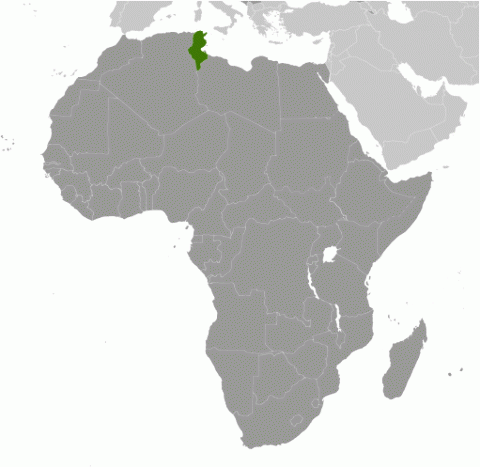

Minimal Advancement
In 2024, Tunisia made minimal advancement in efforts to eliminate the worst forms of child labor. The Ministry of Family, Women, Children, and Seniors established a notification mechanism for the National Authority for Combating Human Trafficking to ensure that suspected cases of child trafficking and sexual exploitation are reported to the relevant authorities. The government also increased payments as part of its AMEN social support program by 9 percent to benefit 574,126 children and provided grants to 597,000 families to improve access to education to prevent children from dropping out of school to work. However, despite these efforts, the labor inspectorate's budget for staffing, fuel, and transportation was inadequate to carry out inspections, especially in remote areas of the country. In addition, the government lacks a centralized system for digitization of court records, resulting in a limited availability of data on investigations, prosecutions, and convictions of child labor crimes. Moreover, programs are insufficient to remove barriers to education access and mitigate child labor risks for rural children.
| Children | Age | Percent of Population |
|---|---|---|
| Working | 5 to 14 | 3.5% (Unavailable) |
| Boys | 5 to 14 | 4.5% |
| Girls | 5 to 14 | 2.5% |
| Urban | 5 to 14 | 2.5% |
| Rural | 5 to 14 | 5.4% |
| Hazardous Work by Children | 15 to 17 | 0.9% (Unavailable) |
| Boys | 15 to 17 | 1.4% |
| Girls | 15 to 17 | 0.4% |
| Urban | 15 to 17 | 0.9% |
| Rural | 15 to 17 | 1.0% |
| Attending School | 5 to 14 | 94.2% |
| Combining Work and School | 7 to 14 | 5.8% |
| Sector/Industry | Activity |
|---|---|
| Agriculture | Farming, fishing, animal husbandry, forestry. |
| Industry | Manufacturing and industrial work. Construction. |
| Services | Domestic work† and street work.† Working in small businesses, including mechanics’ shops. |
| Categorical Worst Forms of Child Labor‡ | Forced labor in domestic work and begging. Commercial sexual exploitation, sometimes as a result of human trafficking. Use in illicit activities, including organized crime and drug trafficking. |
† Determined by national law or regulation as hazardous and, as such, relevant to Article 3(d) of ILO C. 182.
‡ Child labor understood as the worst forms of child labor per se under Article 3(a)–(c) of ILO C. 182.
Children at Higher Risk
Children from the Northwest region of Tunisia are vulnerable to child labor in agriculture, and girls often drop out of school to serve as domestic workers. Children whose parents lack legal documentation, including children from sub-Saharan African countries and neighboring Arab countries, are vulnerable to labor exploitation as their parents do not have the status to legally work in Tunisia.
Barriers to Education Access
Tunisian schools lack a sufficient number of teachers, and some schools have failing infrastructure or lack access to water. In rural areas, some families cannot afford transportation costs associated with schooling. Students lacking documentation may face difficulties enrolling. Additionally, Arabic is the sole language of instruction, creating barriers for students who are not proficient in Arabic.
| Standard | Age | Meets International Standards | Legislation |
|---|---|---|---|
| Minimum Age for Work | 16 | ✓ | Article 53 of the Labor Code |
| Minimum Age for Hazardous Work | 18 | ✓ | Article 58 of the Labor Code |
| Identification of Hazardous Occupations or Activities Prohibited for Children | ✓ | Ministry of Social Affairs Order of April 1, 2020 | |
| Prohibition of Slavery, Debt Bondage, and Forced Labor | ✓ | Articles 2, 3, 5 and 8 of the Law on the Prevention and the Fight Against the Trafficking of Persons | |
| Prohibition of Child Trafficking | ✓ | Articles 2, 3, 5, 8, and 23 of the Law on the Prevention and the Fight Against the Trafficking of Persons | |
| Prohibition of Commercial Sexual Exploitation of Children | ✗ | Articles 226 bis, 232–234 of the Penal Code; Articles 20 and 25 of the Child Protection Code; Article 2, 3, 5, 8 and 23 of the Law on the Prevention and the Fight Against the Trafficking of Persons | |
| Prohibition of Using Children in Illicit Activities | ✓ | Articles 5 and 11 of Law No. 92.52 on Narcotics | |
| Minimum Age for Voluntary State Military Recruitment | 18 | ✓ | Article 2 of the National Service Law |
| Prohibition of Compulsory Recruitment of Children by (State) Military | ✓ | Article 2 of the National Service Law | |
| Prohibition of Military Recruitment by Non-state Armed Groups | ✓ | Article 2(5) of the Law on the Prevention and the Fight Against the Trafficking of Persons; Articles 3 and 18 of the Child Protection Code | |
| Compulsory Education Age | 16 | ✓ | Section 1 of the Law on Education |
| Free Public Education | ✓ | Articles 38 of the Constitution; Article 4 of the Law on Education |
Tunisian law does not meet international standards because it does not prohibit the use of a child for prostitution.
| Organization/Agency | Role & Activities |
|---|
| Ministry of Social Affairs (MSA): Conducts labor inspections and assesses fines and penalties for infractions. Employs social workers and medical inspectors to assist in addressing child labor. Monitors the implementation of labor legislation and initiates prosecutions through the General Directorate of Labor Inspection. Implements social programs to assist those affected by child labor through the General Administration for Social Development. Fines assessed for infractions are reported to be insufficient to deter violations. |
| Ministry of the Interior (MOI): Investigates reports of the worst forms of child labor, including complaints that fall outside of the labor inspectorate's mandate and those pertaining to the informal sector. Through its Child Protection Service under the National Police, addresses the commercial sexual exploitation of children and coordinates with MSA and the Ministry of Family, Women, Children, and Seniors regarding violations. Through its Judicial Police, coordinates with MSA to refer cases of at-risk youth to social services. The lack of digitized court records makes it difficult to compile data and evaluate trends in convictions and penalties for the worst forms of child labor violations. |
| Overview of Enforcement Efforts | 2024 |
|---|---|
| Has a Labor Inspectorate | Yes |
| Able to Assess Civil Penalties | Yes |
| Routinely Conducted Worksite Inspections | Yes |
| Unannounced Inspections Permitted | Yes |
| Has a Complaint Mechanism | Yes |
| Imposed Penalties for Child Labor Violations | Unknown |
| Conducted Criminal Investigations for Worst Forms of Child Labor Crimes | Yes |
| Imposed Penalties for Worst Forms of Child Labor Crimes | Unknown |
In 2024, 194 labor inspectors conducted 13,550 worksite inspections, finding 19 child labor violations. The government also conducted an unknown number of investigations into suspected worst forms of child labor crimes, and prosecuted and convicted an unknown number of worst forms of child labor crimes.
| Coordinating Body | Role & Activities |
|---|
| The National Authority for Combating Human Trafficking: Operates within the Ministry of Justice and acts as the main coordinating body for responding to cases of human trafficking, including child labor, and refers them to judicial authorities. In 2024, the Ministry of Family, Women, Children, and Seniors established a notification mechanism for the National Authority for Combating Human Trafficking to ensure that suspected cases of child trafficking and sexual exploitation are reported to the relevant authorities. |
| Policy | Description & Activities |
|---|
| National Strategy to Combat Trafficking in Persons (2018–2023): Aimed to establish a global evidence-based approach to address trafficking in persons by coordinating national and international actors. This policy lapsed in 2023 and was not renewed in 2024. However, the National Authority for Combating Human Trafficking drafted an updated strategy during the reporting period. |
| Program | Description & Activities |
|---|
| Support Efforts to Combat Human Trafficking (2014–2024): U.S. Department of State-funded project implemented by the International Organization for Migration to carry out anti-human trafficking activities in collaboration with the Ministry of Justice, MOI, MSA, and the Ministry of Family, Women, Children, and Seniors. Included three objectives: (1) building the capacity of relevant institutions and agencies to identify and assist survivors of human trafficking based on their individual needs; (2) strengthening cross-sector cooperation and the sharing of information through the implementation of a national referral mechanism; and (3) conducting an awareness-raising campaign to keep children in school and prevent human trafficking. Active in 2024. |
| Centers to Provide Aid to Victims of Child Labor:‡ Serve up to 6,000 children engaged in child labor or vulnerable to child labor through the maintenance of 79 youth centers. Many of these centers are located in Tunis and provide education and health care to children who would otherwise be on the street. The centers were active during the reporting period. |
| Shelters and Services for Victims of Human Trafficking:‡ Serve survivors of human trafficking, predominantly children, through shelters operated by the Government of Tunisia. Provide lodging, food, clothing, and legal aid through a network of pro bono lawyers, and free medical care in collaboration with the Ministry of Health. Two shelters, specifically for minor victims of human trafficking, operate in Tunis and Sidi Bouzid. Active in 2024. |
‡ Program is funded by the Government of Tunisia.
† The government had other social programs that may have included the goal of eliminating or preventing child labor, including its worst forms.
| Area | Suggested Action |
|---|---|
| Legal Framework | Criminalize and prescribe punishments for the use of all children in prostitution. |
| Enforcement | Provide adequate staff and other resources, including fuel and transportation, to enable the labor inspectorate to conduct a greater number of inspections, particularly in remote areas and in the informal economy. Increase the number of labor inspectors in the field from 194 to 269 to ensure adequate coverage of the labor force of nearly 4 million workers. |
| Provide labor inspectors with sufficient training to identify child labor. | |
| Increase the amount imposed for penalties for those who employ children in violation of child labor law protections to deter potential violations and reduce recidivism. | |
| Collect, digitize, and publish information related to the financial penalties collected for violations of child labor laws. | |
| Implement a digital tracking system for civil worst forms of child labor inspections. | |
| Collect, digitize, and publish information on efforts to enforce criminal prohibitions on the worst forms of child labor, including on the number of child labor investigations that were conducted, prosecutions initiated, and convictions secured. | |
| Ensure that law enforcement and the judiciary are fully informed as to the existence and application of anti-human trafficking penalties and impose these penalties when appropriate. | |
| Ensure that exploited children are not prosecuted for their involvement in trafficking activities and are instead referred to social and psychological services. | |
| Government Policies | Implement a national action plan that covers all forms of child labor present in the country. |
| Social Programs | Collect and publish data on the extent and nature of child labor to inform policies and programs. |
| Enhance efforts to eliminate barriers and make education accessible for all children, including rural children, by improving access to transportation, water, and non-Arabic learning resources, and providing a sufficient number of teachers. | |
| Ensure that services for survivors of human trafficking are accessible to those with disabilities. | |
| Expand existing programs to fully address the scope of the child labor problem, including in agriculture, fishing, commerce, manufacturing, domestic work, and construction. |