


Child Labor and Forced Labor Reports
Namibia
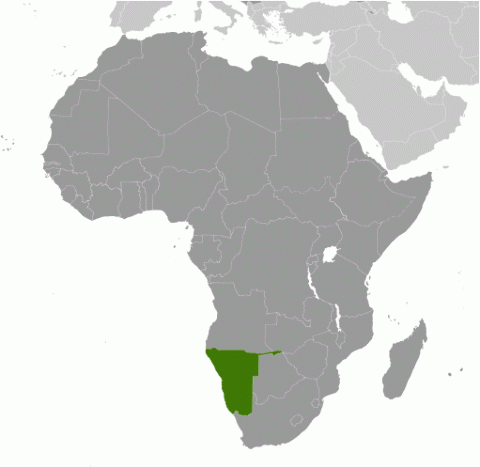

Minimal Advancement
In 2024, Namibia made minimal advancement in efforts to eliminate the worst forms of child labor. The government began drafting a National Action Plan on Child Labor with a focus on key sectors in which child labor is prevalent, such as agriculture and domestic work. The government also coordinated with the United Nations Central Emergency Fund to provide $3 million for relief for children and households impacted by drought, which is a cause of child labor in the country, and facilitated the temporary housing of approximately 200 children and safe return home of 73 children and their mothers to Angola who had been found street vending. However, the government lacked financial resources for the enforcement of child labor laws, and it did not publish data on labor or criminal law enforcement efforts for inclusion in this report. Namibia’s light work framework is also insufficient because it does not prescribe the number of hours children ages 14 to 18 may work.
| Children | Age | Percent and Population |
|---|---|---|
| Working | 8 to 14 | 64.5% (235,125) |
| Boys | 61.5% | |
| Girls | 67.6% | |
| Urban | 40.3% | |
| Rural | 78.8% | |
| Hazardous Work by Children | 15 to 17 | 2.7% (3,885) |
| Boys | 2.2% | |
| Girls | 3.2% | |
| Urban | 0.7% | |
| Rural | 4.0% | |
| Attending School | 8 to 14 | 95.1% |
| Combining Work and School | 8 to 14 | 61.5% |
| Children | Percent of Population |
|---|---|
| Agriculture | 45.3% |
| Industry | 6.7% |
| Services | 48.0% |
| Sector/Industry | Activity |
|---|---|
| Agriculture | Farming, herding, and fishing. |
| Services | Domestic work and street work, including vending. |
| Categorical Worst Forms of Child Labor‡ | Commercial sexual exploitation, sometimes as a result of human trafficking; use in illicit activities, including organized begging, drug trafficking, and smuggling of fuel and wildlife products; forced labor in agriculture including herding, fishing, domestic work, and street work including vending. |
‡ Child labor understood as the worst forms of child labor per se under Article 3(a)–(c) of ILO C. 182.
Children at Higher Risk
An extended drought and economic downturn in northern Namibia and southern Angola have affected children’s vulnerability to child labor, including its worst forms. Child-headed households in Namibia experience heightened economic pressure due to the loss of their parents and are therefore susceptible to labor exploitation. Native children, particularly those of the San, Zemba, and Himba communities, are susceptible to child and forced labor, including on farms and in homes. Growing numbers of children from Angola, many driven by food insecurity, travel to Namibia to seek work, and sometimes live in informal settlements and are often at risk of being coerced into street vending, farming, or domestic work, or recruited for illicit activities. Many Angolan children lack identification documents and, therefore, may not access social protection services.
Barriers to Education Access
Both primary and secondary education are free by law; however, a shortage of schools, qualified teachers, infrastructure, and sufficient transportation, particularly in rural and remote locations, may deter some children from attending school and may increase their vulnerability to child labor. The Education Act stipulates that no child be denied an education due to documentation; however, reporting indicates that the implementation of education law and key policies such as the 2015 Revised National Curriculum, the 2023 Inclusive Education Policy, and the 2008 National School Health Policy suffer from inconsistent regional enforcement, inconsistency among policies, and lack of resources. In particular, alien children face difficulty securing identification documents, which sometimes results in delays or barriers to school admission, enrollment, and attendance. Reports also highlight that children with disabilities or special learning needs may not receive adequate education due to the lack of specialized teachers, assistive technologies, disability-friendly infrastructure, and teaching and learning materials. Additionally, reporting indicates that native students face inadequate teaching and curricula in their languages, experience abuse such as bullying for speaking their languages in school, and sometimes face strict enforcement of school uniform policy in secondary schools. These issues contribute to absenteeism and disrupt their learning.
| Standard | Age | Meets International Standards | Legislation |
|---|---|---|---|
| Minimum Age for Work | 18 | ✓ | Chapter 2, Article 3(2) of the Labor Act |
| Minimum Age for Hazardous Work | 18 | ✓ | Chapter 2, Article 3(4) of the Labor Act; Article 2(2) of the Labor Act (Regulations Related to Domestic Work); Article 15(2) of the Constitution |
| Identification of Hazardous Occupations or Activities Prohibited for Children | ✓ | Chapter 2, Articles 3(3)(d) and 3(4) of the Labor Act | |
| Prohibition of Slavery, Debt Bondage, and Forced Labor | ✓ | Chapter 2, Article 4 of the Labor Act; Article 9 of the Constitution; Articles 202, 234(1)(a), and 234(7) of the Child Care and Protection Act | |
| Prohibition of Child Trafficking | ✓ | Sections 202 and 234 of the Child Care and Protection Act; Chapter 2, Articles 1 and 3 of the Combating of Trafficking in Persons Act | |
| Prohibition of Commercial Sexual Exploitation of Children | ✓ | Section 234 of the Child Care and Protection Act; Articles 1 and 3 of the Combatting of Trafficking in Persons Act | |
| Prohibition of Using Children in Illicit Activities | ✓ | Section 234 of the Child Care and Protection Act | |
| Minimum Age for Voluntary State Military Recruitment | 18 | ✓ | Section 17 of Defense Act 1 of 2002 (Government Notice 189 of 2010) |
| Prohibition of Compulsory Recruitment of Children by (State) Military | N/A* | ||
| Prohibition of Military Recruitment by Non-state Armed Groups | ✓ | Section 234(1)(b) of the Child Care and Protection Act | |
| Compulsory Education Age | 18 | ✓ | Sections 9 and 19 of the Promulgation of Basic Education Act, 2020 |
| Free Public Education | ✓ | Sections 19 and 67 of the Promulgation of Basic Education Act, 2020; Article 20 of the Constitution; Article 38 of the Education Amendment Act of 2017 |
* Country has no conscription
Namibia’s light work framework for children aged 14-18 prohibits activities for children, such as work at night, done underground, in construction or demolition, in places in which goods are manufactured, or where electricity is generated or distributed. However, the framework is insufficient because it does not prescribe the number of hours children aged 14-18 may work.
| Organization/Agency | Role & Activities |
|---|
Ministry of Justice and Labor Relations:* With the Namibian Police Force, responsible for enforcing criminal laws against forced child labor, child trafficking, commercial sexual exploitation, recruitment and use of child soldiers, and use of children in illicit activities. Also oversees the labor inspectorate and ensures compliance with the Labor Act of 2007, including the prohibition of child labor. Operates a hotline that receives labor complaints, including child labor, via text message. In March 2024, a trial commenced for the case of 1 person facing 74 charges related to the rape of and use of children to produce pornography, including 10 counts of using a child to produce pornography and 18 counts of child trafficking. During the reporting period, the Ministry also reported that lack of coordination among agencies and limited funding, resources, and training hindered enforcement efforts, such as the need to prioritize sectors and locations; this led to unannounced inspections being conducted inconsistently across all sectors and areas. *Agency responsible for both civil and criminal law enforcement as of 2025. During the 2024 reporting period, the Government of Namibia maintained the Ministry of Justice and the Ministry of Labor, Industrial Relations and Employment Creation as 2 separate ministries. |
| Overview of Enforcement Efforts | 2024 |
|---|---|
| Has a Labor Inspectorate | Yes |
| Able to Assess Civil Penalties | Yes |
| Routinely Conducted Worksite Inspections | Yes |
| Unannounced Inspections Permitted | Yes |
| Has a Complaint Mechanism | Yes |
| Imposed Penalties for Child Labor Violations | Unknown |
| Conducted Criminal Investigations for Worst Forms of Child Labor Crimes | Unknown |
| Imposed Penalties for Worst Forms of Child Labor Crimes | Unknown |
In 2024, 51 labor inspectors conducted an unknown number of worksite inspections and found an unknown number of child labor violations. It is also unknown whether investigations into suspected cases of the worst forms of child labor were conducted or whether perpetrators were convicted, although 1 prosecution was initiated.
| Coordinating Body | Role & Activities |
|---|
| National Advisory Council on Children: Coordinates government efforts on child welfare and rights. Comprises the Children’s Advocate and the government’s health, education, youth, justice, labor, and home affairs ministries’ Executive Directors. Houses an Interministerial Committee on Child Labor. The government did not report if the Council implemented activities during the reporting period. |
| Policy | Description & Activities |
|---|
| Social Protection Policy (2021–2030): Aims to improve coordination of social protection mechanisms and provides a framework to strengthen child grants through optimizing child grant-related data, reviewing and developing the implementation mechanism, and linking government agencies. The government did not report on actions to implement the policy during the reporting period. |
| National Action Plan on Combatting Trafficking in Persons (2023–2027): Aims to strengthen and improve legislation related to trafficking in persons, secure sustainable financing for anti-human trafficking efforts, and enhance victim identification procedures, among other goals. The Plan emphasizes the protection of child trafficking victims. The government continued to implement the action plan as well as the National Referral Mechanism and Standard Operating Procedures on Trafficking in Persons, but it did not report on specific actions it took to implement these during the reporting period. |
| Program | Description & Activities |
|---|
| Social Protection Grants:‡ Government-funded grants to support vulnerable children and households. Include child maintenance grants, place-of-safety allowances, and foster care grants. Child maintenance grants provide monthly stipends to single-parent families and are contingent upon school enrollment of all school-age children; place of safety and foster care grants provide support for people who and places that provide temporary care for children. The government allocated funds to the Childcare and Protection Division indicating continued commitment to the grants, including $15 million to cover the Orphan and Vulnerable Children Grant, although it is unclear if the government undertook specific activities to implement the grants during the reporting period. |
| Shelters and Victims Services:‡ Government and NGO shelters provide safe accommodations, meals, clothing, toiletries, psychosocial support, legal assistance, medical services, and access to education. Registered residential childcare facilities provide services for children experiencing mistreatment and neglect. The government provides subsidies, either per child or as a percentage of operating expenses, to private shelters. Reporting indicates that government-run shelters for abuse and trafficking victims were reopened in December 2024 after nearly a year, but shelters operated with limited volunteer staff who received small stipends. |
‡ Program is funded by the Government of Namibia.
† The government had other social programs that may have included the goal of eliminating or preventing child labor.
| Area | Suggested Action |
|---|---|
| Legal Framework | Ensure that Namibia’s light work framework prescribes the number of hours children ages 14 to 18 may work. |
| Enforcement | Publish information on labor law enforcement efforts undertaken, including labor inspectorate funding, number and types of labor inspections conducted, number of child labor violations found, and penalties imposed and collected. |
| Publish information on criminal law enforcement efforts undertaken, including number of criminal investigations conducted and prosecutions initiated related to the worst forms of child labor, and penalties imposed and collected. | |
| Ensure that training is provided to labor inspectors, including training of new inspectors and refresher courses, on laws related to child labor, and publish information on such trainings. | |
| Train criminal law enforcement investigators, including new hires, on laws related to child labor including its worst forms, and publish information on such trainings. | |
| Increase the number of labor inspectors from 51 to 73 to ensure adequate coverage of the labor force of approximately 1.1 million workers. | |
| Publish information on the Ministry of Justice and Labor Relation’s Short Message Service hotline, including the number of child labor complaints reported through the hotline. | |
| Ensure clear procedures at the Ministry of International Relations and Trade for receiving, consolidating, and preparing child labor-related data submitted by stakeholders, and publish data sorted by source to ensure transparency. | |
| Establish a mechanism to compile and publish comprehensive statistics related to labor and criminal law enforcement, including convictions for crimes related to the worst forms of child labor. | |
| Adequately resource and fund all protection units that specialize in domestic violence and violence against women and girls, as well as all government shelters for survivors of such violence, to fulfill their mandates. | |
| Adequately fund and resource criminal law enforcement agencies and ensure effective communication among agencies to adequately address the worst forms of child labor. | |
| Provide sufficient funding and resources, and ensure adequate coordination among government agencies, so that labor law enforcement agencies can adequately address child labor across all sectors and areas. | |
| Implement a digital tracking system for civil worst forms of child labor inspections. | |
| Coordination | Ensure the National Advisory Council on Children, including its Interministerial Committee on Child Labor, is funded, and carries out its mandate of coordinating policies and efforts to prevent and eliminate child labor. |
| Government Policies | Undertake activities to implement policies relevant to child well-being, including the Social Protection Policy and the National Action Plan on Combatting Trafficking in Persons, and annually publish results from activities implemented. |
| Adopt a policy that addresses all relevant worst forms of child labor, such as forced child labor in fishing, agriculture, street vending, and domestic work. | |
| Social Programs | Conduct a comprehensive study of children’s activities to determine whether they are engaged in or at risk for involvement in child labor. |
| Enhance efforts to make education accessible and affordable for all children, particularly in rural areas, including by expanding social support to orphaned children, providing adequate school facilities, reducing long distances to schools or improving transportation to schools, increasing the number of qualified teachers, and providing adequate learning resources and instruction for students with disabilities. | |
| Expand access to birth registration and national identification among all children to improve access to education and social programs. | |
| Provide adequate funding, operational resources, and full-time staff to operate victims shelters, and annually publish information on specific activities undertaken to implement the Social Protection Grants program and Shelters and Victims Services. | |
| Institute programs or expand existing programs to address child labor in agriculture and domestic work, including for San, Zemba, and Himba children. | |
| Establish or expand programs to ensure that children from Angola and other countries, including those at risk of child labor and forced labor, can access social protections, support services, and rehabilitative services, and can safely return home when appropriate. |