


Child Labor and Forced Labor Reports
Grenada
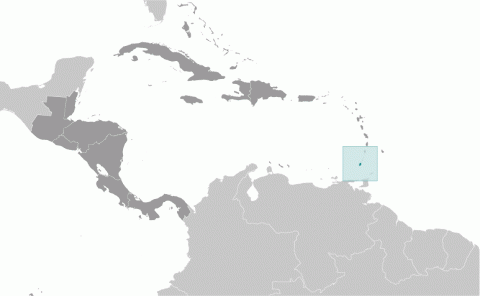

Moderate Advancement
Although research found no evidence that child labor exists in Grenada, in 2024, the government made moderate advancement in efforts to prevent the worst forms of child labor. The government passed the Education Amendment Bill, raising the compulsory school age from 16 to 17. In addition, in its most recent budget, the government removed some education fees and funded programs to help defray other school-related costs, such as school feeding programs and assistance for uniforms and books. However, despite these efforts, the law requires the use of force, threats, abuse of power, or other forms of coercion to classify an act as child trafficking. Grenada’s legal framework also has not identified hazardous activities prohibited for children or criminally prohibited the use, procuring, or offering of a child for all forms of commercial sexual exploitation.
| Children | Age | Percent and Population |
|---|---|---|
| Working | 5 to 14 | Unavailable |
| Hazardous Work by Children | 15 to 17 | Unavailable |
| Attending School | 5 to 14 | Unavailable |
| Combining Work and School | 7 to 14 | Unavailable |
Research found no evidence that child labor exists in Grenada.
| Standard | Age | Meets International Standards | Legislation |
|---|---|---|---|
| Minimum Age for Work | 16 | ✓ | Articles 32 and 35 of the Employment Act |
| Minimum Age for Hazardous Work | ✗ | ||
| Identification of Hazardous Occupations or Activities Prohibited for Children | ✗ | Article 40 of the Employment Act | |
| Prohibition of Slavery, Debt Bondage, and Forced Labor | ✓ | Article 25 of the Employment Act; Article 4 of the Constitution; Articles 2 and 9–12 of the Prevention of Trafficking in Persons Act | |
| Prohibition of Child Trafficking | ✗ | Articles 2, 9–11, and 14 of the Prevention of Trafficking in Persons Act | |
| Prohibition of Commercial Sexual Exploitation of Children | ✗ | Articles 137(29) and 188 of the Criminal Code; Articles 2 and 12 of the Electronic Crimes Bill; Articles 2 and 10 of the Prevention of Trafficking in Persons Act | |
| Prohibition of Using Children in Illicit Activities | ✓ | Articles 22 and 23 of the Drug Abuse (Prevention and Control) Act | |
| Minimum Age for Voluntary State Military Recruitment | N/A† | ||
| Prohibition of Compulsory Recruitment of Children by (State) Military | N/A† | ||
| Prohibition of Military Recruitment by Non-state Armed Groups | ✗ | ||
| Compulsory Education Age | 17 | ✓ | Article 15 of the Education Act; Education Amendment Bill |
| Free Public Education | ✗ | Article 16 of the Education Act |
† Country has no standing military
On June 4, 2024, the Education Amendment Bill was passed, raising the compulsory school age from 16 to 17. The government has not identified by national law or regulation the types of hazardous work prohibited for children; however, night work is prohibited for those under age 18. Although Grenada’s Employment Act and Education Act allow holiday employment for children over 14 years of age, they do not meet international standards as the laws do not determine the activities for which light work may be permitted or limit the number of hours for light work. Despite establishing heightened penalties for traffickers of children, the Prevention of Trafficking in Persons Act does not sufficiently prohibit the trafficking of children because it requires the use of force, threats, abuse of power, or other forms of coercion to classify an act as human trafficking. The Criminal Code, Electronic Crimes Bill, and Prevention of Trafficking in Persons Act also do not criminally prohibit the use, procuring, or offering of a child for all forms of commercial sexual exploitation. Moreover, laws guaranteeing free basic education do not meet international standards because they permit schools to charge tuition fees for some students who reside in Grenada but are not citizens.
| Organization/Agency | Role & Activities |
|---|
| Ministry of Labor: Enforces laws related to child labor through its Labor Commission, which generates a list of workplaces to inspect. Inspections are conducted at random as well as based on complaints, and unannounced inspections can be conducted in any sector, including the private sector and on farms. Although labor inspectors are not authorized to assess penalties, they inform the Royal Grenada Police Force if a child labor violation is found. The Royal Grenada Police Force then conducts a criminal investigation, and charges can be laid against violators through the Office of the Director of Public Prosecutions. |
| Royal Grenada Police Force (RGPF): Investigates crimes and enforces laws related to child labor. If child labor is confirmed, the RGPF is notified and works with the Child Protection Authority and Ministry of Social Development, Housing, and Community Empowerment to have the child removed from the home, if needed. Upon finding sufficient evidence of a criminal violation, submits findings for possible prosecution by the Department of Public Prosecutions. Helps the Child Protection Authority and the Ministry of Social Development, Housing, and Community Empowerment provide emergency services to children. |
| Overview of Enforcement Efforts | 2024 |
|---|---|
| Has a Labor Inspectorate | Yes |
| Able to Assess Civil Penalties | No |
| Routinely Conducted Worksite Inspections | Yes |
| Unannounced Inspections Permitted | Yes |
| Has a Complaint Mechanism | Yes |
| Imposed Penalties for Child Labor Violations | N/A |
| Conducted Criminal Investigations for Worst Forms of Child Labor Crimes | N/A |
| Imposed Penalties for Worst Forms of Child Labor Crimes | N/A |
As there is no evidence of a problem, there appears to be no need for a mechanism to coordinate efforts to address child labor.
As there is no evidence of a problem, there appears to be no need for policies to address child labor.
| Program | Description & Activities |
|---|
| Education Funding Programs:† Government-funded programs committed to ensuring that there are no barriers to accessing education through enhanced educational training, infrastructure development, vocational training, curricular reform, and technological integration, as well as through removed fees and the introduction of grants, including to preschools. The government also assists parents with the cost of uniforms, books, and food through a school feeding program for parents who are unable to afford it. Programs include the Support for Education and Empowerment Development (SEED) Program, which supports vulnerable families through monthly cash disbursements. The SEED Program provided 7,745 people with cash assistance during the reporting period. |
‡ Program is funded by the Government of Grenada.
| Area | Suggested Action |
|---|---|
| Legal Framework | Raise the minimum age for work from 16 to 17 to align with the compulsory education age. |
| Determine by national law or regulation the types of hazardous work prohibited for children, after consultation with employers’ and workers’ organizations. | |
| Ensure that the minimum age for hazardous work is age 18. | |
| Ensure that the law’s light work provisions specify the activities in which light work may be undertaken and limit the number of hours for light work. | |
| Ensure that the law criminalizes all forms of child trafficking, including in cases that do not involve the use of force, threats, abuse of power, or other forms of coercion. | |
| Enact legislation prohibiting the use, procuring, or offering of a child for all forms of commercial sexual exploitation. | |
| Ensure that the law criminally prohibits the recruitment of children under age 18 by non-state armed groups. | |
| Ensure that laws guaranteeing free basic education include all children in Grenada, including non-citizens. | |
| Enforcement | Collect and publish labor law enforcement data, including information on inspectorate funding, the training system for inspectors, the number of worksite inspections, unannounced inspections and routine targeted inspections. |
| Ensure that criminal investigators receive trainings on criminal laws involving the categorical worst forms of child labor. | |
| Establish a mechanism to assess civil penalties. |