


Child Labor and Forced Labor Reports
Gabon
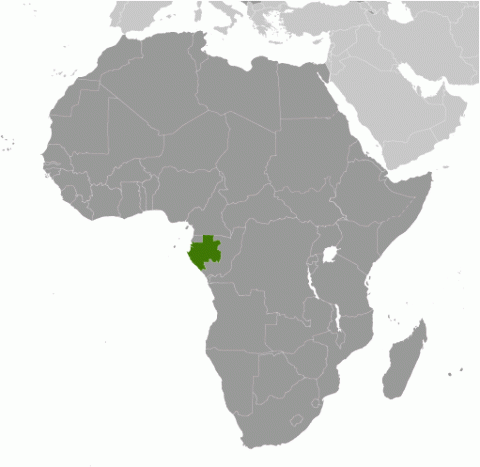

Minimal Advancement – Efforts Made but Continued Practice that Delayed Advancement
In 2024, Gabon made minimal advancement in efforts to eliminate the worst forms of child labor. The government established the National Commission for the Prevention and Fight Against Human Trafficking to, in part, oversee the enforcement of laws relating to child labor. It also began the construction of several educational complexes, as well as the refurbishment of other educational facilities in greater Libreville. However, despite new initiatives to address child labor, Gabon is assessed as having made only minimal advancement because the government failed to provide evidence that it conducted worksite inspections during the reporting period. Labor inspections are a key tool for identifying child labor violations, and their absence makes children more vulnerable to child labor. Gabon's Labor Code allows some forms of hazardous work for children ages 16 to 18 without providing the necessary safeguards to fully protect children aged 16 and 17 while performing dangerous tasks. In addition, funding and resources for enforcement of criminal laws remain a major barrier at every level. Finally, the court system held no criminal adjudication sessions during the reporting period; therefore, it neither initiated prosecutions nor convicted or sentenced offenders for the worst forms of child labor crimes.
| Children | Age | Percent and Population |
|---|---|---|
| Working | 5 to 14 | 12.5% (Unavailable) |
| Boys | 13.6% | |
| Girls | 11.6% | |
| Urban | 11.7% | |
| Rural | 20.1% | |
| Hazardous Work by Children | 15 to 17 | 1.2% (Unavailable) |
| Boys | 1.5% | |
| Girls | 1.0% | |
| Urban | 1.2% | |
| Rural | 2.0% | |
| Attending School | 5 to 14 | 94.1% |
| Combining Work and School | 7 to 14 | 14.1% |
| Sector/Industry | Activity |
|---|---|
| Agriculture | Working in fishing. |
| Industry | Mining and quarrying.† Manufacturing of construction materials. |
| Services | Domestic work; street work, including windshield cleaning, street vending, and cleaning market spaces at night; garbage scavenging; working as microbus transportation assistants† and as mechanics.† |
| Categorical Worst Forms of Child Labor‡ | Forced labor in domestic work and as nannies, in street vending, as mechanics, and in fishing, mining, quarrying, and manufacturing. Forced begging. Smuggling wildlife. Commercial sexual exploitation, sometimes as a result of transnational criminal activity. |
† Determined by national law or regulation as hazardous and, as such, relevant to Article 3(d) of ILO C. 182.
‡ Child labor understood as the worst forms of child labor per se under Article 3(a)–(c) of ILO C. 182.
Children at Higher Risk
Children who come to Gabon from other African countries—including Benin, Togo, Cameroon, Mali, Guinea, and Nigeria—are at increased risk of child labor due to their lack of identity documentation.
Barriers to Education Access
While public education in Gabon is free, there are insufficient teachers and schools to serve all children, especially in isolated rural areas where volunteers often step in to educate the local children. Poor infrastructure, a lack of basic supplies like furniture, as well as limited access to and the prohibitive costs of learning materials are also barriers to education. Violence in school settings is a recognized problem in Gabon. Lack of birth certificates, which are required for school enrollment, impedes attendance of non-citizen children and children born in isolated areas, where no government services are available.
| Standard | Age | Meets International Standards | Legislation |
|---|---|---|---|
| Minimum Age for Work | 16 | ✗ | Articles 7, 214, and 233 of the Labor Code; Article 2 of the Decree Establishing Individual Exceptions to the Minimum Age for Admission to Employment |
| Minimum Age for Hazardous Work | 16 | ✗ | Article 214 of the Labor Code; Articles 1–3 and 5 of the Hazardous Work List |
| Identification of Hazardous Occupations or Activities Prohibited for Children | ✓ | Articles 2, 3, and 5 of the Hazardous Work List | |
| Prohibition of Slavery, Debt Bondage, and Forced Labor | ✓ | Articles 225 to 225-6 of the Penal Code; Articles 3, 11, 12, and 20 of the Law Preventing and Fighting Against Child Trafficking; Articles 4, 5, and 16 of the Labor Code. | |
| Prohibition of Child Trafficking | ✓ | Articles 3, 11–14, and 20 of the Law Preventing and Fighting Against Child Trafficking; Articles 225 to 225-7 of the Penal Code | |
| Prohibition of Commercial Sexual Exploitation of Children | ✓ | Articles 225 to 225-6, 260, 261, 263, and 281-3 to 281-5 of the Penal Code | |
| Prohibition of Using Children in Illicit Activities | ✓ | Article 281-1 of the Penal Code | |
| Minimum Age for Voluntary State Military Recruitment | 16 | ✓ | Article 97 of the Child Code; Article 185 of the Order on the Particular Status of Members of the Military |
| Prohibition of Compulsory Recruitment of Children by (State) Military | N/A* | Article 97 of the Child Code | |
| Prohibition of Military Recruitment by Non-state Armed Groups | ✗ | ||
| Compulsory Education Age | 16 | ✓ | Article 1 of the Constitution; Article 2 of the Law on General Education; Article 340-6 of the Penal Code |
| Free Public Education | ✓ | Articles 1.18 and 1.19 of the Constitution; Article 2 of the Law on General Education |
* Country has no conscription
Although Gabon's Labor Code prohibits employment of children under age 16, minimum age protections do not apply to children outside of formal work relationships, contrary to international standards, which require all children be protected under the law. The minimum age of 16 for hazardous work as established in Gabon does not ensure that children receive adequate specific training and fails to protect the health, safety, and morals of the child in accordance with international obligations. Furthermore, Gabon's light work provision permits children under age 16 to perform light work with parental permission, but it neither sets a minimum age or determines the activities in which light work may be permitted, nor specifies the conditions under which light work may be undertaken.
| Organization/Agency | Role & Activities |
|---|
| Ministry of Labor and the Fight Against Unemployment: Responsible for receiving, investigating, and addressing child labor complaints. Labor inspections are coordinated by the Labor, Staffing and Employment Department, which includes special inspection units for mining and agriculture. According to the Labor Code, local labor inspectors are required to submit periodic reports on their activities, and the central authority is required to publish annual labor inspection reports. However, the government has yet to collect the required statistics and publish such a report. |
| Ministry of the Interior's Police Force: Enforces laws, investigates violations of the worst forms of child labor, and refers cases to the Ministry of Justice for prosecution. Refers survivors of child trafficking to the Ministry of Health and Social Affairs, which connects them to government-supported, NGO-operated shelters for vulnerable children to receive medical and psychosocial services, legal assistance, and education. Sources stated that police officers from vice squads investigated reports of the worst forms of child labor and referred cases of violations for court action during 2024; however, no official reporting on the cases was made available. |
| Overview of Enforcement Efforts | 2024 |
|---|---|
| Has a Labor Inspectorate | Yes |
| Able to Assess Civil Penalties | Yes |
| Routinely Conducted Worksite Inspections | No |
| Unannounced Inspections Permitted | Yes |
| Has a Complaint Mechanism | No |
| Imposed Penalties for Child Labor Violations | No |
| Conducted Criminal Investigations for Worst Forms of Child Labor Crimes | Unknown |
| Imposed Penalties for Worst Forms of Child Labor Crimes | Unknown |
It is unknown how many labor inspectors conducted worksite inspections, or whether child labor violations were found. It is also unknown whether investigations into suspected cases of the worst forms of child labor were conducted, prosecutions were initiated, or perpetrators were convicted.
While a labor inspectorate does exist in Gabon, the government again failed to provide evidence that it conducted worksite inspections during the reporting period. Research suggests that irregular pay undermines inspectors' ability and willingness to perform their duties. Without an active practice of conducting worksite inspections, Gabon allows employers to exploit child laborers with impunity.
| Coordinating Body | Role & Activities |
|---|
| National Commission for the Prevention and Fight Against Human Trafficking:* Responsible for the enforcement of laws relating to child labor. Established in 2024, the commission is fully operational and meeting. A training workshop for commission members and other relevant stakeholders took place on December 20 with the support of the UN. |
*Mechanism to coordinate efforts to address child labor was created during the reporting period.
| Policy | Description & Activities |
|---|
| National Action Plan (2024–2028):* Founded on five pillars: building the internal framework for combating trafficking, understanding the phenomenon of trafficking so as to better combat it, supporting and protecting victims, acting internationally and facilitating the voluntary return of survivors, and strengthening criminal justice capacity within and across borders. |
* Policy was approved during the reporting period.
† The government had other policies that may have addressed child labor issues or had an impact on child labor.
| Program | Description & Activities |
|---|
| Shelters for Children in Need:‡ Provide social services to survivors of child trafficking. Children receive medical care, literacy training, and reintegration support. The government provides in-kind assistance, including government social workers and medical supplies, to shelters run by civil society organizations. However, research indicates that shelter space and funding are insufficient to accommodate all survivors of the worst forms of child labor. Officials reported referring children to services in 2024; however, specific data were not available by the end of the reporting period. |
| Education Sector Investment Program (Programme d'investissements dans le secteur de l'éducation [PISE]):‡ Program of the Ministry of Education to create optimal learning conditions by providing high quality educational facilities in Gabon's two largest cities. In 2024, official groundbreaking took place, launching Phase 2 of PISE, with the construction and rehabilitation of several educational complexes and high schools, and the refurbishment of other educational facilities in greater Libreville. |
| UNICEF Programs: Have included support for birth registration, education access, child protection, and population data collection and analysis. No activities were undertaken to implement or expand funding and support for the existing programs during the reporting period due to budget constraints. |
‡ Program is funded by the Government of Gabon.
| Area | Suggested Action |
|---|---|
| Legal Framework | Ensure that minimum age protections are extended to all children, regardless of employment relationship. |
| Ensure that children under age 18 who are engaged in hazardous work receive adequate training in the type of work being done and that the health, safety, and morals of the child are protected in accordance with international standards. | |
| Ensure that the legal framework for light work establishes a minimum age no younger than age 13, determines activities that are considered light work, and specifies the conditions under which light work may be undertaken. | |
| Establish criminal prohibitions for the recruitment of children under age 18 for use in armed conflict by non-state armed groups. | |
| Enforcement | Conduct worksite inspections, including routine and unannounced inspections in both the formal and informal sectors, to identify child labor violations. |
| Publish complete information on civil law enforcement efforts to address child labor, including the funding level for the labor inspectorate, the number of labor inspectors employed, the number of inspections conducted, the number of child labor violations found, and the number of penalties imposed and collected. | |
| Employ at least 54 labor inspectors to ensure adequate coverage for the labor force of approximately 807,000 people. | |
| Ensure that sufficient funding is allocated to the labor inspectorate, labor inspector salaries are paid regularly, and inspectors have the training and material resources they need to fulfill their mandate. | |
| Establish a mechanism to receive child labor complaints. | |
| Ensure that labor inspectors are not tasked with conciliation or arbitration duties so that they can carry out their primary duties of inspection and monitoring throughout the country. | |
| Implement a digital tracking system for the worst forms of child labor inspections, and establish a mechanism to receive child labor complaints from the public. | |
| Ensure that the government conducts an adequate number of criminal investigations into alleged child labor crimes, and publish data on criminal law enforcement efforts. | |
| Ensure that criminal law enforcement bodies, including the courts, have sufficient resources and training to investigate, prosecute, and impose penalties for violations related to the worst forms of child labor, including on government officials for their involvement in child trafficking. | |
| Ensure that courts regularly hear cases related to child labor crimes and that perpetrators are, as appropriate under the law, convicted and sentenced. | |
| Coordination | Ensure that the National Commission for the Prevention and Fight Against Human Trafficking has a defined mandate and the funding and capacity to coordinate efforts to address the worst forms of child labor in Gabon. |
| Government Policies | Adopt a policy that addresses all relevant worst forms of child labor, including forced labor and commercial sexual exploitation. |
| Social Programs | Address barriers to education access by improving school infrastructure, including access to water, toilets, and adequate sanitation, and increasing the number of teachers and schools in rural areas. Provide classroom furniture, learning materials, and school supplies for students. Ensure the safety and well-being of children at school, especially girls, by assuring that schools are free from sexual and physical violence. |
| Expand efforts to ensure that all children have access to identity documentation, including by expanding birth registration opportunities for children born in rural areas. | |
| Ensure that the government provides adequate support to survivors of child labor, including sufficient shelter space and services, and publish activities undertaken by the Shelters for Children in Need program during the reporting period. | |
| Expand programs to address the scope of the country's child labor problem, including in domestic work and commercial sexual exploitation. |