


Child Labor and Forced Labor Reports
Côte d'Ivoire










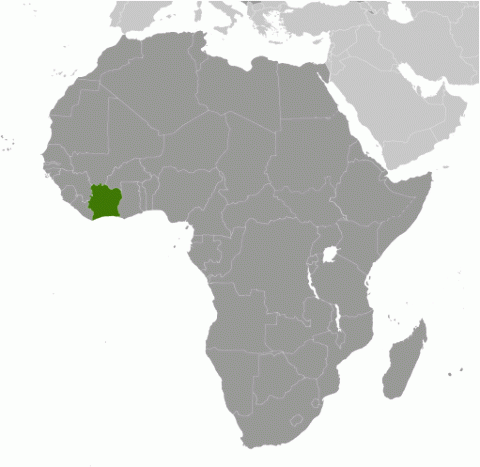

Moderate Advancement
In 2024, Côte d’Ivoire made moderate advancement in efforts to eliminate the worst forms of child labor. The government signed the Child Labor in Cocoa Coordinating Group Framework of Action, which addresses child labor in the West African cocoa sector through tackling the root causes of child labor, improving access to education and training, strengthening social protection mechanisms and social services, and improving cocoa traceability systems and child protection case management systems. In addition, the government continued to expand its child labor monitoring mechanism, launching a national database used by stakeholders to record incidents and coordinate to combat child labor. Furthermore, funding for the labor inspectorate increased 36 percent, from $305,600 (2023) to $416,300 (2024), and inspections increased 50 percent, from 9,536 (2023) to 14,262 (2024) in the formal sector, with an additional 417 unannounced inspections targeting high-risk informal sectors, including agriculture, construction, and public works, which led to 756 cases of alleged child labor violations. However, despite these efforts, the government does not yet have a mechanism to assess civil penalties for labor law violations. Although funding has increased, there are still insufficient financial, transportation, and personnel resources to meet the expanding responsibilities of labor inspection and law enforcement. Political instability in neighboring countries has increased asylum claims and the number of abandoned children, who are more susceptible to forced labor and human trafficking. Finally, educational accessibility issues make it difficult for some children to attend schools, making them more susceptible to child labor.
| Children | Age | Percent and Population |
|---|---|---|
| Working | 10 to 14 | 28.8% (868,671) |
| Boys | 22.1% | |
| Girls | 36.0% | |
| Urban | 24.9% | |
| Rural | 32.9% | |
| Hazardous Work by Children | 15 to 17 | 12.6% (93,568) |
| Boys | 11.9% | |
| Girls | 13.4% | |
| Urban | 12.7% | |
| Rural | 12.6% | |
| Attending School | 5 to 14 | 70.1% |
| Combining Work and School | 10 to 14 | 2.1% |
| Sector/Industry | Percent of Population |
|---|---|
| Agriculture | 65.1% |
| Industry | 5.9% |
| Services | 29.0% |
| Sector/Industry | Activity |
|---|---|
| Agriculture | Production of cocoa (including cocoa butter, cocoa paste, cocoa powder, and chocolate) and coffee, including burning† and clearing fields,† cutting down trees,† exposure to agrochemicals,† spraying pesticides,† using sharp tools to break pods,† and transporting heavy loads† of water and pods. Herding animals and forestry. |
| Industry | Mining,† including crushing, transporting, blasting, digging, and sieving. Also in construction† and carpentry. Welding and automobile repair. |
| Services | Domestic work, carrying goods,† street vending, car washers, parking lot attendants, and work in restaurants and in transportation. Also, working as seamstresses, tailors, and hairdressers. |
| Categorical Worst Forms of Child Labor‡ | Forced mining, carpentry, construction, domestic work, street vending, begging, and agriculture, including in the production of cocoa and coffee, each sometimes as a result of human trafficking. Children are also engaged in commercial sexual exploitation, sometimes as a result of human trafficking. Lastly, children are used in illicit activities, including drug trafficking, sometimes as a result of human trafficking. |
† Determined by national law or regulation as hazardous and, as such, relevant to Article 3(d) of ILO C. 182.
‡ Child labor understood as the worst forms of child labor per se under Article 3(a)–(c) of ILO C. 182.
Children at Higher Risk
Due to recent political instability in the region, a surge of displaced children from Mali and Burkina Faso have fled into Côte d’Ivoire, with an estimated 57 percent of asylum seekers being children under the age of 18. While the government and UN High Commissioner for Refugees provide services, including housing and education, to asylum seekers and their families in northern Côte d’Ivoire, these children are at higher risk of child labor. In addition, approximately 520,000 abandoned children and children of unknown parentage are at high risk of becoming stateless because they cannot prove their citizenship through valid documentation. Without birth certificates, children are unable to enroll in school past the elementary level and are at higher risk of child labor. The number of displaced children from neighboring countries exacerbated the number of children without birth certificates in 2024.
Barriers to Education Access
The Ministry of Education had a budget of $471 million in 2024, which increased the number of teachers, classrooms, and materials available for students. Despite these efforts, there remains a shortage of teachers. In addition, poor school infrastructure, insufficient classroom space, the lack of transportation systems in rural areas, and inadequate sanitation facilities have negatively impacted children’s ability to attend school. Research also suggests that some students are sexually harassed at school or on the way to school, which may deter some students from attending school. Although the education laws provide for free education, students are often required to pay for tuition, textbooks, and other school supplies, which may be prohibitively costly for some families. In addition, birth registration or identity documents are required for students to take entrance exams for secondary school, posing a barrier to continued education beyond the primary level. These birth documents can be difficult for stateless children to obtain, thereby hindering their ability to attend school. In addition, reports indicate that while the government does provide schooling for refugee children, there are some classrooms with upwards of 100 children in a class. In key cocoa-producing regions, cocoa and chocolate manufacturers provided financial support to the Ministry of National Education and Literacy through the Child Learning Education Facility project, which helps integrate children aged 9 to 14 into the formal school system and participated in the construction of 104 schools in 2024.
| Standard | Age | Meets International Standards | Legislation |
|---|---|---|---|
| Minimum Age for Work | 16 | ✓ | Article 23.2 of the Labor Code; Article 16 of the Constitution |
| Minimum Age for Hazardous Work | 18 | ✓ | Article 4 of the Prohibitions of Hazardous Work List |
| Identification of Hazardous Occupations or Activities Prohibited for Children | ✓ | Articles 5–11 of the Prohibitions of Hazardous Work List; Articles 6 and 19 of the Prohibition of Trafficking and the Worst Forms of Child Labor Law | |
| Prohibition of Slavery, Debt Bondage, and Forced Labor | ✓ | Article 5 of the Constitution; Articles 4, 6, 7, 8, 11–14, and 20–23 of the Prohibition of Trafficking and the Worst Forms of Child Labor Law; Article 3 of the Labor Code | |
| Prohibition of Child Trafficking | ✓ | Article 5 of the Constitution; Articles 11, 12, 20–22, and 26 of the Prohibition of Trafficking and the Worst Forms of Child Labor Law; Article 370 of the Penal Code; Articles 4.4 and 6 of the Law on Combating Trafficking of Persons | |
| Prohibition of Commercial Sexual Exploitation of Children | ✓ | Articles 8, 9, 15, and 24–29 of the Prohibition of Trafficking and the Worst Forms of Child Labor Law; Articles 4.4 and 6 of the Law on Combating Trafficking of Persons | |
| Prohibition of Using Children in Illicit Activities | ✓ | Articles 4 and 30 of the Prohibition of Trafficking and the Worst Forms of Child Labor Law | |
| Minimum Age for Voluntary State Military Recruitment | 18 | ✓ | Article 56.4 of the Armed Forces Code; Articles 7, 8, and 18 of the Law Determining the Conditions for Entering the Military |
| Prohibition of Compulsory Recruitment of Children by (State) Military | ✓* | Article 56.4 of the Armed Forces Code | |
| Prohibition of Military Recruitment by Non-state Armed Groups | ✓ | Articles 4 and 31 of the Prohibition of Trafficking and the Worst Forms of Child Labor Law | |
| Compulsory Education Age | 16 | ✓ | Article 10 of the Constitution; Article 2.1 of the Law on Education |
| Free Public Education | ✗ | Article 2 of the Law on Education |
* Country has no conscription
Cote d'Ivoire's laws do not meet the international standard for free public education because the law allows for charging of fees, including school registration fees.
| Organization/Agency | Role & Activities |
|---|
| Ministry of Employment and Social Protection (MESP): Enforces labor laws, including those related to child labor, and oversees labor inspection services. The Anti-Trafficking Unit, a Sub-Directorate, and the Ministry of Women, Family, and Children provide support to survivors of child trafficking and other forms of child labor. The Child Labor Directorate coordinates the National Child Labor Monitoring System (SOSTECI). In 2024, MESP implemented a comprehensive strategic plan for labor inspections that focused on child labor in workplaces. |
| Ministry of the Interior and Security: Through its Criminal Police Sub-Directorate for Combating Child Trafficking, Child Exploitation, and Juvenile Delinquency, and the Anti-Trafficking Unit, investigates crimes related to child trafficking and provides survivors with rehabilitation support. Law enforcement officers investigate all crimes related to child labor and forced labor, including commercial sexual exploitation, and refer cases for prosecution to the Ministry of Justice and Human Rights. Through its Unit for Combating Transnational Organized Crime, supports the UN Office on Drugs and Crime under the West African Coast Initiative, which aims to improve cross-border cooperation to address human trafficking crimes. |
| Overview of Enforcement Efforts | 2024 |
|---|---|
| Has a Labor Inspectorate | Yes |
| Able to Assess Civil Penalties | No |
| Routinely Conducted Worksite Inspections | Yes |
| Unannounced Inspections Permitted | Yes |
| Has a Complaint Mechanism | Yes |
| Imposed Penalties for Child Labor Violations | N/A |
| Conducted Criminal Investigations for Worst Forms of Child Labor Crimes | Yes |
| Imposed Penalties for Worst Forms of Child Labor Crimes | Yes |
In 2024, 369 labor inspectors conducted 14,262 worksite inspections in the formal sector, finding 0 child labor violations. Additionally, labor inspectors conducted 417 unannounced inspections in the informal sector, leading to 756 cases of alleged child labor violations. The police, to whom individuals can report suspected violations directly, received 1,250 reports of alleged child labor violations. The government also conducted 557 investigations into suspected worst forms of child labor crimes, initiated 456 prosecutions, made 257 arrests of alleged perpetrators, and convicted an unknown number of perpetrators.
| Coordinating Body | Role & Activities |
|---|
| National Monitoring Committee on Actions to Combat Trafficking, Exploitation, and Child Labor (CNS): Supervises, monitors, and evaluates all government activities related to child labor and child trafficking, including making policy recommendations and harmonizing laws with international conventions. Also oversees the country’s child labor observation and monitoring system (SOSTECI), which enables communities to collect and analyze statistical data on the worst forms of child labor. The system operates in 111 departments, 42 sub-prefectures, and 304 villages. In addition, the committee chairs the Interministerial Committee for the Fight against Trafficking, Exploitation, and Child Labor (CIM), represents Côte d’Ivoire in the Child Labor in Cocoa Coordinating Group, and provides medical and social assistance to survivors of child labor and trafficking. In 2024, Côte d’Ivoire launched the SOSTECI national database on child labor, which is used by stakeholders to record child labor incidents, cases, and related activities, and continues to update and expand applications and information technology tools to facilitate data collection through this system. |
| Policy | Description & Activities |
|---|
| National Action Plan to Combat Trafficking, Exploitation, and Child Labor: Implemented by CNS and CIM, aimed to significantly reduce the number of children engaged in the worst forms of child labor by drawing on best practices and building on lessons learned from the implementation of previous national action plans. Priorities included increasing efforts to mobilize resources at the national level, reinforcing regional cooperation and public-private partnerships, and incorporating worst forms of child labor considerations into national and sector-specific programming. This national action plan expired in December 2023. In 2024, the government reviewed its implementation and conducted an independent evaluation of the strategy to combat child labor, and aims to introduce the new national action plan in 2025. |
| National Strategy to Combat Human Trafficking (2022–2025): Implemented by the Ministry of Social Cohesion, Solidarity, and the Fight Against Poverty, set out an action plan that addresses human trafficking. Strategies from this plan include coordinating at the regional and national levels, providing additional protection and care for survivors, and improving the legal proceedings in the court system. Research could not determine whether activities took place to implement this policy during the reporting period. |
| Child Labor in Cocoa Coordinating Group Framework of Action (2024–2029):* Implemented through CNS and CIM, and with external partners in industry and government, aims to address child labor in the West African cocoa sector through tackling the root causes of child labor, improving access to education and technical and vocational training, strengthening social protection mechanisms and social services, and improving national cocoa traceability systems and child protection case management systems, including the alignment and interoperability of private child labor monitoring and remediation systems and the SOSTECI systems. In order to implement this Framework, signatories will establish an Action Plan within 6 months. |
* Policy was approved during the reporting period.
‡ The government had other policies that may have addressed child labor issues or had an impact on child labor.
| Program | Description & Activities |
|---|
| ILO Projects: Include Accelerating Action for the Elimination of Child Labor in Supply Chains in Africa (ACCEL Africa), a Government of Netherlands-funded program partnering with the ILO and UNICEF aimed at promoting employment, inclusive growth, and social protection; elimination of child labor; and other issues related to work and social protection in cocoa and gold supply chains in Côte d’Ivoire. ACCEL Africa supported cooperatives, savings and loans, and worker groups, while extending its activities to banks, microfinance institutions, insurance companies, and fintech. Additionally, includes the "Together to act on the root causes of child labor in Nawa" project with funding from the EU. The project is implemented by the ILO, the International Organization for Migration, and UNICEF, and aims to address child labor in the Nawa region by providing children with access to education and basic social services and offering children above the minimum working age and their parents decent work opportunities. |
| World Bank-Funded Projects: Aim to improve access to education and provide poverty relief. Includes the Productive Social Safety Net (2015–2024), which has supported 327,000 households and more than 1.9 million people with financial assistance. In 2024, the program provided quarterly disbursements of $57 for each household. |
| Projects in the Cocoa Sector: Aim to increase sustainability in the cocoa sector, improve farmer livelihoods, increase access to education opportunities for children, and address the worst forms of child labor in cocoa-growing areas. The Cocoa and Forests Initiative, a public-private partnership, works to eliminate deforestation, encourage sustainable cocoa production, and address child labor through community participation. The $22 million Child Learning Education Facility initiative, part of both the 2016–2025 Education Sector Plan and the National Sustainable Cocoa Strategy, aims to eradicate child labor in cocoa farming by increasing access to quality education by building schools and creating bridging classes to integrate 9–14-year-olds into formal schooling. During the reporting period, the Child Learning Education Facility initiative built 104 schools, each with an administrative building, a cafeteria, and 4 classrooms. |
† The government had other social programs that may have included the goal of eliminating or preventing child labor.
| Area | Suggested Action |
|---|---|
| Legal Framework | Establish by law free public education. |
| Ensure that the age of entry into apprenticeship is set consistently at 14 years in applicable laws. | |
| Enforcement | Establish a mechanism to assess penalties for child labor violations. |
| Ensure that the labor inspectorate receives sufficient funding to conduct inspections throughout the country, including in the informal sector. | |
| Increase the number of labor inspectors from 369 to 791 to ensure adequate coverage of the labor force of approximately 11.9 million people. | |
| Ensure that criminal law enforcement agencies, including the Anti-Trafficking Unit, receive the resources and personnel needed to adequately enforce laws related to the worst forms of child labor. | |
| Government Policies | Finalize and publish the National Action Plan to Combat Trafficking, Exploitation, and Child Labor to address child labor. |
| Social Programs | Improve access to education by increasing transportation options and the number of teachers, textbooks, sanitation facilities, and classrooms; increasing the number of schools in rural areas; ensuring that schools are free of physical and sexual abuse; and increasing children’s access to birth registration and identity documents. |
| Ensure that survivors of the worst forms of child labor are able to access social services throughout the country. Ensure that social services systems (such as the regional/district social services centers) receive the resources and personnel needed to adequately support survivors. | |
| Expand identification and support services for registered refugees, asylum seekers, and abandoned children, especially from Burkina Faso, Mali, and Niger, including access to housing, education, and documentation. |