


Child Labor and Forced Labor Reports
Congo, Republic of the
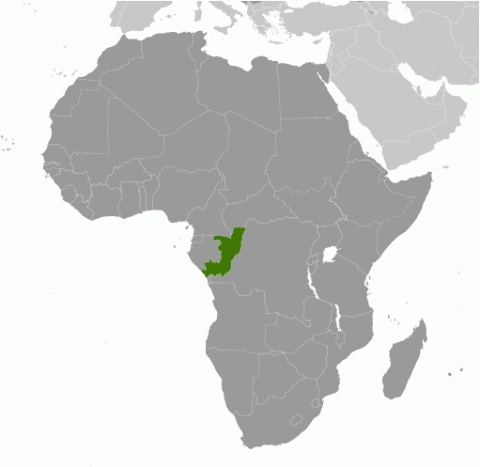

Moderate Advancement
In 2024, the Republic of the Congo made moderate advancement in efforts to eliminate the worst forms of child labor. A coordination committee working under the authority of the Ministry of Labor was created for the planning and supervision of an action plan to eradicate child labor and forced labor. The government also established a 20-person, full-time and permanent National Anti-Trafficking Commission and provided sufficient staffing to finalize and resource an Anti-Trafficking National Action Plan, which was completed in March 2025. Finally, the government launched the Social Safety Nets National Program (2023–2026) under the authority of the Ministry of Social Affairs, Solidarity, and Humanitarian Action, which aims to provide cash transfers to 70,000 poor households. However, the government lacks a legal statute identifying the hazardous occupations or activities prohibited for children. In addition, both civil and criminal enforcement agencies in the Republic of the Congo lack the funding, capacity, and training they need to enforce child labor laws and track data on their efforts to address child labor. Lastly, existing policies on child labor have not been fully implemented.
| Children | Age | Percent and Population |
|---|---|---|
| Working | 5 to 14 | 25.4% (Unavailable) |
| Hazardous Work by Children | 15 to 17 | Unavailable |
| Attending School | 5 to 14 | 92.9% |
| Combining Work and School | 7 to 14 | 27.1% |
| Sector/Industry | Activity |
|---|---|
| Agriculture | Farming, including harvesting crops. Working in fishing. |
| Industry | Working in mines and quarries, including extracting minerals. |
| Services | Directing road traffic, domestic work, begging, working in markets and street vending, and carrying heavy loads. |
| Categorical Worst Forms of Child Labor‡ | Commercial sexual exploitation, sometimes as a result of human trafficking. Forced labor in agriculture and fishing. Forced labor in market and street vending as well as in domestic work. Forced labor in quarries. |
‡ Child labor understood as the worst forms of child labor per se under Article 3(a)–(c) of ILO C. 182.
Children at Higher Risk
Children from the Democratic Republic of the Congo, Benin, and other West African nations are frequently subjected to forced domestic work, forced labor in market vending, and potentially to commercial sexual exploitation in the Republic of the Congo; girls are especially at risk. In addition, refugees and children from rural areas are at risk of being used for exploitation in cities, notably by individuals in the fishing industry and market shop owners. Furthermore, children from the Baka, Aka, and Kola groups are also vulnerable to being subjected to the worst forms of child labor, including forced agricultural work by members of the majority Bantu community.
Barriers to Education Access
Reports show that the development of educational facilities has not kept pace with the increasing enrollment in Congolese schools, resulting in an insufficient number of schools and classrooms, and a lack of school infrastructure, such as latrines, water points, and school desks. Barriers to education also include a lack of transportation, insufficient school materials, and a shortage of qualified teachers. In addition, significant disparities exist between rural areas and urban areas, leading to the use of a two-shift system in certain classrooms, makeshift furniture, and unqualified volunteer teachers. Moreover, while the country’s constitution provides for free education until age 16, in practice, some parents are required to pay for books, uniforms, meals, and school fees, which limits access to education for some children. The lack of birth registration can be a barrier to education for native children.
| Standard | Age | Meets International Standards | Legislation |
|---|---|---|---|
| Minimum Age for Work | 16 | ✓ | Article 116 of the Labor Code; Article 68 of the Child Protection Code |
| Minimum Age for Hazardous Work | 18 | ✓ | Article 68 of the Child Protection Code |
| Identification of Hazardous Occupations or Activities Prohibited for Children | ✗ | ||
| Prohibition of Slavery, Debt Bondage, and Forced Labor | ✓ | Article 4 of the Labor Code; Articles 68 and 122 of the Child Protection Code; Article 33 of the Constitution; Articles 4–6 and 14 of Law No. 22-2019 on Combating Trafficking in Persons | |
| Prohibition of Child Trafficking | ✓ | Articles 2, 4, and 6 of Law No. 22-2019 on Combating Trafficking in Persons | |
| Prohibition of Commercial Sexual Exploitation of Children | ✓ | Articles 60, 65–68, and 122 of the Child Protection Code; Articles 334 and 335 of the Penal Code | |
| Prohibition of Using Children in Illicit Activities | ✓ | Articles 68–70 and 122 of the Child Protection Code | |
| Minimum Age for Voluntary State Military Recruitment | 18 | ✓ | Article 30 of the Military and Gendarmerie Code; Article 49 of the Child Protection Code |
| Prohibition of Compulsory Recruitment of Children by (State) Military | N/A | ||
| Prohibition of Military Recruitment by Non-state Armed Groups | ✓ | Articles 49 and 111 of the Child Protection Code | |
| Compulsory Education Age | 16 | ✓ | Article 27 of the Child Protection Code; Article 29 of the Constitution; Articles 1 and 3 of the Education Law |
| Free Public Education | ✓ | Article 29 of the Constitution; Articles 1 and 3 of the Education Law |
The government has not developed a list of hazardous work prohibited for children. In addition, decrees implementing the 2010 Child Protection Code have yet to be signed, hindering enforcement.
| Organization/Agency | Role & Activities |
|---|
| Ministry of Civil Service, Labor, and Social Security: Enforces child labor laws. Conducts initial inspections before referring cases to the Ministry of Justice, Human Rights, and the Promotion of Indigenous People (MOJ) for prosecution and works with the Ministry of Social Affairs, Solidarity, and Humanitarian Action (MSA) to provide support to victims. Research could not determine what actions the Ministry took in relation to child labor enforcement in 2024. |
| Ministry of the Interior’s National Police: Enforce criminal laws related to the worst forms of child labor and conduct investigations into cases of forced labor, human trafficking, and the use of children in illicit activities. Conduct operations to remove trafficked children from labor and commercial sexual exploitation. Collect evidence and refer cases to the District Attorney’s office under MOJ. The annual training for law enforcement officials includes a human trafficking module. |
| Overview of Enforcement Efforts | 2024 |
|---|---|
| Has a Labor Inspectorate | Yes |
| Able to Assess Civil Penalties | Yes |
| Routinely Conducted Worksite Inspections | Yes |
| Unannounced Inspections Permitted | Yes |
| Has a Complaint Mechanism | Yes |
| Imposed Penalties for Child Labor Violations | No |
| Conducted Criminal Investigations for Worst Forms of Child Labor Crimes | No |
| Imposed Penalties for Worst Forms of Child Labor Crimes | No |
In 2024, 235 labor inspectors conducted an unknown number of worksite inspections, and found 0 child labor violations. The government conducted 0 investigations into suspected cases of the worst forms of child labor, initiated 0 prosecutions, and convicted 1 perpetrator.
| Coordinating Body | Role & Activities |
|---|
| National Commission to Fight Against Trafficking in Persons: Coordinates government efforts on human trafficking and forced labor, including of children. The Commission met during the reporting period. |
| Policy | Description & Activities |
|---|
| Child Protection Action Plan (2022–2026): Updated and disseminated by the Legal Directorate of MSA, with input from MOJ and the National Police. Identifies specific measures for MSA to pursue in the area of child protection, including assisting child trafficking survivors, undertaking a census of relevant NGOs to improve coordination, and providing training for Directorate personnel on human trafficking identification and protection techniques. Research could not determine whether activities took place to implement the policy during the reporting period. |
| National Action Plan for the Improvement of Indigenous Population’s Quality of Life (2022–2025): Under the coordination of the MOJ, includes strategies to ensure the protection and promotion of these people’s rights. Focuses on ensuring equal rights, including on labor issues and the improvement of education access for children. A lack of financial resources limited the activities carried out under this policy during the reporting period. |
| Education Sector Strategy (Stratégie sectorielle de l’éducation) (2021–2030): Focuses on the priorities of offering quality basic education for all children, addressing the human resource needs for the country’s developing economy, and creating mechanisms for the efficient management of an educational system. During the reporting period, school supplies and school furniture were distributed to students and public and private schools around the country. |
† The government had other policies that may have addressed child labor issues or had an impact on child labor.
| Program | Description & Activities |
|---|
| Social Safety Nets National Program (Programme national de filets sociaux) (2023–2026):‡ Launched in 2024 under the authority of the MSA, aims to provide cash transfers to 70,000 poor households. Financial aid is conditional on children’s school enrollment and attendance. During the reporting period, cash transfers began reaching the population of several districts, including Lékoumou Zanaga and Bambama. |
| Education Initiatives:‡ Ministry of Education programs implemented under the Education Sector Strategy (2021–2030), which aim to provide quality basic education for all young people and remove barriers to access for girls, out-of-school children, and other populations in situations of vulnerability. Includes initiatives to improve infrastructure, build instructional and administrative capacity, and provide vocational and secondary education to prepare young people for productive employment. Observe, Reflect, Act provides 2 to 3 years of community-based instruction to native children to prepare them to enter the formal primary education system. However, Observe, Reflect, Act schools are primarily funded by international organizations, private companies, or local communities. In addition, facing a severe teacher shortage, the government resorted to some teachers working on a voluntary basis rather than increasing the number of civil servant teachers. During the reporting period, the World Bank approved $95 million in funding for Transforming the Education Sector for Better Outcomes and Results, co-financed with the Global Partnership for Education. This program intends to improve equitable access to quality pre-primary and primary schools. |
‡ Program is funded by the Government of the Republic of the Congo.
| Area | Suggested Action |
|---|---|
| Legal Framework | Accede to the Palermo Protocol on Trafficking in Persons. |
| Determine by national law or regulation the types of hazardous work prohibited for children, after consultation with employers’ and workers’ organizations. | |
| Issue and enforce implementing regulations for the 2010 Child Protection Code. | |
| Enforcement | Implement a digital tracking system for civil worst forms of child labor inspections. |
| Take active measures to investigate, prosecute, convict, and sentence public officials who participate in or facilitate the worst forms of child labor. | |
| Publish information related to labor and criminal law enforcement statistics, including the funding level for the labor inspectorate, the number and type of labor inspections conducted, violations found, penalties imposed and collected for child labor violations, the number of criminal investigations conducted, convictions secured, and penalties imposed. Also ensure that labor and criminal law enforcement agencies, in particular the Ministry of Civil Service, Labor, and Social Security and the Ministry of the Interior's National Police, enforce relevant laws. | |
| Ensure that the government establishes a formal process for referring children to the appropriate social services when they are found in situations of child labor. | |
| Conduct investigations and prosecutions, and impose penalties for worst forms of child labor crimes. | |
| Strengthen the labor inspectorate by initiating routine inspections rather than performing inspections solely based on complaints received, and conduct targeted inspections based on analysis of data related to risk-prone sectors and patterns of serious incidents, including inspections of employers in rural areas, family enterprises, the informal sector, and those hiring self-employed children. | |
| Institutionalize training for all labor inspectors, investigators, and law enforcement officers, including by offering periodic refresher courses and courses on child labor issues, and strengthen the labor inspectorate by ensuring that inspectors have adequate resources, such as government vehicles, to conduct unannounced inspections. | |
| Ensure that funds budgeted for the Ministry of Social Affairs, Solidarity, and Humanitarian Action to address human trafficking are sufficiently disbursed. | |
| Remove barriers to enforcement and prosecution by strengthening the judicial system through improved record-keeping, decreased court backlogs, more frequent hearings, and improved training for criminal law enforcement officials and judges on human trafficking legislation and on identifying, recognizing, prosecuting, and handling worst forms of child labor cases. | |
| Expand criminal law enforcement efforts related to child labor beyond large cities. | |
| Ensure that criminal enforcement agencies such as the National Police are properly funded and do not seek payment from stakeholders to conduct investigations and operations. Also provide them with equipment, such as surveillance or detention facilities, the means to coordinate with international organizations and other countries, and sufficient personnel. | |
| Coordination | Ensure that the National Commission to Fight Against Trafficking in Persons receives adequate resources, including sufficient funding, to function as intended. |
| Establish and fund a national coordinating mechanism to address the worst forms of child labor in all relevant sectors, including in agriculture, mining, and domestic work. | |
| Government Policies | Implement the Child Protection Action Plan and the National Action Plan for the Improvement of Indigenous Population’s Quality of Life and publish results from activities implemented on an annual basis. |
| Social Programs | Fund and implement social programs to address the worst forms of child labor, including forced domestic work and commercial sexual exploitation, and provide social protection to populations particularly at risk, such as Baka, Aka, and Kola children. |
| Conduct a comprehensive study of children’s activities to determine whether they are engaged in or at risk for involvement in child labor. | |
| Improve access to education for all children, including those in rural areas, by eliminating all school-related fees, providing transportation, improving infrastructure and sanitation facilities —notably with desks, latrines, and water points— building additional schools, training additional teachers, and ensuring that students are not subjected to physical or sexual violence. | |
| Ensure that children do not experience discrimination or barriers to education, including by raising awareness of tuition waivers, providing instruction in native languages, and facilitating obtention of the identity documentation required to register for national exams. |