


Child Labor and Forced Labor Reports
Congo, Democratic Republic of the (DRC)












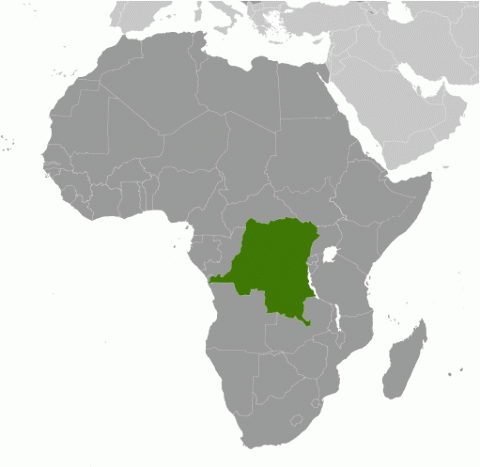

Minimal Advancement – Efforts Made but Continued Practice that Delayed Advancement
In 2024, the Democratic Republic of the Congo made minimal advancement in efforts to eliminate the worst forms of child labor. The government worked with the United Nations Organization Stabilization Mission in the Democratic Republic of the Congo to conduct age verification assessments on 2,987 candidates for recruitment into the Congolese army, which led to 219 children being identified, excluded from recruitment, and referred to social services. However, despite new initiatives to address child labor, the Democratic Republic of the Congo is assessed as having made only minimal advancement because it failed to remedy practices that delayed advancement to eliminate child labor. The country’s armed forces coordinated with and supplied material support to armed groups known for recruiting children, and the labor inspectorate did not conduct unannounced inspections. In addition, the government did not publish labor enforcement data or criminal law enforcement statistics related to the worst forms of child labor. Other gaps remain, including inadequate financial resources allocated to enforcement agencies.
| Children | Age | Percent and Population |
|---|---|---|
| Working | 5 to 14 | 17.4% (Unavailable) |
| Hazardous Work by Children | 15 to 17 | Unavailable |
| Attending School | 5 to 14 | 68.8% |
| Combining Work and School | 7 to 14 | 16.3% |
| Sector/Industry | Activity |
|---|---|
| Agriculture | Farming, fishing, and herding livestock. |
| Industry | Mining, including carrying heavy loads,† digging, sifting, sorting, transporting, washing, and working underground† in the production of diamonds, copper, cobalt ore (heterogenite), gold, tin ore (cassiterite), tantalum ore (coltan), and tungsten ore (wolframite). |
| Services | Domestic work and street vending. |
| Categorical Worst Forms of Child Labor‡ | Forced mining of gold, tantalum ore (coltan), tin ore (cassiterite), and tungsten ore (wolframite); forced labor in domestic work and agriculture; forced begging; commercial sexual exploitation; recruitment of children by non-state armed groups for use in armed conflict; and use in illicit activities, including the smuggling of minerals. |
† Determined by national law or regulation as hazardous and, as such, relevant to Article 3(d) of ILO C. 182.
‡ Child labor understood as the worst forms of child labor per se under Article 3(a)–(c) of ILO C. 182.
In 2024, members of the Armed Forces of the Democratic Republic of the Congo (FARDC) continued to coordinate with and provide material support to non-state armed groups that recruited and used children in armed conflict, including the Democratic Forces for the Liberation of Rwanda (FDLR), Alliance of Patriots for a Free and Sovereign Congo (APCLS), Nduma Défense du Congo-Rénové (NDC-Rénové), and other non-state armed groups that mobilized in support of FARDC’s fight against the Rwanda-backed March 23 Movement (M23) armed group and the Rwanda Defense Force. A coalition of combatants led by leaders from APCLS, NDC-Rénové, and other non-state armed groups is loosely known as “Wazalendo” (“patriots”) or in certain cases Volunteers for the Defense of the Homeland (VDP), which tend to serve as proxy forces of FARDC. UN reporting documented significant and growing numbers of children being recruited and used by proxy forces in the eastern Democratic Republic of the Congo during the reporting period, as well as the logistical coordination and material resources being provided. In March 2024, UN observers also noted the presence of armed children at Goma and Sake, including children carrying assault rifles accompanying FARDC soldiers. Research could not determine, however, whether these children were directly recruited by FARDC or by a non-state armed group coordinating with FARDC.
Children at Higher Risk
In the Democratic Republic of the Congo, homeless children and children in conflict zones are more vulnerable to the worst forms of child labor. In Kinshasa, the capital city, there are up to 35,000 homeless and displaced street children who are at higher risk of labor exploitation, commercial sexual exploitation, and use in illicit activities. In 2024, the Democratic Republic of the Congo had 6.9 million internally displaced people, many due to conflict in the east. The effects of the conflict left children increasingly vulnerable to recruitment by non-state armed groups, forced labor in artisanal mining, and child sex trafficking. United Nations agencies verified some 2,365 children who were recruited and used by various armed groups during the reporting period. Many violations were attributed to the Rwanda-backed non-state armed group March 23 Movement, which recruited children in the Democratic Republic of the Congo with false promises of employment, transported them to Rwanda and Uganda for military training, and then redeployed them into combat after returning them to the Democratic Republic of the Congo. Former child soldiers separated from armed groups often remain vulnerable to re-recruitment due to insufficient rehabilitation services.
Barriers to Education Access
While Congolese law provides for free, compulsory primary education, parents are sometimes asked to pay informal school fees, which were often prohibitively high, to support teacher salaries. In 2024, the government did not consistently pay teachers’ salaries, which prompted multiple strikes that interrupted schooling. Families are also regularly asked to pay indirect fees for uniforms, school supplies, and meals. Across the country, insufficient numbers of schools meant that children had to travel long distances on poor or non-existent roads to access education. As of March 2024, the UN estimated that 7.5 million children were out of school due to armed conflict and displacement. Children unable to access education may be more vulnerable to the worst forms of child labor.
| Standard | Age | Meets International Standards | Legislation |
|---|---|---|---|
| Minimum Age for Work | 18 | ✓ | Prelude and Articles 6 and 7 of the Labor Code; Articles 2, 50, 54, and 55 of the Child Protection Code |
| Minimum Age for Hazardous Work | 18 | ✓ | Article 10 of the Decree Establishing the Conditions for Children’s Work |
| Identification of Hazardous Occupations or Activities Prohibited for Children | ✓ | Articles 8–15 of the Decree Establishing the Conditions for Children’s Work; Articles 26 and 299 of the Mining Code; Article 8b of the Decree on Validation Procedures for Artisanal Mines; Article 125 of the Labor Code | |
| Prohibition of Slavery, Debt Bondage, and Forced Labor | ✓ | Articles 2 and 3 of the Labor Code; Articles 53 and 187 of the Child Protection Code; Articles 16 and 61 of the Constitution; Article 8 of the Decree Establishing the Conditions for Children’s Work; Articles 2 and 3 of the Law Concerning the Prevention and Suppression of Trafficking in Persons | |
| Prohibition of Child Trafficking | ✗ | Articles 3 and 326 of the Labor Code; Articles 2 and 3 of the Law Concerning the Prevention and Suppression of Trafficking in Persons; Articles 53, 58, 162, and 187 of the Child Protection Code; Article 174j of the Penal Code; Articles 8 and 20 of the Decree Establishing the Conditions for Children’s Work | |
| Prohibition of Commercial Sexual Exploitation of Children | ✓ | Article 3 of the Labor Code; Articles 53, 61, 169, 173, 179, 180, 182, 183, and 187 of the Child Protection Code; Articles 174b, 174j, 174m, and 174n of the Penal Code; Article 8 of the Decree Establishing the Conditions for Children’s Work | |
| Prohibition of Using Children in Illicit Activities | ✓ | Article 3 of the Labor Code; Article 8 of the Decree Establishing the Conditions for Children’s Work; Articles 53, 187, 188, and 194 of the Child Protection Code | |
| Minimum Age for Voluntary State Military Recruitment | 18 | ✓ | Article 27 of the Law on the Military Status of the Congolese Armed Forces; Articles 2, 53, 71, and 187 of the Child Protection Code |
| Prohibition of Compulsory Recruitment of Children by (State) Military | N/A* | Articles 2 and 7 of the Law on Armed Forces; Article 27 of the Law on the Military Status of the Congolese Armed Forces; Articles 53, 71, and 187 of the Child Protection Code | |
| Prohibition of Military Recruitment by Non-state Armed Groups | ✓ | Articles 53, 71, and 187 of the Child Protection Code; Article 190 of the Constitution | |
| Compulsory Education Age | 12‡ | ✗ | Article 38 of the Child Protection Code; Articles 71 and 72 of the Law on National Education; Article 43 of the Constitution |
| Free Public Education | ✗ | Article 38 of the Child Protection Code; Article 43 of the Constitution; Articles 10, 12, 72, and 79 of the Law on National Education |
* Country has no conscription
‡ Age calculated based on available information
The criminal prohibition on trafficking in children is inconsistent with international standards because it requires threat, use of force, coercion, fraud, deception, or abuse of power for a child to have been considered trafficked. In addition, children are required to attend school only up to approximately age 12, based on available information. This standard makes children ages 12 to 18 vulnerable to child labor as they are not required to attend school but are not legally permitted to work. In addition, the law is not in compliance with international standards defining basic education as lasting a total of 9 years because it provides for free schooling for only 8 years. The failure to provide for complete free basic education may increase the risk of children’s involvement in the worst forms of child labor.
| Organization/Agency | Role & Activities |
|---|
| Ministry of Employment, Labor, and Social Welfare: Includes the labor inspectorate, which inspects worksites to identify violations of the Labor Code, including child labor, and the labor courts, which adjudicate disputes between employees and employers. Currently lacks the capacity to regularly conduct inspections in the mining sector. In 2023, it hired over 2,000 new staff, including labor inspectors, controllers, and administrative personnel. However, the government did not allocate funds for the Ministry to pay the salaries of the newly hired civil servants in 2024. For 9 months, most staff were not paid and did not have access to government-provided trainings, transportation, office space, computers, or other equipment. While the government retroactively remunerated unpaid staff with 30 percent of their annual salaries for the last trimester of 2024, the budget allocation did not include sufficient funds to cover the 9 months of back pay. |
| Ministry of Justice: Through a General Prosecutor’s Office in each province, enforces criminal laws related to child labor, including child trafficking; oversees five juvenile courts in Kinshasa. Coordinates on enforcement with the Ministry of the Interior’s Congolese National Police, who investigate trafficking cases through their Child Protection and Sexual Violence Directorate, which is headquartered in Kinshasa and has squads in 15 provinces. However, research suggests that justice officials lacked the capacity to prosecute cases in a timely manner in all jurisdictions. In addition, during the reporting period, 4 girls between the ages of 14 and 16 were arrested for prostitution and sent to a correctional facility rather than being properly identified as trafficking victims and referred to social services. |
| Overview of Enforcement Efforts | 2024 |
|---|---|
| Has a Labor Inspectorate | Yes |
| Able to Assess Civil Penalties | Yes |
| Routinely Conducted Worksite Inspections | Yes |
| Unannounced Inspections Permitted | Yes |
| Has a Complaint Mechanism | No |
| Imposed Penalties for Child Labor Violations | No |
| Conducted Criminal Investigations for Worst Forms of Child Labor Crimes | Yes |
| Imposed Penalties for Worst Forms of Child Labor Crimes | Yes |
In 2024, an unknown number of labor inspectors conducted an unknown number of worksite inspections. The government also conducted an unknown number of investigations into suspected cases of the worst forms of child labor, and the number of prosecutions initiated and perpetrators convicted is unknown.
| Coordinating Body | Role & Activities |
|---|
| National Committee to Combat the Worst Forms of Child Labor: Led by the Ministry of Labor and includes representatives from 12 other ministries, local NGOs, and civil society. Oversees the implementation of the National Action Plan to Combat the Worst Forms of Child Labor. Reports suggested that the committee was still active, but research was unable to show specific evidence of its activities or impacts during the reporting period. |
| Policy | Description & Activities |
|---|
| National Action Plan to Combat the Worst Forms of Child Labor (2012–2025): Promotes the enforcement of laws prohibiting the worst forms of child labor, awareness raising, prevention and reintegration services, universal primary education, monitoring and evaluation efforts, and improved coordination of stakeholders. During the reporting period, the Ministry of Labor conducted awareness-raising efforts with employers to prevent the engagement of child labor in street work, agriculture, mining, and other sectors. |
| National Sectoral Strategy to Combat Child Labor in Artisanal Mines and Artisanal Mining Sites (2017–2030): Aims to strengthen relevant laws, improve data collection on the prevalence of child labor in the mining sector, promote responsible sourcing practices, improve child protection measures, and build stakeholder capacity. During the reporting year, the government extended it from 2025 to 2030 because child labor in the mining sector remained a problem. |
| National Action Plan on Trafficking in Persons (2020–2024): Aimed to prevent human trafficking through national awareness raising and government training programs, survivor identification and care, and law enforcement cooperation and coordination. During the reporting year, the activities of the Coordination for Youth and the Fight Against Sexual Violence and Trafficking in Persons, which is a coordination group responsible for implementing the plan, were hampered by funding constraints and a lack of dedicated technical staff. The plan expired at the end of the reporting year, and the government has not yet adopted a new national action plan. However, the coordination group held a session to begin the process of drafting a new 5-year national action plan. |
| Program | Description & Activities |
|---|
| Child Labor Monitoring and Remediation System (CLMRS): Aims to identify and provide remediation services for child laborers in the artisanal cobalt sector. Managed by the national Interministerial Commission for Monitoring Child Labor in Artisanal Mines (CISTEMA), previously with support from ILO. While ILO handed ownership of the CLMRS to CISTEMA in June, research could not determine if CISTEMA carried out additional monitoring and remediation efforts after the transition. |
| Area | Suggested Action |
|---|---|
| Legal Framework | Ensure that laws on child trafficking do not require force, fraud, or coercion for a child to have been considered trafficked. |
| Establish by law free basic education, lasting at least 9 years. | |
| Raise the compulsory education age from 12 years to 18 years to align with the minimum age for work. | |
| Enforcement | Fully fund the labor inspectorate, including by funding salaries and providing vehicles, office space, and government-issued computers, to allow inspectors to carry out their mandated duties. |
| Collect and publish complete data on labor law enforcement efforts, including the number of worksite inspections conducted, and the number of violations found, penalties imposed, and fines collected. | |
| Establish a mechanism to receive child labor complaints. | |
| Facilitate and carry out unannounced inspections, including inspections in the informal sector, as allowed under the Labor Code. | |
| Impose penalties on workplaces that do not permit access to labor inspectors as required by law. | |
| Provide criminal law enforcement personnel with adequate training to carry out their duties. Provide the criminal justice system with sufficient resources to investigate and prosecute child labor violations. | |
| Collect and publish complete data related to criminal law enforcement efforts, including the number of investigations conducted, prosecutions initiated, convictions achieved, and penalties imposed related to worst forms of child labor crimes. | |
| Cease support by the Armed Forces of the Democratic Republic of the Congo for non-state armed groups that recruit children. | |
| Hold perpetrators of child labor crimes, including child soldiering, accountable. | |
| Refer children separated from non-state armed groups to demobilization and social services and do not subject them to lengthy detention. | |
| Improve coordination among relevant criminal law enforcement agencies in conducting investigations, collecting data, and providing services to survivors. | |
| Ensure that security forces do not subject children to human rights violations in artisanal small-scale mining operations. | |
| Coordination | Ensure that the National Committee to Fight the Worst Forms of Child Labor and the Interministerial Commission for Monitoring Child Labor in Artisanal Mines are active and implement their mandates. |
| Government Policies | Fund and implement the National Action Plan to Combat the Worst Forms of Child Labor and the Interministerial Commission for Monitoring Child Labor in Artisanal Mines as intended. |
| Social Programs | Improve access to education by ensuring that teachers consistently receive their salaries, eliminating informal and indirect fees, improving school infrastructure, making additional efforts to prevent schools from being attacked and occupied by armed groups, and ensuring that internally displaced children have access to education. |
| Expand access to shelters and social services for survivors of child labor and child trafficking. | |
| Establish or expand social programs designed to assist children engaged in forced labor in agriculture, mining, street work, domestic work, and commercial sexual exploitation, and implement programs to protect children at higher risk, including street children and children displaced by armed conflict. |