


Child Labor and Forced Labor Reports
Armenia
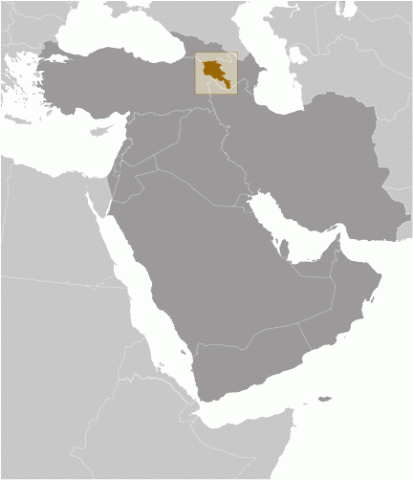

Minimal Advancement – Efforts Made but Continued Law that Delayed Advancement
In 2024, Armenia made minimal advancement in efforts to eliminate the worst forms of child labor. The Ministry of Internal Affairs' Criminal Police department established a direct connection to the National Center for Missing and Exploited Children, allowing it to receive cyber-tips on child commercial sexual exploitation. The government also developed, but has yet to formally adopt, the Comprehensive Program for the Protection of Children's Rights for 2024–2029, a tool to ensure a safe and secure environment and development opportunities for all children and to collect data on children performing hazardous work. However, despite new initiatives to address child labor, Armenia is assessed as having made only minimal advancement because labor inspectors lack full legal authority to conduct unannounced inspections, which may leave potential violations of child labor laws and other labor abuses undetected in workplaces. In addition, as the minimum age for work at age 16 is lower than the compulsory education age of 18, children may be encouraged to leave school before the completion of compulsory education. The government also does not routinely collect or maintain official data on the prevalence of child labor. Furthermore, the government does not have coordinating mechanisms and policies to address all worst forms of child labor, including in agriculture, services, and other forms of informal work.
| Children | Age | Percent and Population |
|---|---|---|
| Working | 5 to 14 | 7.0% (24,602) |
| Hazardous Work by Children | 15 to 17 | Unavailable |
| Attending School | 5 to 14 | 95.4% |
| Combining Work and School | 7 to 14 | 8.6% |
| Sector/Industry | Percent of Population |
|---|---|
| Agriculture | 93.9% |
| Industry | 0.5% |
| Services | 5.7% |
| Sector/Industry | Activity |
|---|---|
| Agriculture | Farming, raising livestock, forestry, and fishing. |
| Industry | Construction. |
| Services | Vehicle maintenance. Street work, including vending; selling food, flowers, napkins, and icons; and begging. Working in shops, cafés, and supermarkets. |
| Categorical Worst Forms of Child Labor‡ | Commercial sexual exploitation, sometimes as a result of human trafficking. Forced begging, forced street vending, and forced labor in stores. Forced labor in agriculture. Forced domestic labor. |
‡ Child labor understood as the worst forms of child labor per se under Article 3(a)–(c) of ILO C. 182.
Children at Higher Risk
Researchers report that children forcibly displaced from Nagorno-Karabakh are vulnerable to the worst forms of child labor. Although Armenia requires children to attend school through grade 12, Nagorno-Karabakh did not require school attendance beyond grade 9, which heightens the risk that children from Nagorno-Karabakh may be less likely to comply with education requirements. Additional elements that expose this group to heightened risk include the insecurity of temporary housing and the loss of the primary income-earning adult in many displaced families, which encourages children in those families to enter the workforce prematurely. International and national aid has been insufficient, and the monthly stipend received to cover rent and basic needs has greatly diminished this year. In addition, the government did not conduct any assessment on potential child labor risks in this population. Furthermore, children who live in remote rural areas and children of families who travel for seasonal labor are vulnerable to the worst forms of child labor, including forced child labor in agriculture.
Finally, authorities note that less-educated, socially vulnerable children, especially girls, are at higher risk of commercial sexual exploitation, while children living in economic hardship or children deinstitutionalized from orphanages are more likely to be coerced into forced begging, farm work, and forced labor in the service sector.
Barriers to Education Access
Children of families that travel for seasonal labor, and children from low-income families, including those in remote areas, have education access issues. In addition, enrollment and attendance rates are lower for Yezidi, Kurd, and Molokan children because of an insufficient number of teachers who speak minority languages. Yezidi children are particularly at risk of dropping out. Reports also indicate that in some rural areas, families do not prioritize girls' education due to traditional cultural norms. Furthermore, the Law on Education requires all schools to be inclusive for children with disabilities by 2025. However, children with disabilities—including hearing, visual, and mental disabilities—face difficulties with education access due to non-accessible school buildings, a lack of accessible learning materials, and a shortage of special education teachers and other specialists.
| Standard | Age | Meets International Standards | Legislation |
|---|---|---|---|
| Minimum Age for Work | 16 | ✓ | Articles 15, 17, 18, and 102 of the Labor Code; Article 57 of the Constitution; Article 41.6 of the Administrative Violations Code |
| Minimum Age for Hazardous Work | 18 | ✓ | Articles 17.1 and 257 of the Labor Code; Article 41.6 of the Administrative Violations Code |
| Identification of Hazardous Occupations or Activities Prohibited for Children | ✓ | Decree on Approval of the List of Occupations and Work That Are Likely to be Heavy and Hazardous for Persons Under the Age of 18 Years, Pregnant Women, and Women Taking Care of a Child Under the Age of 1 Year; Articles 140, 144(3), 148, 149, 153, 155, 209, 249, and 257 of the Labor Code | |
| Prohibition of Slavery, Debt Bondage, and Forced Labor | ✓ | Article 57 of the Constitution; Articles 3 and 3.2 of the Labor Code; Articles 188 and 189 of the Criminal Code | |
| Prohibition of Child Trafficking | ✓ | Articles 188 and 189 of the Criminal Code | |
| Prohibition of Commercial Sexual Exploitation of Children | ✓ | Articles 188–190, 239, and 298–300 of the Criminal Code | |
| Prohibition of Using Children in Illicit Activities | ✓ | Articles 71, 238, 393, and 394 of the Criminal Code | |
| Minimum Age for Voluntary State Military Recruitment | 16‡ | ✓ | Article 29 of the Law on the Rights of the Child; Law on Military Service and Status of the Military Servant; Government Decree No. 525-N of April 26, 2012 |
| Prohibition of Compulsory Recruitment of Children by (State) Military | ✓ | Article 19 of the Law on Military Service and the Status of the Military Servant | |
| Prohibition of Military Recruitment by Non-state Armed Groups | ✓ | Article 29 of the Law on the Rights of the Child; Articles 137, 147, 238, and 320 of the Criminal Code | |
| Compulsory Education Age | 18 | ✓ | Article 18 of the Law on Education |
| Free Public Education | ✓ | Article 38 of the Constitution; Article 6 of the Law on Education. |
‡ Age calculated based on available information
In 2024, the National Assembly approved changes to Articles 188 and 189 of the Criminal Code to include more severe sentences of imprisonment in cases in which a close relative is responsible for the trafficking of a child or a person in a helpless situation. In addition, the National Assembly approved changes to Article 257 of the Labor Code so that students between the ages of 16 and 18 may participate in some hazardous work if part of a vocational education and training program.
As the minimum age for work at age 16 is lower than the compulsory education age of 18, children may be encouraged to leave school before the completion of compulsory education. In addition, the Labor Code allows children ages 14 and 15 to work restricted hours with the permission of a parent or guardian but does not identify specific activities that constitute light work.
| Organization/Agency | Role & Activities |
|---|
| Health and Labor Inspection Body (HLIB): Ensures compliance with legal requirements in the fields of healthcare and labor law. Carries out on-site inspections based on a pre‐determined list of companies compiled based on risk assessment methodology, and an annual work plan, as well as in response to complaints, including child labor complaints, and administrative proceedings. Authorized to issue penalties for any administrative violations uncovered and to refer cases to criminal law enforcement when appropriate. In 2024, HLIB continued to maintain a hotline to receive complaints and provide advice and clarifications. Labor inspectors also received training on the implementation of labor rights in the country during a workshop organized by ILO. |
| Prosecutor General's Office: Through the Department for Combating Crimes against Humans within the Prosecutor General's Office, oversees the legality of police (of the Ministry of Internal Affairs [MOIA]) operations and Investigative Committee investigations, and prosecutes criminal cases involving child trafficking. Prosecutors receive regular training on human trafficking and other worst forms of child labor. During the reporting period, the police underwent restructuring. The reform included the establishment of four specialized units: patrol, criminal, community, and police guard units. MOIA established the main department of community police in summer 2024 and the main department of criminal police in October 2024. Community police officers’ tasks include identification, first response, and prevention of minor- and medium-gravity crimes, while criminal police officers respond to grave and especially grave crimes, including trafficking in persons and child labor. In addition, in June, MOIA's Criminal Police department established a direct connection to the National Center for Missing and Exploited Children. As a result, MOIA now receives cyber-tips on child sexual exploitation. |
| Overview of Enforcement Efforts | 2024 |
|---|---|
| Has a Labor Inspectorate | Yes |
| Able to Assess Civil Penalties | Yes |
| Routinely Conducted Worksite Inspections | Yes |
| Unannounced Inspections Permitted | No |
| Has a Complaint Mechanism | Yes |
| Imposed Penalties for Child Labor Violations | Yes |
| Conducted Criminal Investigations for Worst Forms of Child Labor Crimes | Yes |
| Imposed Penalties for Worst Forms of Child Labor Crimes | Yes |
In 2024, 54 labor inspectors conducted 408 worksite inspections, finding 0 child labor violations. The government also conducted 7 investigations into suspected cases of the worst forms of child labor, and 0 convictions were achieved.
However, HLIB lacks legal mechanisms to fully enforce compliance with labor legislation, including conducting unannounced inspections. HLIB can carry out unannounced inspections only when detecting unregistered employment cases. Even for routine inspections, HLIB must inform employers of an upcoming inspection 3 business days in advance. HLIB has broader authority when responding to a complaint, in which case HLIB may issue notification to the employer via e-mail and immediately conduct a site visit; however, if the business director or acting director is not present and does not receive the notification, inspectors are not allowed to start. Since 2024, with a special written order of the HLIB chief, inspectors are now able to conduct inspections outside working hours.
| Coordinating Body | Role & Activities |
|---|
| Interagency Working Group Against Trafficking in Persons: Operates under the Ministerial Council to Combat Human Trafficking and ensures operational coordination. Multidisciplinary group of government representatives and national and international NGOs, chaired by the Ministry of Labor and Social Affairs (MoLSA). MoLSA also chairs the Trafficking Victims Identification Commission, comprising representatives from MoLSA, the Prosecutor's Office, the police, and two NGOs, and tasked with identifying individuals as victims of trafficking and referring them for required assistance and support. During the reporting period, the Ministerial Council did not meet, and the working group held two meetings. |
| Policy | Description & Activities |
|---|
| National Action Plan Against Trafficking in Persons (2023–2025): Supports the development of policy and the implementation of activities to address human trafficking and includes a chapter on the prevention of child trafficking and child exploitation. Commits the government to continue to train specialists in multiple spheres, including law enforcement, the courts, educators, and the media. This plan, compared to the previous one, has a more targeted approach, measurable activities, clear outcomes, and mechanisms for accountability. Supports MoLSA in establishing standard trafficking in persons data collection tools for use by NGO implementers and a reporting format for state agencies that share data with MoLSA. During the reporting period, MoLSA organized trainings, seminars, and awareness campaigns on human trafficking that included representatives of almost all groups involved with human trafficking issues, including social workers, NGO employees, criminal lawyers and public defenders, and students. |
| Program | Description & Activities |
|---|
| Family Benefits Program:‡ Seeks to mitigate poverty for families with children by giving families a monthly payment based on their financial situation, the number of children in the family, and the geographical location of their home. The program was active throughout the reporting period, and a new, more targeted model for assessing neediness was introduced, with updated and stricter criteria to be able to access benefits. |
| UNICEF Country Program (2021–2025): Improves child protection systems, including through expanding programs for children in extreme poverty, improving social integration of children with disabilities, and developing a victim witness protection system. In 2024, continued to support the government’s child protection systems and services through humanitarian and technical assistance, operationalization of policies, and strengthening of systems at central and local levels to ensure more integrated delivery of services for children and families in various social sectors, including the expansion of child-friendly and learning spaces to host children from Nagorno-Karabakh. Also supported training sessions organized for police patrol officers from Yerevan, Vayots Dzor, and Tavush, focusing on child-friendly communication, psychological first aid, and trauma-informed interventions, and specifically tailored to enhance the officers' skills when working with children from Nagorno-Karabakh. During the reporting period, MoLSA collaborated with UNICEF to provide cash assistance to over 10,000 households. |
| Shelter for Victims of Human Trafficking:‡ Operates in partnership with NGOs to provide medical, psychological, social, and legal services to victims of human trafficking and access to education for children. In 2024, provided services to victims and survivors throughout the year. However, research reports that the government's grant structure was not flexible and spending could not deviate from the budget included in implementing partner's original application. As a result, the anti-trafficking shelter could not plan and spend resources based on the needs of the victims staying at the shelter, such as for social activities. The implementing partners also reported disruptions to services as a result of MoLSA’s use of single-year contract terms, which may result in shelter relocation and fresh relationship and trust building with the victims if the implementing partner is replaced by a new organization. |
‡ Program is funded by the Government of Armenia.
† The government had other social programs that may have included the goal of eliminating or preventing child labor.
| Area | Suggested Action |
|---|---|
| Legal Framework | Raise the minimum age for work from age 16 to age 18 to align with the compulsory education age, and ensure that Armenian law specifies the types of light work acceptable for children ages 14 to 15. |
| Enforcement | Strengthen the inspection system by permitting unannounced inspections and conducting inspections where child labor is likely to occur, including in rural areas and sectors with seasonal workers. |
| Implement digital tracking systems for civil worst forms of child labor inspections. | |
| Put in place a unified national referral mechanism for police officers, social workers, and other front-line officials, especially in remote regions, to identify, refer, and monitor potential child labor victims. | |
| Increase the number of labor inspectors from 54 to 73 to ensure adequate coverage of the labor force of approximately 1,469,000 people. | |
| Implement existing witness protection mechanisms to protect victims and survivors of child trafficking who cooperate with law enforcement, including by protecting survivors' confidentiality, improving legal assistance to survivors of child labor and trafficking, and providing competent psychologists during witness interrogation. | |
| Ensure that criminal law enforcement officials, including the Investigative Committee and judges, understand their mandated duties and are adequately trained on trafficking issues. | |
| Strengthen enforcement of child labor laws, including involvement in hazardous work, by issuing corrective actions and pursuing penalties. | |
| Coordination | Establish coordinating mechanisms across relevant law enforcement bodies to prevent and eliminate all worst forms of child labor in all sectors, including in street work, services, and agriculture. |
| Ensure that the Ministerial Council to Combat Human Trafficking and the Interagency Working Group Against Trafficking in Persons are active and able to carry out their intended mandates, including by holding meetings at the established intervals and publishing efforts undertaken on a regular basis. | |
| Government Policies | Adopt policies to address all relevant worst forms of child labor, including in agriculture, services, and other forms of informal work. |
| Social Programs | Collect and publish data on the extent and nature of child labor, including in agriculture and construction, to inform policies and programs. |
| Ensure that all children, including girls, children in remote areas, those from low-income families and from families that travel for seasonal labor, and Yezidi, Kurd, and Molokan children, have equal access to education. | |
| Continue existing efforts to ensure ongoing access to all social protection systems for children from Nagorno-Karabakh to mitigate their vulnerability to human trafficking and labor exploitation, and conduct research to assess potential child labor risks in this population. | |
| Ensure that there are a sufficient number of qualified teachers of minority languages who can address the educational needs of all Yezidi, Kurd, and Molokan children as defined under the law. | |
| Ensure that mainstream education is accessible to children with special education needs and children with disabilities by improving the accessibility of the physical infrastructure and increasing the availability of special education teachers and other specialists for students with disabilities. | |
| Strengthen measures in the education system to identify, track, and prevent children from leaving school, and enforce mandatory school attendance requirements to ensure that children are not engaged in child labor. | |
| Increase social services supporting children currently residing in government institutions, ensure the availability of out-of-care services, and continue prevention efforts for deinstitutionalized children to prevent reengagement in child labor. | |
| Institute programs to eliminate child labor, including in street work and in agriculture. | |
| Allocate sufficient personnel and resources to publicize and provide social services throughout the country, offer sufficient training to services providers, and assign reasonable caseloads. Allow allocated grants more flexibility and longer terms of engagement to allow non-governmental organizations and shelters for victims of human trafficking to provide personalized assistance and make long-term plans. |