Forced Labor Remediation Guide
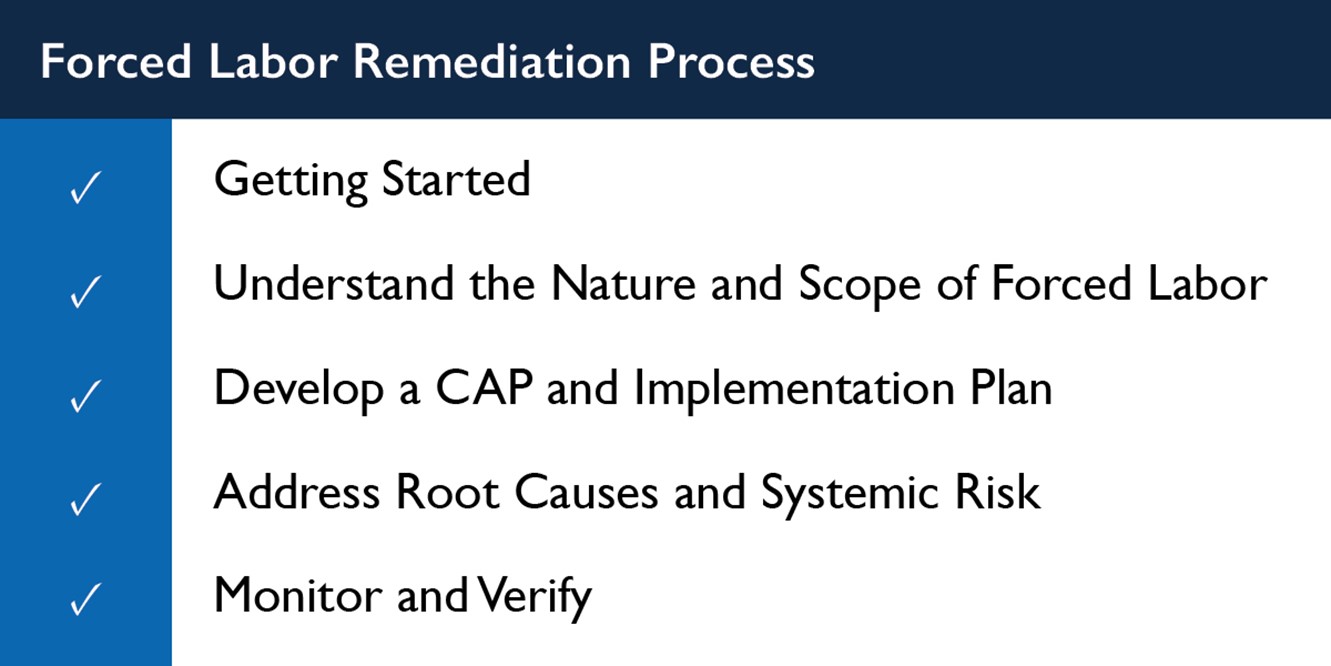
GETTING STARTED
As companies and stakeholders work to remediate forced labor conditions, they should consider how the following principles apply in this phase of the process.
Establish Safety and Trust
Workers need to feel safe from violence, intimidation, threats, harassment, and retaliation before they can genuinely participate in a remediation process. To meet this need, compa nies should:
Establish zero-tolerance policies prohibiting violence, intimidation, threats, harassment, and retaliation: Alleged violations must be credibly investigated and promptly enforced in a transparent process.
Enact Imminent Danger Protocols: Develop a set of criteria and procedures to implement when workers are subject to, or at risk of, physical or sexual violence, retaliation, forcible removal, or circumstances that imminently jeopardize workers’ lives or risks of severe injury are identified. The protocol should explain how stakeholders will meet workers’ basic needs (safe housing, health care, food, medications).
Senior Executive Commitment
Active and vocal support from senior executive buyers and suppliers signals that eliminating forced labor is a corporate-wide business priority. Often a forced labor remediation program requires companies and personnel to change their business environment. Senior leaders, including executives and the C-suite, have a unique opportunity to demonstrate the company's commitment to these changes, since leadership sets the tone for a company and ensures accountability.
Senior leaders can:
Communicate consequences of non-compliance: Senior leaders should announce the consequences of non-compliance. In the case of zero-tolerance policies, senior leaders can explain that personnel will be dismissed, without the option of rehire.
Ensure remediation is properly resourced: Senior leaders should ensure that remediation plans have adequate budget and personnel to support remediation activities.
Show public support for new policies: Senior leaders should announce new policies, such as the zero-tolerance policies against violence, intimidation, threats and retaliation against workers, and commit to enforcing them.
Worker Engagement
Remediation is most effective when workers, worker-led organizations, or civil society organizations (CSO) engage in the remediation process. Their involvement, free from threats or retaliation, provides solutions that reflect an accurate understanding of workers’ experiences and needs. A credible and effective corrective action plan (CAP) and implementation strategy should reflect workers' unique perspectives.
Identify Worker-led Organizations and Civil Society Partners
To identify independent partners to represent worker perspectives in the remediation process, companies should work with a facilitator to assess a series of indicators, including:
- Has the organization advocated on behalf of workers’ interests in the past?
- Do workers routinely seek out representatives of this organization for help?
- Does the advocacy of the organization reflect the interests of workers?
- Did the organization remain silent or fail to challenge the forced labor conditions previously?
- Are leaders or representatives working in human resources, management, or elevated positions in the company?
- Are worker representatives selected by the company?
- Are the organizations subject to allegations of influence from the company?
- Is the company, buyers, suppliers, sub-contractors, or industry association paying the organization?
- Are conflicts of interest present that may undermine the credibility of the worker engagement process?
If the answer to any of the five questions above is “yes,” this is a warning sign that this organization may not be independent and is likely not a good candidate for representing workers’ interests. In the absence of a suitable organization to support the remediation process, workers may wish to elect a series of representatives by secret ballot to represent their interests in the process.
UNDERSTAND THE NATURE AND SCOPE OF FORCED LABOR
Companies should undertake a series of activities to solicit information on, and to better understand, the nature and scope of forced labor in their operations and supply chain:
Map the company operations, supply chain, and workforce
Baseline assessment
Grievance mechanism data review
Worker engagement mechanisms
The data collected from these activities should be analyzed to determine the nature of the forced labor conditions and the scope of workers impacted by these conditions. This should include an understanding of the systemic risks present and root causes.
DEVELOP A CORRECTIVE ACTION PLAN (CAP) AND
IMPLEMENTATION PLAN
Companies should coordinate with workers to jointly develop a CAP and implementation plan that reflects workers’ perceptions and inputs.
Implement Quick Fixes
Workers and their representatives should be encouraged to share ideas for improvements that can be quickly fixed before addressing long-term issues in the CAP. This will signal to workers that the company takes the remediation process seriously and intends to act credibly to address the conditions. It is a critical show of good faith. While it is important to act quickly to address forced labor conditions, it is also important to ensure that quick fixes don’t create secondary problems that need to be fixed later.
Companies should take quick and decisive action to end physical or sexual violence, intimidation, threats, retaliation against workers, or risk of death or severe injury. Companies should also contract with an independent third-party to set up an interim reporting mechanism where workers can safely and confidentially submit reports of these conditions.
Companies should consider the following guidance on additional remediation efforts: https://www.dol.gov/agencies/ilab/comply-chain/steps-to-a-labor-due-diligence-system/step-6-remediate-violations
ADDRESS ROOT CAUSES & SYSTEMIC RISK
The CAP and implementation plan should reflect an understanding of, and plan to mitigate, root causes and systemic risk.
Root Causes and Risk Factors
As the assessors develop a statistical sample of worker interviews, they should consider if any of the following factors may increase the risk of forced labor among the workforce:
- Recruitment Geography
- Worksite Location
- Migration
- Informality
- High Unemployment
- Cascading Costs and Procurement Pressures
- Debt
- Rights Awareness
Systemic Risk
Companies should understand when their operations intersect with areas of systemic risk and reform their management systems and oversight protocols to prevent future recurrence.
Table 1. Common Systemic Risks
| Examples of Systemic Risks Before and During Employment | |
|---|---|
| Recruitment | Suppliers often outsource their recruitment and hiring functions to third parties due to lack of in-house recruitment capacity. This is a known forced labor risk, particularly for migrant workers. This risk is exacerbated when third-party recruiters are also the employer of record for the workers. |
| Worker Contracts | Workers may not receive accurate information regarding the terms and conditions of work at the time of recruitment. This is an acute risk if workers lack: 1) employment contracts, 2) supplementary verbal explanations of the contracts’ terms and conditions, and 3) access to independent third-party grievance mechanisms to resolve contract disputes. Workers may also be subject to contract substitution. |
| Abusive Conditions | Workers are more likely to accept abusive conditions if they lack alternative livelihood or income-generating activities due to their socio-economic status and other risk factors. This risk is higher in isolated areas with insufficient monitoring. |
| Recruitment and Wage Payments | Debt bondage occurs when workers acquire unwanted debt to meet their essential needs or acquire debt due to deceptive recruitment or deceptive payment practices. It often overlaps with deficiencies in payment and recruitment systems. |
| Isolation | When business operations occur in isolated areas, there may not be sufficient oversight of operations to ensure compliance with company policies. There is a higher risk of business operations occurring in isolated areas in the agriculture, seafood, or mining sectors. |
| Lack of Management Oversight | A lack of management oversight allows supervisors to act with impunity and may raise the risk of sexual harassment, verbal abuse, intimidation, threats, worker retaliation, or abusive working and living conditions. |
| Examples of Supply Chain Systemic Risks | |
| Supplier or Subcontractor Contracts | Cascading requirements, in which tier-one suppliers pass along requirements to sub-tier suppliers throughout the supply chain, are rarely accompanied by sufficient funding (or price increases) to cover the cost of the requirements. Sub-tier suppliers will then cut labor costs to cover the cascading requirement costs. |
| Procurement Pressures | Procurement practices, such as infeasibly short lead times on orders, demands for post-production discounts, and shifting costs of production to suppliers, often increase forced labor risks. For example, equipment, inputs, or personal protective equipment (PPE) costs are often cascaded throughout the upstream supply chain. Suppliers often shift the cost burden to workers in the form of undisclosed salary deductions. |
For further details on systemic risk assessment, see Step 2 Key Topic Identify Risks and Vulnerable Groups.
MONITOR AND VERIFY
Remediation outcomes should be transparent, timebound, measurable, and verifiable. The verification should be undertaken by an independent third party, which can provide assurance to regulators, buyers, and investors. As the remediation process is implemented, companies and stakeholders in the worker engagement process should monitor whether timely remedy is occurring and determine if it is truly eliminating forced labor conditions. Companies should contract with an independent assessor to conduct worker interviews. This feedback should determine whether the CAP activities had the intended impact, or if supplementary measures should be added.
Once the CAP is complete, companies should contract with an independent assessor to verify the outcomes of the remediation process. This should include a statistical sample of worker interviews and assessments of new management systems, internal controls, risk data, and record reviews. Companies should collaborate with worker engagement stakeholders to make remediation information publicly available to ensure transparency.
CONCLUSION
This remediation guide serves as a starting point for companies to create solid foundations for forced labor remediation and to apply forced labor specific tools to monitor, assess, and address issues in their supply chain tiers. Companies can proactively reduce their financial, reputational, and regulatory risks by addressing current forced labor risks and issues, and taking steps to prevent future occurrences of forced labor, such as engage with workers throughout the process, understand the nature and scope of forced labor throughout the supply chain, develop and implement corrective action plans, address immediate and root cause issues in a timebound and transparent manner, and monitor and verify outcomes. Addressing forced labor in supply chains levels the playing field for American businesses and workers, protecting them from unfair forms of economic competition such as exploitative cost advantages, labor law violations, or degrading practices. Companies can directly contribute to U.S.-led efforts to eliminate forced labor in supply chains globally while meeting their bottom line.
 Step 6: Remediate Violations