


Child Labor and Forced Labor Reports
Timor-Leste
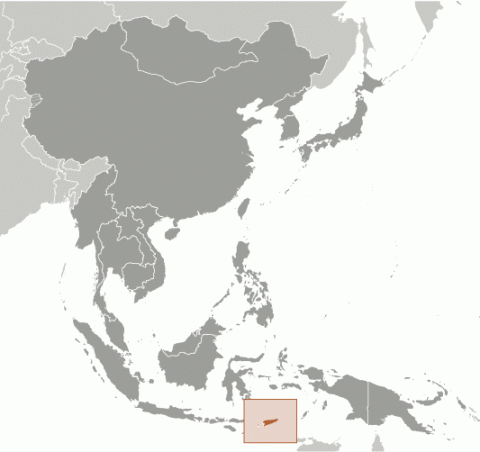

Minimal Advancement – Efforts Made but Continued Practice that Delayed Advancement
In 2024, Timor-Leste made minimal advancement in efforts to eliminate the worst forms of child labor. The government increased funding for the labor inspectorate to $778,284, an increase from $535,000 in 2023. In addition, the government launched a “Child Protection Information Management and Digital Case Management” application to provide web-based case management assistance to social service providers that receive reports of children in situations of violence or abuse and are in need of immediate assistance. However, despite new initiatives to address child labor, Timor-Leste is assessed as having made only minimal advancement because research indicates that pregnant girls are sometimes prohibited from attending school while pregnant or from returning to school after pregnancy, making them more vulnerable to involvement in child labor, including its worst forms. In addition, the Penal Code fails to criminalize the use of a child for prostitution unless the perpetrator knows that the child has been trafficked. Timor-Leste’s laws consider someone of 17 years of age to be an adult. As a result, its laws do not meet international standards on the minimum age for hazardous work as the Labor Code sets the minimum age for hazardous work at age 17. Finally, laws related to the use of children in illicit activities do not meet international standards as the Penal Code only prohibits guardians, including under employment, from using children under the age of 17 in the production and trafficking of drugs.
| Children | Age | Percent and Population |
|---|---|---|
| Working | 5 to 14 | 12.3% (40,337) |
| Hazardous Work by Children | 15 to 17 | Unavailable |
| Attending School | 5 to 14 | 83.7% |
| Combining Work and School | 7 to 14 | 12.4% |
| Sectory/Industry | Percent of Population |
|---|---|
| Agriculture | 36.9% |
| Industry | 7.3% |
| Services | 55.8% |
| Sector/Industry | Activity |
|---|---|
| Agriculture | Farming and fishing.† |
| Industry | Construction† and quarrying.† |
| Services | Domestic work† and street work, including vending, begging, and scavenging. Also working in shopkeeping, selling goods in markets, and restaurant services. |
| Categorical Worst Forms of Child Labor‡ | Commercial sexual exploitation, sometimes as a result of human trafficking. Forced domestic and agricultural work. Forced labor in street vending. |
† Determined by national law or regulation as hazardous and, as such, relevant to Article 3(d) of ILO C. 182.
‡ Child labor understood as the worst forms of child labor per se under Article 3(a)–(c) of ILO C. 182.
Children at Higher Risk
Children from rural areas sent to live with relatives in the capital, Dili, are more vulnerable to the exploitation of forced domestic work. Children living in Timor-Leste’s urban centers and border regions are especially vulnerable to commercial sexual exploitation and other forms of forced labor. Of these children, children at higher risk because of their sexual orientation are particularly vulnerable to commercial sexual exploitation. Although data are limited, it is reported that children are sometimes directed to work on family farms against their wishes to pay off family debt.
Barriers to Education Access
Pregnant girls are sometimes not permitted to continue their education at school and therefore drop out. Those wishing to re-enroll in school face hurdles in doing so, including difficulty receiving necessary school documents or transferring schools. In addition, other barriers to education access in Timor-Leste include inadequate school facilities, a limited number of teachers, inadequate teacher training, and long distances to school, especially in rural areas. Children with disabilities are also often unable to attend school due to accessibility challenges. Further, students need birth records to enroll in school, and birth registrations are sometimes unavailable in rural areas. Although public education is free, families of students must pay for school uniforms and supplies, and these costs can restrict access to school, particularly for children from poor and rural areas.
| Standard | Age | Meets International Standards | Legislation |
|---|---|---|---|
| Minimum Age for Work | 15 | ✓ | Article 68 of the Labor Code |
| Minimum Age for Hazardous Work | 17 | ✗ | Article 67 of the Labor Code |
| Identification of Hazardous Occupations or Activities Prohibited for Children | ✓ | List of Hazardous and Prohibited Activities to Children Under the Age of 18 | |
| Prohibition of Slavery, Debt Bondage, and Forced Labor | ✓ | Article 81 of the Immigration and Asylum Act; Articles 155, 162, 163, and 166 of the Penal Code; Fourth Amendment to Articles 163 and 164 of the Penal Code | |
| Prohibition of Child Trafficking | ✓ | Article 81 of the Immigration and Asylum Act; Fourth Amendment to Articles 163 and 164 of the Penal Code; Articles 162 and 166 of the Penal Code | |
| Prohibition of Commercial Sexual Exploitation of Children | ✗ | Article 81 of the Immigration and Asylum Act; Fourth Amendment to Articles 163 and 164 of the Penal Code; Articles 155 and 174–176 of the Penal Code; Articles 5(h), 67, and 99 of the Labor Code | |
| Prohibition of Using Children in Illicit Activities | ✗ | Article 155 of the Penal Code; Articles 5, 67, and 99 of the Labor Code | |
| Minimum Age for Voluntary State Military Recruitment | 18 | ✓ | Article 17 of the Law on Military Service |
| Prohibition of Compulsory Recruitment of Children by (State) Military | ✓ | Article 14 of the Law on Military Service | |
| Prohibition of Military Recruitment by Non-state Armed Groups | ✓ | Article 125 of the Penal Code | |
| Compulsory Education Age | 15 | ✓ | Article 11 of the Education System Framework Law |
| Free Public Education | ✗ | Section 59 of the Constitution of the Democratic Republic of Timor-Leste; Article 2 of the Education System Framework Law |
Although Timor-Leste has adopted the List of Hazardous and Prohibited Activities to Children Under the Age of 18, it is uncertain how this law will interact with the Labor Code, which sets the minimum age for hazardous work at age 17 and does not meet international standards. The Labor Code permits children between 13 and 15 years of age to work up to 25 hours per week, which is not consistent with international standards. In addition, the Penal Code fails to criminalize the use of a child for prostitution unless the perpetrator knows that the child has been trafficked. The law criminalizing the use of children for illicit activities is limited to children under the age of 17, thus failing to meet the international standard. In addition, free public education is limited to citizens, which does not meet the standard for free public education for all children.
| Organization/Agency | Role & Activities |
|---|
| Administration of the Labor Inspectorate General: Falls under the Coordinating Ministry of Economic Affairs and conducts labor inspections. Provides oversight of civil laws related to child labor, investigates incidents of forced labor, and refers potential criminal violations of labor laws to the Timor-Leste National Police. |
| Timor-Leste National Police: Enforce criminal laws against forced labor, commercial sexual exploitation, child abuse, and human trafficking. Include the Vulnerable Persons Unit. |
| Overview of Enforcement Efforts | 2024 |
|---|---|
| Has a Labor Inspectorate | Yes |
| Able to Assess Civil Penalties | Yes |
| Routinely Conducted Worksite Inspections | Yes |
| Unannounced Inspections Permitted | Yes |
| Has a Complaint Mechanism | Yes |
| Imposed Penalties for Child Labor Violations | No |
| Conducted Criminal Investigations for Worst Forms of Child Labor Crimes | No |
| Imposed Penalties for Worst Forms of Child Labor Crimes | No |
In 2024, 26 labor inspectors conducted 1,478 worksite inspections, finding 0 child labor violations. The government also conducted 0 investigations into suspected worst forms of child labor crimes, initiated 0 prosecutions, and convicted 0 perpetrators.
| Coordinating Body | Role & Activities |
|---|
| National Commission Against Child Labor (CNTI): Chaired by the Secretary of State for Training and Employment to develop child labor policies, raise awareness, and contribute to efforts to ratify and implement international conventions related to child protection. Develops the National Action Plan to Eliminate the Worst Forms of Child Labor in Timor-Leste. Elaborates, approves, and periodically reviews the hazardous work list of jobs prohibited for children under age 18. During the reporting period, CNTI conducted several activities, including providing training on preventing and combating child labor for community police, local authorities, and school inspectors at the municipal level; and submitting the National Action Plan for Child Labor and the List of Hazardous Work Prohibited to Child Labor Under 18 Years for approval by the Minister Coordinator for Economic Affairs. |
| Policy | Description & Activities |
|---|
| Timor-Leste Strategic Development Plan (2011–2030): Provides short-term and long-term plans for the nation’s development, including the eradication of child labor and other forms of child exploitation, poverty alleviation, and implementation of social assistance programs. Also specifies commitments to improve the education system from 2011 to 2030. Research was unable to determine whether activities were undertaken to implement the Timor-Leste Strategic Development Plan (2011–2030) during the reporting period. |
| Program | Description & Activities |
|---|
| Primero CPIMS+:*‡ Joint initiative to implement a management system to coordinate support for children who experience violence and abuse. In March 2024, the government launched the “Child Protection Information Management and Digital Case Management” application that provides web-based case management assistance to social services providers that receive reports of children in situations of violence or abuse and in need of immediate assistance. |
| Casa Vida:‡ Joint program between MSSI and the Australian Department of Foreign Affairs and Trade’s “Nabilan Program and Shelter” initiative. Provides shelter, health assistance, and psychological counseling to minor survivors, including survivors of child labor. Provides specialized assistance for girls up to age 18 who have escaped situations of sexual violence. Receives referrals from civil society organizations, as well as the Timor-Leste National Police Vulnerable Persons Unit. Since its founding in 2008, Casa Vida has provided shelter and assistance for more than 300 children who were survivors of abuse. Research was unable to determine whether activities were undertaken to implement Casa Vida during the reporting period. |
* Program was launched during the reporting period.
‡ Program is funded by the Government of Timor-Leste.
| Area | Suggested Action |
|---|---|
| Legal Framework | Criminalize the use of children for prostitution, regardless of whether the child has been trafficked. |
| Criminalize the use of children under 18 for the production and trafficking of drugs, regardless of the perpetrator's relationship to the child. | |
| Raise the minimum age for hazardous work from 17 to 18 years old. | |
| Ensure that the law’s light work provisions limit the number of hours children under 15 may work to a maximum of 14 per week. | |
| Ensure that laws establishing free public education apply to all children. | |
| Enforcement | Ensure that the Administration of the Labor Inspectorate General is staffed with the appropriate number of labor inspectors to conduct the targeted number of labor inspections. |
| Ensure that the Administration of the Labor Inspectorate General conducts inspections in the informal sector, including on farms and in private homes where domestic work takes place. | |
| Ensure that labor law enforcement agencies receive sufficient funding to carry out inspections, especially in rural areas of Timor-Leste, including funding for fuel for government vehicles. | |
| Ensure that criminal law enforcement officials receive sufficient training on laws related to the worst forms of child labor and human trafficking. | |
| Ensure that the Vulnerable Persons Unit receives sufficient funding to carry out investigations. | |
| Finalize, implement, and train all relevant officials on formal procedures for victim identification and employ proper screening procedures when encountering vulnerable populations. | |
| Government Policies | Adopt the National Action Plan to Eliminate the Worst Forms of Child Labor in Timor-Leste. |
| Publish activities undertaken on an annual basis to implement the Timor-Leste Strategic Development Plan (2011–2030). | |
| Establish a policy to enable girls to receive an education while pregnant and to encourage them to return to school after giving birth. | |
| Social Programs | Cease the practice of prohibiting pregnant students from attending school or re-enrolling in school after giving birth, and ensure that they can, as needed, obtain school records and transfer documentation to continue their education at another school. |
| Improve access to education by providing safe and healthy sanitation facilities, especially for girls, making schools accessible for children with disabilities, eliminating school-related expenses, allowing students to enroll without birth registrations, providing adequate training for teachers, and providing a sufficient number of teachers. | |
| Institute programs to address child labor and the worst forms of child labor, including in agriculture and street vending. | |
| Publish activities undertaken to implement social programs. |