


Child Labor and Forced Labor Reports
Mexico

















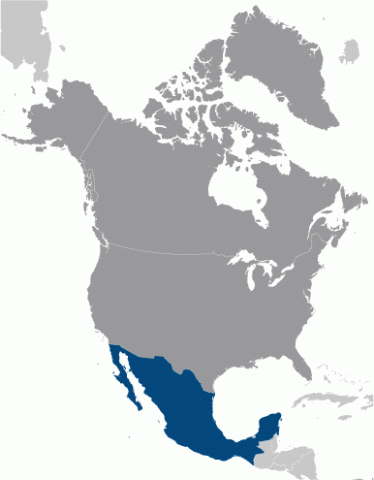

Significant Advancement
In 2024, Mexico made significant advancement in efforts to eliminate the worst forms of child labor. The government published regulations outlining permissible non-hazardous agricultural activities for minors and modified the General Law for the Prevention, Sanction, and Eradication of Crimes Related to Human Trafficking to increase penalties for violations of the worst forms of child labor. It also provided additional trainings to enforcement officials and prosecutors to address human trafficking cases, and the labor inspectorate implemented significant upgrades to its 10-year-old electronic case management system for labor inspectors, which can now disaggregate violations found in inspections, including child labor. Further, the continued coordination between the federal Inter-Institutional Commission for Prevention and Eradication of Child Labor and the Protection of Adolescent Workers of the Permitted Age (CITI) and the CITI Network of state- and local-level commissions resulted in the creation of a child labor eradication and adolescent protection working group, a new CITI in the state of Colima, Mexico, and a municipal CITI in Merida, Yucatan. The government also introduced a new strategy for the prevention of child labor in main tourist destinations and published a protocol to bolster labor inspections. Finally, the government established a new conditional cash transfer program for school-aged children and provided funding to carry out a National Child Survey in 2025. Despite these efforts, Mexico’s 660 federal labor inspectors are far fewer than the recommended number of 4,035 inspectors to provide adequate coverage for the approximately 60.5 million workers. In addition, although the government provided some information on investigations conducted, prosecutions initiated, and convictions achieved, the government did not provide complete information on labor and criminal law enforcement efforts to address the worst forms of child labor.
| Children | Age | Percent and Population |
|---|---|---|
| Working | 5 to 14 | 4.3% (924,176) |
| Boys | 5.9% | |
| Girls | 2.6% | |
| Urban | 2.8% | |
| Rural | 8.4% | |
| Hazardous Work by Children | 15 to 17 | 6.0% (422,850) |
| Boys | 9.2% | |
| Girls | 2.8% | |
| Urban | 4.8% | |
| Rural | 9.8% | |
| Attending School | 5 to 14 | 96.9% |
| Combining Work and School | 7 to 14 | 4.2% |
| Sector/Industry | Percent of Population |
|---|---|
| Agriculture | 40.3% |
| Industry | 27.8% |
| Services | 31.9% |
| Sector/Industry | Activity |
|---|---|
| Agriculture | Working in agriculture,† including in cattle raising and the production of beans (green beans), chile peppers, coffee, cucumbers, eggplants, melons, onions, poppies, sugarcane, tobacco,† and tomatoes. Working in hunting, fishing, and forestry. |
| Industry | Manufacturing† garments. Construction.† Mining.† |
| Services | Street work† as vendors, beggars, and car washers. Working in bars.† Scavenging in landfills and recycling. Domestic work. |
| Categorical Worst Forms of Child Labor‡ | Forced labor in domestic work, street vending, and begging. Commercial sexual exploitation, sometimes as a result of human trafficking, including in the production of pornography. Use by cartels to perform illicit activities, including the production of poppies for heroin, drug trafficking, stealing fuel, and carrying out armed attacks, sometimes as a result of human trafficking. |
† Determined by national law or regulation as hazardous and, as such, relevant to Article 3(d) of ILO C. 182.
‡ Child labor understood as the worst forms of child labor per se under Article 3(a)–(c) of ILO C. 182.
Children at Higher Risk
Children from rural communities and children with disabilities are particularly vulnerable to child labor in Mexico, as they are more likely to face conditions of extreme poverty, homelessness, and discrimination, and have less access to education and social protection services. Girls in Mexico are particularly vulnerable to commercial sexual exploitation, as they make up 80 percent of victims. Girls are also disproportionately engaged in unpaid domestic work in Mexico. Children traveling by themselves can be exposed to mistreatment and violence, pushing them into informal child labor while they seek sources of income. Organized criminal groups also force Mexican children to carry out assassinations, serve as lookouts, and produce, transport, and sell drugs, including opium poppies; an estimated 30,000 children have joined criminal groups in Mexico.
Barriers to Education Access
Mexico has committed to providing free and compulsory education for children. However, certain children are less likely to attend school due to the lack of learning materials and instruction in native languages. The enrollment of other children in schools is also low due to their inability to present the birth documentation required to enroll.
| Standard | Age | Meets International Standards | Legislation |
|---|---|---|---|
| Minimum Age for Work | 18 | ✓ | Article 123 of the Constitution; Article 22 bis of the Labor Code; Article 47 of the Law on the Rights of Children and Adolescents; Article 6 of the General Education Law |
| Minimum Age for Hazardous Work | 18 | ✓ | Articles 23 and 175 of the Labor Code |
| Identification of Hazardous Occupations or Activities Prohibited for Children | ✓ | Articles 175 and 176 of the Labor Code | |
| Prohibition of Slavery, Debt Bondage, and Forced Labor | ✓ | Articles 1 and 5 of the Constitution; Articles 11, 12, and 22 of the Trafficking in Persons Law; Article 47 of the Law on the Rights of Children and Adolescents | |
| Prohibition of Child Trafficking | ✓ | Articles 10, 13, and 22 of the Trafficking in Persons Law | |
| Prohibition of Commercial Sexual Exploitation of Children | ✓ | Articles 200–205 bis of the Federal Penal Code; Articles 13 and 18 of the Trafficking in Persons Law; Article 47 of the Law on the Rights of Children and Adolescents | |
| Prohibition of Using Children in Illicit Activities | ✓ | Articles 196 and 201 of the Federal Penal Code; Article 24 of the Trafficking in Persons Law; Articles 2, 4, and 5 of the Law on Organized Crime | |
| Prohibition of Compulsory Recruitment of Children by (State) Military | ✓ | Articles 1, 4, and 5 of the Military Service Law | |
| Minimum Age for Voluntary State Military Recruitment | 18 | ✓ | Article 24 of the Military Service Law |
| Prohibition of Military Recruitment by Non-state Armed Groups | ✓ | Articles 123 and 201 of the Federal Penal Code; Articles 16 and 47 of the Law on the Rights of Children and Adolescents | |
| Compulsory Education Age | 18 | ✓ | Articles 6 and 129 of the General Education Law |
| Free Public Education | ✓ | Article 3 of the Constitution; Article 7, Section IV of the General Education Law |
In 2024, the government published NOM-038-STPS-2024, a technical regulation that classifies and lists non-hazardous activities that minors ages 16 to 17 are allowed to undertake in the agriculture, forestry, sawing, hunting and fishing sectors. The technical regulation sets administrative tasks as the only permissible activity minors can do in these sectors. Other work tasks, including the use of chemicals, handling machinery, and operating heavy vehicles, remain prohibited. Mexico also reformed the General Law for the Prevention, Sanction, and Eradication of Crimes Related to Human Trafficking. The reform increases penalties when a child is used for the commission of any crime contemplated in any other sanctioned law or for forced mendicity.
| Organization/Agency | Role & Activities |
|---|
| Secretariat of Labor and Social Welfare (STPS): Responsible for labor law enforcement in 22 industrial sectors under federal jurisdiction (including the sugar and tobacco industries) and 3 types of enterprises, and labor matters affecting 2 or more states. The state-level labor inspectorates are responsible for labor law enforcement in all other situations. The STPS conducts unannounced inspections in the informal sector for child labor violations in response to complaints, and child labor inspections must be coordinated with representatives from the Secretariat of Health’s National System for Integral Family Development (SNDIF) and the local Office of the Attorney General of Mexico. The Federal Attorney for the Defense of Labor, a decentralized unit of the STPS, receives and prosecutes cases involving workers under age 18. The Government of Mexico did not provide information on enforcement efforts during the reporting cycle. |
| Office of the Attorney General of the Republic (FGR): The FGR’s Specialized Unit for Crimes against Women and Trafficking in Persons and the Specialized Unit on Trafficking in Minors, People, and Organs are responsible for investigating and prosecuting human trafficking cases at the federal level, while the Specialized Office for Organized Crime investigates and prosecutes cases linked to commercial sexual exploitation of children. In addition, all 32 states have specialized trafficking in persons prosecutors who are responsible for cases of human trafficking at the state level. Federal and state trafficking in persons units also receive referrals from the National Institute of Migration and the Mexican Commission for Refugee Assistance. The Government of Mexico did not provide information on enforcement efforts during the reporting cycle. |
| Overview of Enforcement Efforts | 2024 |
|---|---|
| Has a Labor Inspectorate | Yes |
| Able to Assess Civil Penalties | Yes |
| Routinely Conducted Worksite Inspections | Yes |
| Unannounced Inspections Permitted | Yes |
| Has a Complaint Mechanism | Yes |
| Imposed Penalties for Child Labor Violations | Unknown |
| Conducted Criminal Investigations for Worst Forms of Child Labor Crimes | Yes |
| Imposed Penalties for Worst Forms of Child Labor Crimes | Yes |
In 2024, 660 federal labor inspectors conducted an estimated 33,000 worksite inspections, finding an unknown number of child labor violations. During the reporting period, there were 3 convictions and sentences for child pornography, including convicting 1 individual to 180 years prison, and 8 convictions and sentences for child trafficking, including 2 individuals sentenced in 2 separate cases of child labor trafficking, 1 individual sentenced in 1 child forced begging case, and 7 individuals sentenced in 5 separate cases of child sex trafficking. There were also an additional 26 documented investigations for crimes related to the worst forms of child labor. However, the government did not provide complete labor and criminal law enforcement data for this report.
| Coordinating Body | Role & Activities |
|---|
| Inter-Institutional Commission for Prevention and Eradication of Child Labor and the Protection of Adolescent Workers of the Permitted Age in Mexico (CITI): Coordinates Mexico’s efforts to eliminate child labor. Meets on a quarterly basis and is chaired by the STPS. There are also state-level (CITI Estatales) and municipal-level committees. In 2024, STPS, CITI, and the CITI Network met three times to strengthen dialogue on concrete actions to prevent and eradicate child labor. The state of Colima formed their state-level CITI in 2024 and similar to the state of Tamaulipas, worked to increase awareness via state-level media campaigns. Some states do not have active CITI committees, and not all states collaborated with CITI at the federal level. The Federal CITI has a Plan of Action on Child Labor (2021–2024), which requires the CITI Secretariat to conduct monitoring activities on a quarterly basis, but it lacks an accompanying budget for activities. |
| Policy | Description & Activities |
|---|
| National Program for the Secretariat of Labor and Social Welfare (2020–2024): Sought to strengthen workers’ rights and increase the participation of workers in the formal sector. The program prioritized addressing child labor as part of the STPS’s social inclusion strategy. STPS published a report on actions taken under this program between 2023 and 2024, including activities to address child labor and informality. |
| National Program for Children and Adolescents (2021–2024): Aimed to guarantee the rights of children by establishing mechanisms to support their growth and development. Has an accompanying action plan, as well as a Strategy for the Prevention of Commercial Sexual Exploitation of Children and Adolescents. The Executive Secretariat for the Protection of Children and Adolescents published a final report on activities undertaken and results achieved under this policy between January 2023 and June 2024. |
| National Action Plan on Trafficking in Persons (PNTdP) (2022–2024): Published by the Secretariat of the Interior (SEGOB), guided the government’s public policy on human trafficking. The PNTdP had five key objectives: (1) strengthening the legal framework; (2) outlining coordination efforts; (3) strengthening services to survivors; (4) conducting research to inform actions and public policies; and (5) promoting the human rights of survivors. Also directed the work of the Interagency Commission to Prevent, Sanction, and Eradicate Crimes of Human Trafficking and for the Protection and Assistance to Victims of Human Trafficking. In March 2025, the Commission published a report listing actions taken and results achieved in implementing the PNTdP between 2023 and 2024. |
† The government had other policies that may have addressed child labor issues or had an impact on child labor.
| Program | Description & Activities |
|---|
| Rita Cetina Scholarship:*‡ In November 2024, the Government of Mexico launched the Rita Cetina Scholarship, one of three national scholarships aimed at providing financial assistance to qualifying families with students in middle and high school. These students will receive a bimonthly scholarship of $99 (1,900 pesos), with an increase of $36 (700 pesos) for each additional student from the same family. In its first phase, the program will benefit 5.6 million students in 2025. |
| Education Programs:‡ Managed by the National Institute of Indigenous Peoples, the Indigenous Education Support Program promotes access to public education for children from indigenous and Afro-Mexican communities through scholarships, lodging, and nutritional assistance. In 2024, the program assisted 80,000 students through enrollment into specialized learning centers where students receive educational and nutritional assistance. The School is Ours (LEEN) program serves to build and improve educational infrastructure and provide meal services. In 2024, the government worked towards integrating LEEN into 99 percent of schools countrywide. Additionally, the Government of Mexico administered the Program for the Well-being of Girls and Boys, Children of Working Mothers, which provided financial support to improve access to care and education for children, adolescents, and young people up to 23 years of age in vulnerable situations due to the absence of one or both parents. In 2024, the government disbursed its bi-annual financial assistance to recipients of the program. |
| Assistance for At-Risk Children and Adolescents Program (PAMAR):‡ Implemented by the SNDIF at the state and municipal levels to assist youth at risk of child labor by providing shelters, psychosocial assistance, and training. PAMAR also provides educational assistance that allows participants to complete their schooling, vocational training such as cosmetology, guitar workshops, and sports and recreational activities. Although these education programs remained active, the Government of Mexico did not provide information concerning their implementation in 2024. |
* Program was launched during the reporting period.
‡ Program is funded by the Government of Mexico.
† The government had other social programs that may have included the goal of eliminating or preventing child labor.
| Area | Suggested Action |
|---|---|
| Enforcement | Increase the number of labor inspectors from 660 to 4,035 to ensure adequate coverage of the labor force of approximately 60.5 million workers. |
| Expand access to trainings for federal and state-level labor inspectors on child labor protocols and ensure that guidelines related to identifying, sanctioning, and referring for criminal investigation of child labor violations are followed. | |
| Collect and publish information on the number of routine and unannounced inspections carried out. | |
| Improve coordination and information-sharing between federal and state-level labor inspectorates and among officials in different states. | |
| Ensure that the Secretariat of Labor and Social Welfare and state-level labor inspectorates conduct targeted routine and unannounced labor inspections in all sectors, including in the informal sector and in rural areas. | |
| Collect and publish complete information on the number of criminal investigations undertaken, convictions achieved, and violations found, and the total penalties imposed and collected. | |
| Ensure that criminal law enforcement agencies and government service providers receive sufficient funding to conduct investigations and prosecutions related to alleged child labor crimes and to provide services to survivors. | |
| Increase coordination and data sharing among government ministries to ensure adequate criminal prosecutions of suspected perpetrators of child labor crimes. | |
| Coordination | Ensure the active participation and continued engagement of all states and relevant stakeholders within the framework of the Inter-Institutional Commission for Prevention and Eradication of Child Labor and the Protection of Adolescent Workers of the Permitted Age in Mexico. |
| Government Policies | Adopt and publish regular information concerning national policies to address all worst forms of child labor, including the use of children in illicit activities. |
| Social Programs | Expand access to education by providing learning materials and instruction in native languages, ensuring that children have access to birth documentation, and reducing barriers to education in rural areas. |
| Expand social protection programs throughout the country for victims of child labor in all relevant sectors, especially for girls, including those involved in commercial sexual exploitation and illicit activities. |