List of Goods Produced by Child Labor or Forced Labor
The Bureau of International Labor Affairs (ILAB) maintains a list of goods and their source countries which it has reason to believe are produced by child labor or forced labor in violation of international standards, as required under the Trafficking Victims Protection Reauthorization Act (TVPRA) of 2005 and subsequent reauthorizations. The List of Goods Produced by Child Labor or Forced Labor comprises 204 goods from 82 countries and areas, as of September 5, 2024.
The Frederick Douglass Trafficking Victims Prevention and Protection Reauthorization Act of 2018 directs that the List include, "to the extent practicable, goods that are produced with inputs that are produced with forced labor or child labor."
ILAB maintains the List primarily to raise public awareness about forced labor and child labor around the world and to promote efforts to combat them; it is not intended to be punitive, but rather to serve as a catalyst for more strategic and focused coordination and collaboration among those working to address these problems.


Previous TVPRA List of Goods Produced by Child Labor or Forced Labor
2022
- List of Downstream Goods (Excel)
- List of Goods (Bibliography) (PDF)
Publication of the List has resulted in new opportunities for ILAB to engage with foreign governments to combat forced labor and child labor. It is also a valuable resource for researchers, advocacy organizations and companies wishing to carry out risk assessments and engage in due diligence on labor rights in their supply chains.
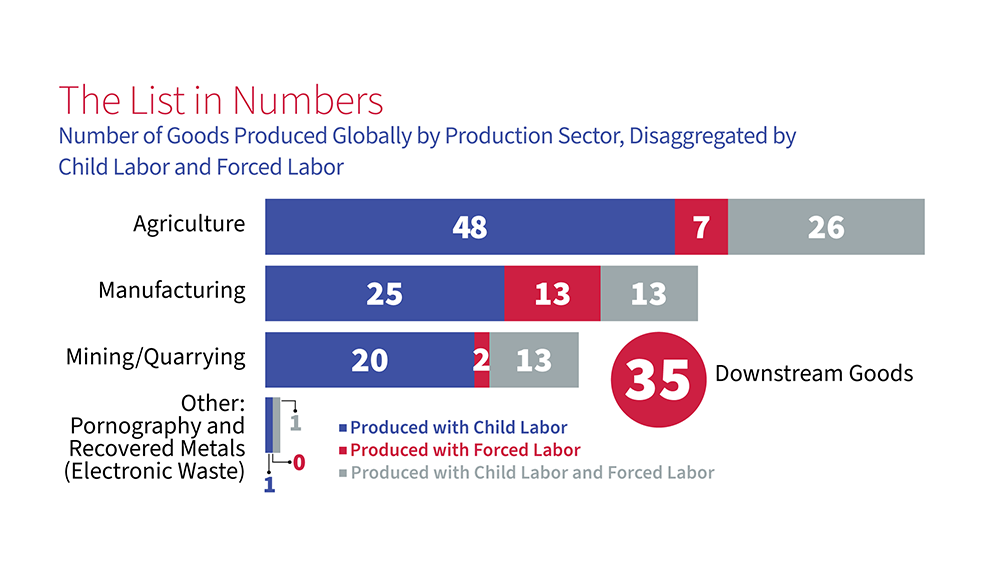
The countries on the List span every region of the world. The most common agricultural goods listed are sugarcane, cotton, coffee, tobacco, cattle, rice, and fish. In the manufacturing sector, bricks, garments, textiles, footwear, carpets, and fireworks appear most frequently. In mined or quarried goods, gold, coal and diamonds are most common.
ILAB published the initial TVPRA List in 2009 and updated it annually through 2014, following a set of procedural guidelines that were the product of an intensive public consultation process. ILAB now updates and publishes the List every other year, pursuant to changes in the law.
Procedural Guidelines
On January 25, 2024, ILAB's Office of Child Labor, Forced Labor, and Human Trafficking published Procedural Guidelines for the development and maintenance of the List of Goods from countries produced by child labor or forced labor in violation of international standards.
DOL's mission is to foster, promote, and develop the welfare of the wage earners, job seekers, and retirees of the United States. This DOL mission is carried out by a variety of sub-agencies and offices (DOL agencies) covering domestic and international policy engagements, workforce development, enforcement, statistics, and benefits. DOL has a responsibility to protect the integrity of scientific information that is produced, communicated, and used across DOL agencies to better carry out its mission. ILAB is committed to using the highest possible scientific integrity and quality standards and practices to conduct our critical work. Scientific integrity is the adherence to professional practices, ethical behavior, and the principles of honesty and objectivity when conducting, managing, using the results of, and communicating about science and scientific activities. Inclusivity, transparency, and protection from inappropriate influence are hallmarks of scientific integrity.
| Country/Area | Good | Exploitation Type |
|---|---|---|
| India | There are reports that children ages 6 to 17 produce sandstone in India. In Rajasthan, which produces 90 percent of India’s sandstone, boys and girls as young as age 6 or 7 work chiseling sandstone cobblestones, and boys ages 13 to 17 quarry sandstone. Children from migrant families or children belonging to scheduled castes, a socially disadvantaged group in India, are particularly vulnerable to child labor in producing sandstone. Based on estimates from international organizations, NGOs, and academic researchers, thousands of children work in Rajasthan’s sandstone quarries. Children working in the quarries are rarely given protective equipment such as goggles or masks, and are exposed to hazards including severe injury from stone chips; hearing loss from drilling and blasting noise; extreme heat; and inhalation of silica dust, which can lead to chronic lung disease and death. Some children also work at night or operate dangerous equipment. There are reports that adult workers are forced to work in the production of sandstone in India. Migrant workers and individuals from scheduled castes, a socially disadvantaged group in India, are especially vulnerable to forced labor in sandstone quarries. According to international organizations, NGOs, and academic researchers, incidents of forced labor and debt bondage are widespread in sandstone quarries in Rajasthan, which is the source of 90 percent of India’s sandstone. Migrant and marginalized workers are lured to the quarries with the promise of well-paying jobs, only to work in dangerous conditions for pay at a daily or per piece rate that is too low to manage basic expenses. Sandstone quarry workers are highly vulnerable to silicosis, a fatal lung disease caused by breathing the dust produced by drilling or breaking quartz-rich rocks. In many cases, quarry owners give workers advances and loans to pay for growing household and medical expenses related to silicosis. Quarry owners withhold workers’ wages as repayment for this debt, which in turn continuously accumulates due to compound interest and additional expenses. Employers record attendance informally and rarely issue written accounts of debt owed, enabling quarry owners to deduct money from the workers’ wages and inflate debts. When an indebted worker grows too ill to work or dies, this debt is transferred to his or her family, who must forfeit property or themselves labor in the quarry to pay off the debt. |
Child Labor, Forced Labor |
| India | There are reports that farm-raised shrimp in India is produced using the forced labor of adults. Peeling sheds and processing plants, concentrated in Andhra Pradesh, employ internal migrant workers, often from marginalized social castes, for processing and packaging of farmed shrimp. Peeling sheds, where many of the worst working conditions are reported, mostly employ women. Third party labor contractors recruit workers from marginalized communities and charge exorbitant job placement fees. Unable to pay what can at times be the equivalent of a full month’s wages, many workers take a loan, often from the labor contractor, and cannot leave the job until the debt is paid off, resulting in debt bondage. Workers often reside at or near the worksite in employer-provided housing—typically in a remote location—and severe security measures including lock-ins and surveillance prevent workers from freely leaving the premises. This situation creates multiple dependencies on the employer to meet basic needs such as food, shelter, personal hygiene, and access to market goods. Work to process shrimp involves exposure to chemicals, extreme cold, standing for long hours, and high risk of injury, sometimes without proper personal protective equipment. Verbal and physical abuse, including sexual harassment and abuse, are reportedly prevalent. Reports indicate housing facilities are commonly overcrowded, dirty, and poorly maintained. There are reports of excessive overtime beyond legal limits, often unpaid. Internal migrant workers—who are usually far from their families and homes with few or no job opportunities outside of shrimp processing— often face intimidation and threats of termination by labor contractors, supervisors, and security guards if they fail to comply with restrictive and exploitative labor policies. There are reports of workers not receiving the legally required minimum wage and of working without receiving their pay for up to 2 years. There are multiple reports of workers laboring for months with few or no days off. |
Forced Labor |
| India | Child Labor | |
| India | Child Labor | |
| India | Child Labor | |
| India | There are reports that children in India are forced to quarry stones. These children work in stone quarries, mines, and crushers under conditions of bonded labor. According to an assessment by the ILO, as many as 500,000 stone quarry workers, including entire families, in Tamil Nadu were bonded laborers. Families receive an advance payment and become bonded for generations to pay off the debt. Some children are used as a guarantee for the loan and are forced to work to pay it off. Some children inherit the debt of their parents and may be bought and sold between contractors. Children of scheduled castes, a socially disadvantaged class in India, and migrant children, are particularly vulnerable. The children live at the worksite and face isolation and restrictions on their movement. Some children are forced to work under threat of financial penalties or physical violence, receive little pay, and are denied wages. |
Child Labor, Forced Labor |
| India | Research found that sugarcane in India, especially sugarcane harvested in Maharashtra, is harvested using forced labor of adults. Workers in the sugarcane fields face excessive and involuntary overtime, severe and unexplained wage deductions, and degrading living conditions. They are commonly recruited against a debt, often resulting often in debt bondage. Women are frequently pressured into receiving unnecessary hysterectomies to avoid taking leave and missing harvesting quotas. |
Child Labor, Forced Labor |
| India | There are reports that men and women working in the production of tea are subjected to forced and bonded labor in India. Evidence of forced and bonded labor has been found in the Assam state. Workers experience non-payment and under payment of wages and withholding of benefits, as well as threats of the same. In addition, sources indicate that workers are not provided access to adequate housing, basic healthcare, and water. While employers are legally required to provide food and medical care, workers are not provided with these services and must borrow money from their employer at high interest rates; workers are also sometimes charged for services they do not receive. This has led to conditions of debt bondage. A smaller number of workers are subjected to forced labor through physical and sexual violence, verbal abuse, and threats of violence and dismissal. |
Forced Labor |
| India | There are reports that forced labor conditions are prevalent among workers in the thread and yarn sector in India. In particular, workers in spinning mills in the state of Tamil Nadu are often recruited using deception about working conditions and wages. Sources indicate conditions of excessive and involuntary overtime, debt bondage, withholding of identity records, and restrictions on free movement of workers. |
Child Labor, Forced Labor |
Are you a company looking to fight child labor and forced labor in supply
chains?
Related
- Findings on the Worst Forms of Child Labor
- Executive Order 13126 List of Products Produced by Forced or Indentured Child Labor
- Against Their Will: The Situation in Xinjiang
Further Resources
- Supply Chain Storyboards
Previous TVPRA List of Goods Produced by Child Labor or Forced Labor
- 2022
- Full Report (PDF)
- Excel format (XLS)
- Bibliography (PDF)
- 2020
- Full Report (PDF)
- Excel format (XLS)
- Bibliography (PDF)
- 2018
- Full Report (PDF)
- Excel format (XLS)
- Bibliography (PDF)
- 2016
- Full Report (PDF)
- Excel format (XLS)
- Bibliography (PDF)
- 2014
- Full report (PDF)
- Excel format (XLS)
- Bibliography (PDF)
- 2013
- Infographic (PDF)
- Excel format (XLS)
- Bibliography (PDF)
- 2012
- Full Report
- Bibliography (PDF)
- List in Excel Format (XLS)
- 2011
- Full Report
- Bibliography (PDF)
- List in Excel Format (XLS)
- 2010
- Full Report (PDF)
- Bibliography (PDF)
- List in Excel Format (CSV)
- 2009 Full Report (PDF)
Public Comments & Submissions
ILAB accepts public submissions for the TVPRA List on an ongoing basis, and reviews them as they are received. Submissions will continue to be taken into account as ILAB works to release periodic updates to the List. To submit information, please send an email to ILAB-TVPRA@dol.gov; fax to 202-693-4830; or mail to ILAB, U.S. Department of Labor, c/o OCFT Research and Policy Unit, 200 Constitution Ave NW, S-5315, Washington, DC 20210. View the list of submissions.
The List in Numbers
What You Can Do